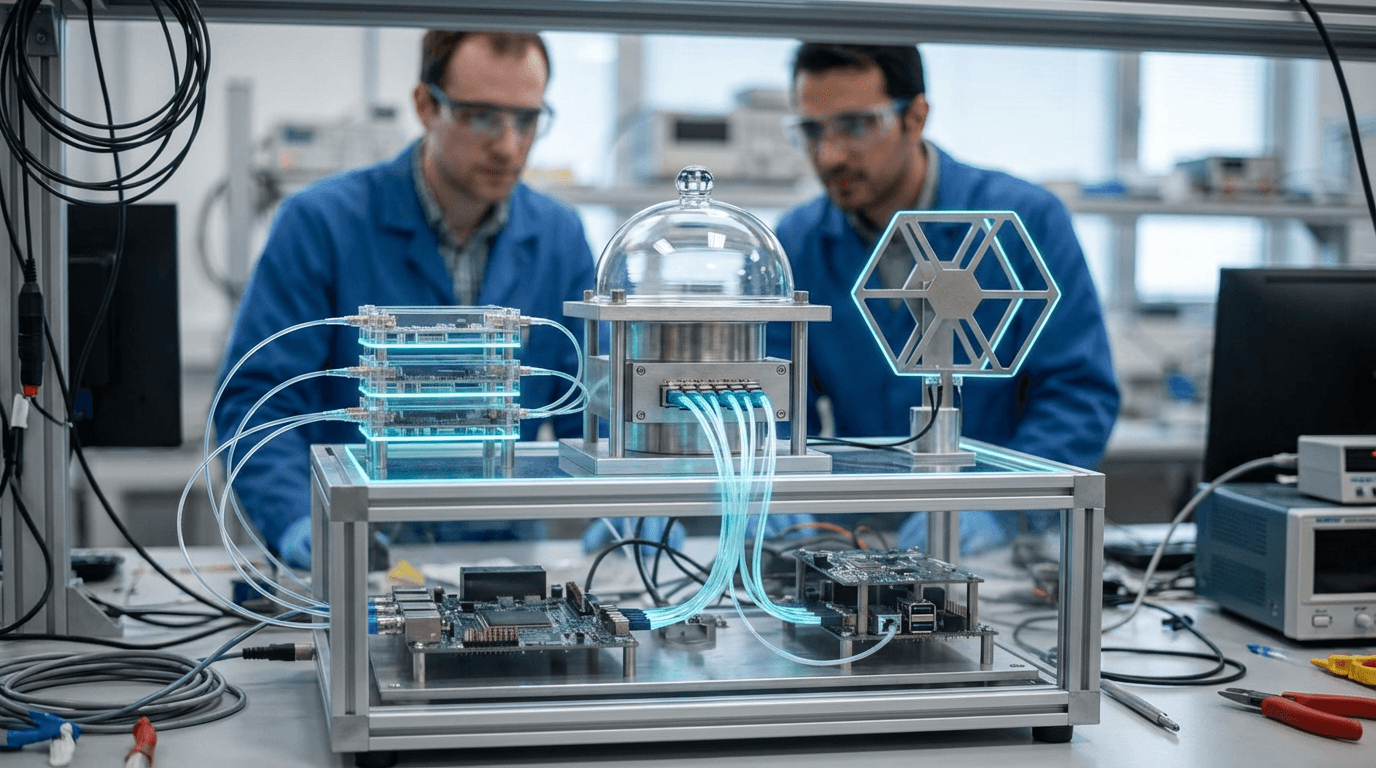
AI-Native Air Interface
The physical layer of wireless communication has traditionally relied on carefully engineered mathematical algorithms developed over decades of research. Each component—from channel coding and modulation to equalization and detection—has been meticulously designed based on theoretical models of how radio signals propagate through space. However, these conventional approaches often struggle in complex, dynamic environments where signal conditions deviate from idealized assumptions. AI-Native Air Interface represents a paradigm shift in this domain, replacing hand-crafted signal processing blocks with deep learning models that can learn optimal transmission and reception strategies directly from data. Rather than relying on predetermined mathematical formulas, neural networks are trained to perform the entire chain of physical layer operations, from encoding information into radio waveforms to decoding received signals corrupted by noise and interference. This approach leverages the pattern recognition capabilities of deep learning to discover signal processing strategies that may be too complex for human engineers to derive analytically.
The telecommunications industry faces mounting pressure to support increasingly diverse use cases—from ultra-reliable low-latency communications for autonomous vehicles to massive machine-type communications for IoT deployments—all while maximizing spectral efficiency in crowded frequency bands. Traditional air interfaces, designed around fixed modulation schemes and coding rates, struggle to adapt optimally across such varied scenarios. AI-Native Air Interface addresses this challenge by enabling the physical layer to learn and adapt to specific channel conditions, interference patterns, and quality-of-service requirements. Early research suggests that learned communication systems can outperform conventional approaches in scenarios with non-linear hardware impairments, complex multipath propagation, or unconventional channel models that defy simple mathematical description. This technology also promises to accelerate the development cycle for new wireless standards, as AI models can be retrained for new environments or requirements without redesigning the entire protocol stack from first principles.
Experimental deployments in controlled laboratory settings have demonstrated the viability of end-to-end learned communication systems, though commercial deployment faces significant hurdles. Researchers have successfully trained neural network-based transceivers that achieve competitive or superior performance compared to conventional systems in specific scenarios, particularly in environments with strong non-linearities or unknown channel characteristics. However, practical implementation requires addressing challenges around computational complexity, interpretability for regulatory compliance, and interoperability with existing infrastructure. The technology aligns with broader industry trends toward software-defined and virtualized network architectures, where baseband processing increasingly occurs on general-purpose computing platforms capable of running AI workloads. As 6G research intensifies, AI-Native Air Interface is emerging as a potential foundational technology, with industry analysts noting its potential to enable truly adaptive networks that optimize themselves in real-time based on observed conditions rather than pre-programmed rules. The trajectory suggests a gradual integration, likely beginning with specific use cases where conventional approaches are demonstrably limited, before potentially expanding to become a core component of future wireless standards.
Related Organizations

Pioneers in deep learning for wireless communications and signal processing.

Industrial research lab with a history of fundamental research in condensed matter physics relevant to topological phases.

Developing foundation models for robotics (Project GR00T) and vision-language models like VILA.

Offers the AI Stack which includes tools for hardware-aware model efficiency and architecture search.

Samsung Research
South Korea · Research Lab
Advanced R&D arm of Samsung Electronics, heavily invested in 6G spectrum and THz communications.

German research institute developing advanced algorithms for 3D Human Body Reconstruction and volumetric video coding.

Mobile technology research and development company that licenses its innovations.

Offers the Quantum Engineering Toolkit (QET) and Labber software for instrument control and pulse generation.

Host of the 6G Flagship, the world's first major 6G research program.

Develops Universal Spectrum Multiplier software for RAN intelligence.

International electronics group specializing in test equipment, broadcast & media, and cybersecurity.
Supporting Evidence
Research this in Signals
Signals turns a topic into a sourced research record you can inspect and rerun. Your first scan is free, and this one starts with AI-Native Air Interface already loaded, so edit it or scan as is.