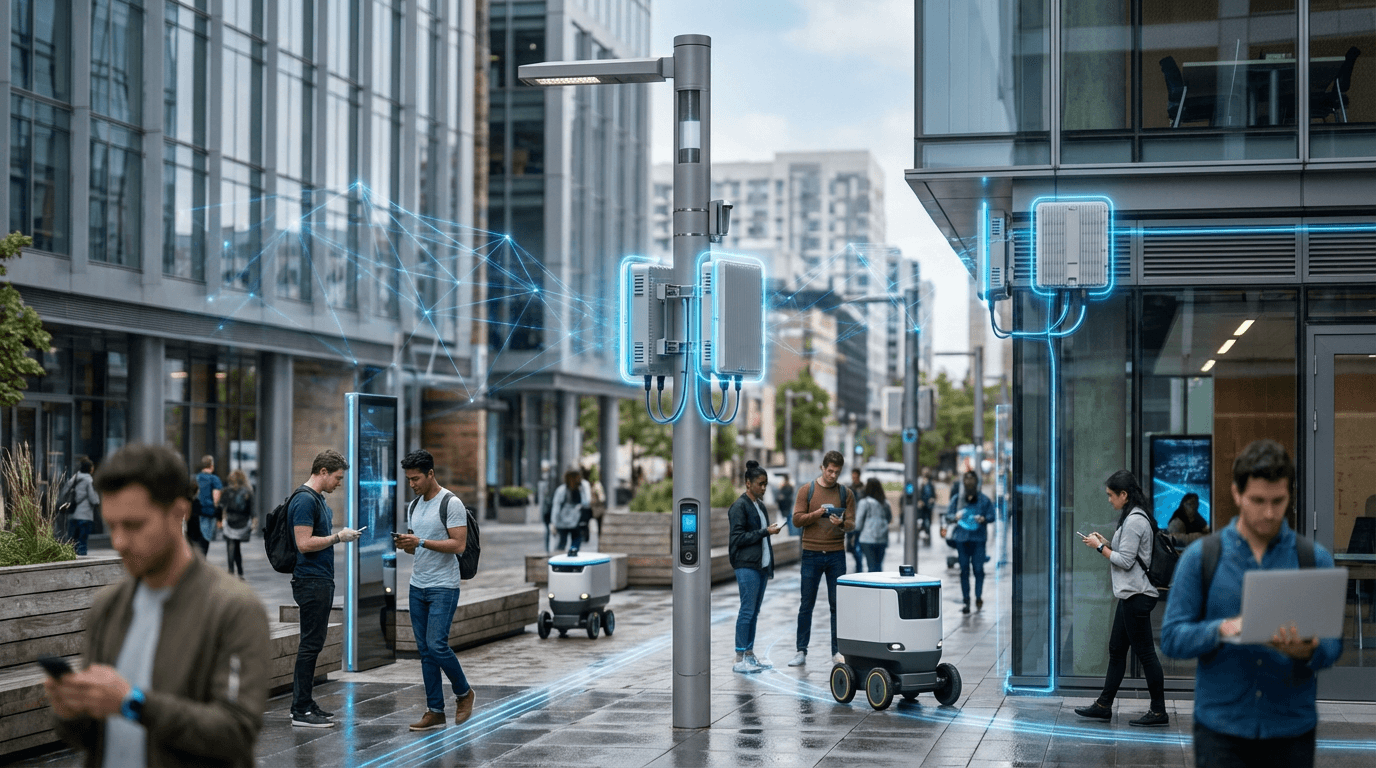
mmWave Small Cells
Millimeter-wave small cells represent a fundamental shift in how wireless networks deliver capacity in congested urban environments. Operating in high-frequency spectrum bands between 24 and 100 GHz, these compact base stations exploit previously underutilized radio frequencies that offer vastly greater bandwidth than traditional cellular bands. Unlike conventional macro cell towers that broadcast signals over several kilometers, mmWave small cells are low-power radio nodes designed for deployment on street furniture, building facades, lamp posts, and indoor spaces. The physics of millimeter-wave propagation creates both opportunities and constraints: these high-frequency signals can carry enormous amounts of data but struggle to penetrate solid materials and typically propagate only a few hundred meters before signal degradation becomes significant. This necessitates dense deployment patterns where multiple small cells work in concert to blanket high-traffic areas with connectivity.
The telecommunications industry faces an escalating capacity crisis as mobile data consumption continues its exponential growth, particularly in urban hotspots where thousands of users congregate in confined spaces. Traditional cellular infrastructure, even with advanced 4G and early 5G technologies operating in sub-6 GHz bands, cannot deliver the multi-gigabit speeds and ultra-low latency that emerging applications demand. Millimeter-wave small cells address this challenge by bringing network capacity directly to where users need it most. In venues like sports stadiums, convention centers, and transportation hubs, a single mmWave small cell can support hundreds of simultaneous connections with throughput measured in gigabits per second. The technology also enables new service models for mobile network operators, who can deploy targeted capacity enhancements without the expense and complexity of upgrading entire macro networks. However, the line-of-sight propagation characteristics require sophisticated planning tools and site acquisition strategies, as even foliage or human bodies can block signals.
Commercial deployments of mmWave small cells have accelerated alongside 5G network rollouts in major metropolitan areas worldwide, with operators installing these nodes in dense urban corridors, entertainment districts, and business centers. Early implementations demonstrate the technology's ability to deliver peak speeds exceeding 1 Gbps in real-world conditions, supporting bandwidth-intensive applications from augmented reality experiences to real-time video streaming for large crowds. The integration of beamforming and beam-steering technologies allows these cells to dynamically direct radio energy toward specific users, maximizing efficiency and coverage. As cities evolve into smart urban environments with proliferating IoT sensors, autonomous vehicles, and immersive digital services, the role of mmWave small cells will expand beyond consumer connectivity to become critical infrastructure for machine-to-machine communications and edge computing applications. The convergence of dense small cell networks with artificial intelligence for network optimization and automated site planning suggests a future where ultra-high-capacity wireless coverage adapts dynamically to shifting demand patterns across the urban landscape.
Related Organizations


Offers the AI Stack which includes tools for hardware-aware model efficiency and architecture search.


Provides 5G small cells and Open RAN software tailored for private network densification.

Creates 5G mmWave active repeater and beamforming technologies to solve signal propagation challenges.

Pioneered Holographic Beam Forming (HBF) technology for 5G mmWave, allowing antennas to shape and steer beams with low power and cost.

Verizon's dedicated network and technology division for first responders.


Real estate investment trust and provider of shared communications infrastructure.

Supporting Evidence
Research this in Signals
Signals turns a topic into a sourced research record you can inspect and rerun. Your first scan is free, and this one starts with mmWave Small Cells already loaded, so edit it or scan as is.