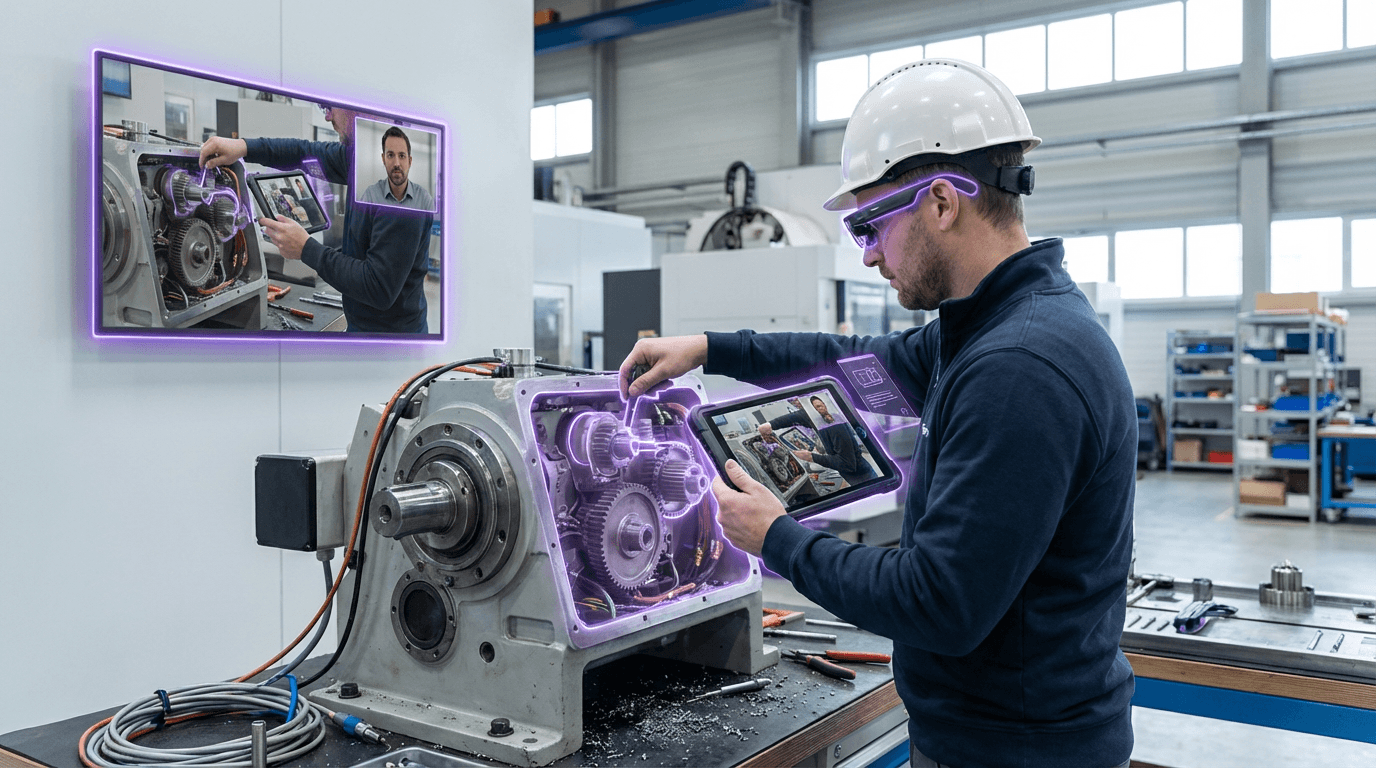
Industrial Remote Assist
Industrial Remote Assist represents a convergence of augmented reality, real-time video streaming, and spatial computing technologies designed to bridge the gap between field technicians and remote subject-matter experts. The system captures the technician's first-person view through head-mounted displays, smart glasses, or mobile devices equipped with depth sensors and cameras, transmitting this visual feed to specialists who may be located thousands of miles away. These remote experts can then overlay digital annotations, directional arrows, 3D models, and even virtual hand gestures directly onto the technician's view of physical equipment, with these augmented elements anchored to specific components in three-dimensional space. The spatial registration ensures that annotations remain fixed to machinery parts even as the field worker moves around the equipment, creating a shared visual workspace that transcends geographic boundaries.
The industrial sector faces persistent challenges in maintaining increasingly complex machinery across geographically dispersed facilities, where equipment downtime translates directly into substantial revenue losses and production delays. Traditional approaches require either flying specialized technicians to remote sites—incurring significant travel costs and time delays—or relying on less experienced local staff working from static manuals and phone guidance. Industrial Remote Assist addresses these pain points by enabling immediate access to expert knowledge regardless of physical location, dramatically reducing mean time to repair for critical systems. Manufacturing plants, oil and gas facilities, and utilities have reported resolution times shortened from days to hours for complex troubleshooting scenarios. The technology also creates new service delivery models, allowing equipment manufacturers to offer premium support contracts that guarantee rapid expert intervention without maintaining large field service teams, while simultaneously capturing institutional knowledge through recorded sessions that can train future technicians.
Early adopters in aerospace manufacturing, energy infrastructure, and heavy equipment maintenance have integrated these systems into standard operating procedures, with some organizations reporting maintenance cost reductions of twenty to thirty percent. The technology proves particularly valuable in hazardous environments where minimizing personnel exposure is critical, allowing a single on-site worker to execute repairs under remote guidance rather than deploying entire specialist teams. As 5G networks expand industrial coverage and edge computing reduces latency in spatial tracking, the fidelity and responsiveness of these remote collaboration sessions continue to improve. The convergence with digital twin technologies promises even richer assistance scenarios, where remote experts can overlay predictive maintenance data and equipment history directly onto physical assets, transforming reactive repair into proactive optimization and positioning Industrial Remote Assist as a foundational element of the broader shift toward spatially-aware, hybrid work environments in industrial operations.
Related Organizations
PTC
United States · Company
Offers ThingWorx, a platform that connects industrial devices, people, and systems.
Develops ruggedized head-mounted tablet devices for industrial frontline workers to access data hands-free.

Offers 'TeamViewer Frontline', an enterprise AR productivity platform (acquired from Ubimax) for logistics and manufacturing.

Provides the Onsight augmented reality platform for remote expert guidance in field service and maintenance.
Develops the WorkLink platform for creating AR work instructions and remote assistance without coding.

Developer of XpertEye, a secure remote assistance solution for smart glasses used in medical and industrial fields.

A Xerox company providing an AR service experience management platform for field service teams.

An AR-powered visual support platform that integrates with CRM systems for insurance and field service.
Supplier of smart glasses and Augmented Reality (AR) technologies.
Supporting Evidence
Research this in Signals
Signals turns a topic into a sourced research record you can inspect and rerun. Your first scan is free, and this one starts with Industrial Remote Assist already loaded, so edit it or scan as is.