Direct Air CO2 Capture
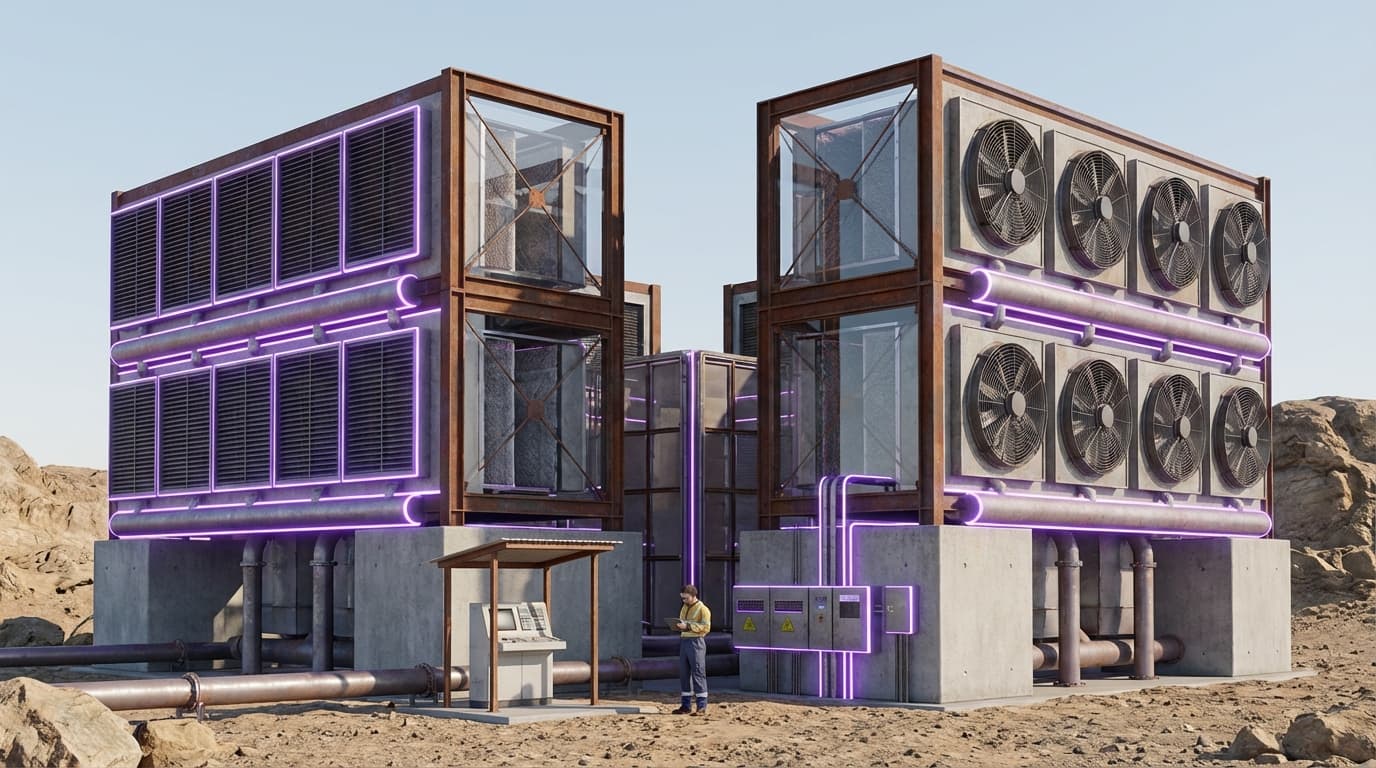
Direct Air Capture (DAC) technology removes carbon dioxide directly from the atmosphere using chemical or physical processes, regardless of the emission source. Unlike carbon capture at point sources like power plants, DAC can address emissions from distributed sources like transportation and can remove historical CO₂ from the atmosphere. The technology typically uses large fans to move air through chemical filters that selectively capture CO₂, which is then released through heating, compressed, and either stored underground or used as a feedstock. Some systems use liquid solvents, while others use solid sorbents.
The technology addresses the challenge of reducing atmospheric CO₂ concentrations, which is necessary to limit climate change even as we reduce emissions. DAC can provide negative emissions when combined with storage, offsetting hard-to-eliminate emissions, and can supply CO₂ for carbon-neutral fuels and materials. Applications include carbon removal to achieve net-negative emissions, supplying CO₂ for synthetic fuels, providing carbon for materials production, and offsetting emissions from sectors that are difficult to decarbonize. Companies like Climeworks, Carbon Engineering, and Global Thermostat are developing and deploying DAC systems.
At TRL 6, direct air capture is being demonstrated at commercial scale, though costs remain high and deployment is limited. The technology faces significant challenges including high energy requirements and costs, the need for large-scale deployment to have meaningful impact, ensuring captured CO₂ is permanently stored, and competition with cheaper emission reduction strategies. However, as costs decrease and the need for carbon removal becomes more urgent, DAC becomes increasingly important. The technology could be essential for achieving climate goals by removing CO₂ from the atmosphere, potentially enabling net-negative emissions, offsetting unavoidable emissions, and providing a pathway to reverse some climate change impacts, though it must be deployed alongside aggressive emission reductions and requires significant energy and infrastructure investment.
Related Organizations

Operator of the world's largest commercial DAC plants (Orca, Mammoth) using solid sorbent technology.

A subsidiary of Occidental Petroleum dedicated to commercializing Carbon Engineering's DAC technology.

Developers of liquid solvent-based DAC technology, acquired by Occidental Petroleum (Oxy).

Uses limestone (calcium carbonate) looping to capture CO2 from the air at low cost.

Global Thermostat
United States · Company
Develops amine-based solid sorbent DAC technology designed for modular deployment.

Uses an electrochemical process to separate CO2 from air, aiming for high energy efficiency.

Developing electric swing adsorption (ESA) technology to capture carbon with significantly less energy.

Hybrid DAC technology that produces water as a byproduct rather than consuming it.

Dutch startup developing a 'fast swing' process using thin fiber adsorbents to increase capture rate.

Israeli startup using electrochemical cell technology for modular, low-energy DAC.
Supporting Evidence
Research this in Signals
Signals turns a topic into a sourced research record you can inspect and rerun. Your first scan is free, and this one starts with Direct Air CO2 Capture already loaded, so edit it or scan as is.