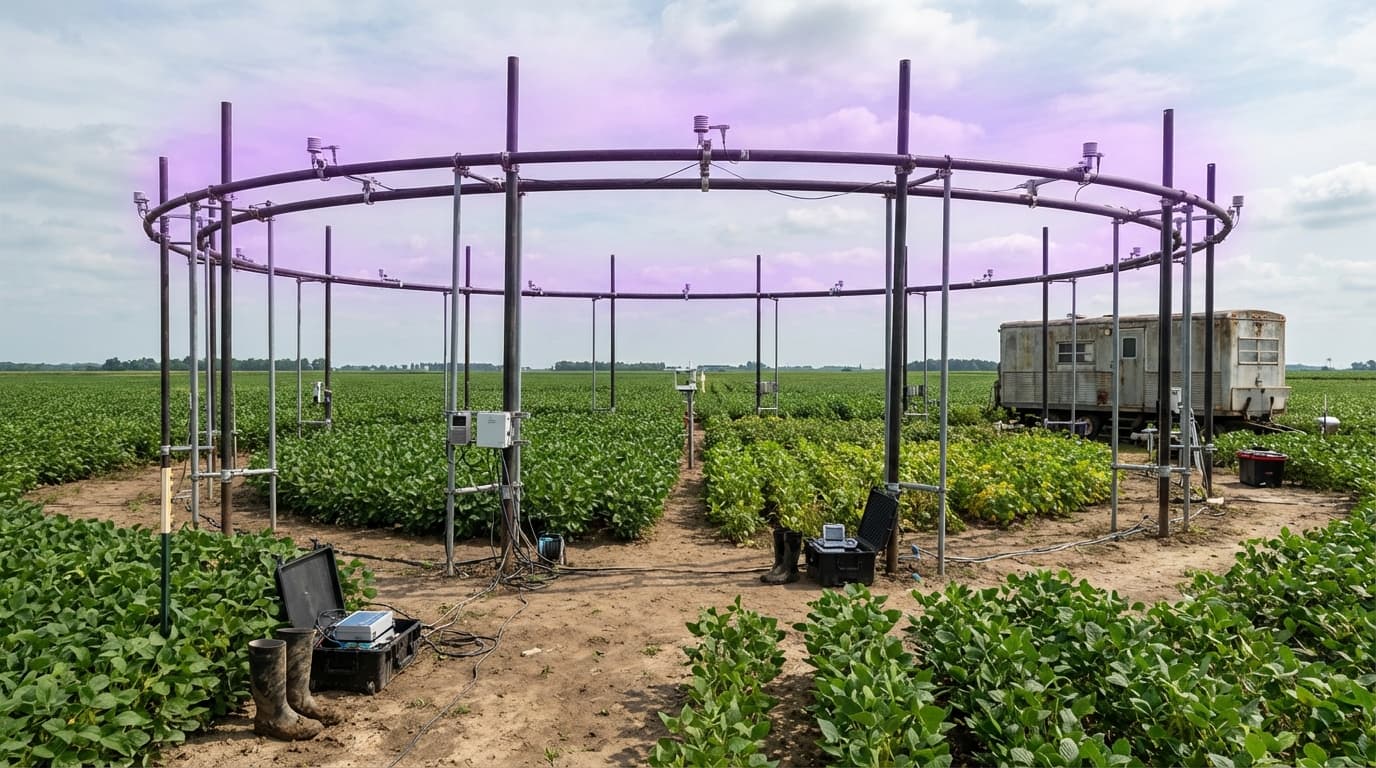
Free Air CO2 Enrichment
Free Air CO₂ Enrichment (FACE) is an experimental technique that releases controlled amounts of carbon dioxide into open-air environments to simulate future atmospheric CO₂ conditions and study ecosystem responses. Unlike greenhouse experiments where plants are enclosed, FACE systems use rings of vertical pipes that release CO₂ around experimental plots, allowing natural conditions like wind, precipitation, and temperature while maintaining elevated CO₂ levels. These long-term experiments—often running for decades—provide realistic data on how plants, soils, and ecosystems respond to increased CO₂, which is essential for understanding climate change impacts and adaptation.
The technology enables critical research on climate change impacts by providing controlled experiments in natural settings. FACE experiments have revealed how different plant species respond to CO₂ enrichment, effects on crop yields, changes in ecosystem carbon cycling, and interactions between CO₂, temperature, and other factors. This research improves climate models, informs agricultural adaptation strategies, and helps predict ecosystem responses to climate change. Applications include agricultural research on crop responses to elevated CO₂, forest ecosystem studies, grassland and ecosystem research, and validation of climate models. Research institutions worldwide operate FACE facilities.
At TRL 6, FACE systems are well-established research tools with multiple facilities operating globally, though they remain research instruments rather than commercial technologies. The technology faces challenges including the cost and complexity of maintaining CO₂ enrichment systems, ensuring consistent CO₂ levels despite weather conditions, and scaling experiments to larger areas. However, as understanding of climate change impacts becomes more urgent, FACE research becomes increasingly valuable. The technology provides essential data for understanding and adapting to climate change, potentially informing agricultural practices, ecosystem management, and climate policy by providing realistic experimental data on how ecosystems will respond to future atmospheric conditions, though the technology itself is a research tool rather than a climate solution.
Related Organizations
United Kingdom · University
Hosts the BIFoR FACE facility, studying the effect of elevated CO2 on a mature temperate oak forest.
Australia · University
Home to EucFACE, the world's only Free Air CO2 Enrichment experiment in a native eucalyptus forest.
National Institute for Amazonian Research (INPA)
Brazil · Government Agency
Brazilian research institute leading the AmazonFACE project to study CO2 effects on the rainforest.

Home to artist-academic Ben Grosser, creator of 'Go Rando', a tool that obfuscates Facebook emotional profiling by randomizing reactions.

US Department of Energy lab that has historically run FACE experiments and currently models data from them.

Runs the KROOF (Kranzberg Forest Roof) experiment, which includes CO2 enrichment components.

The chief scientific in-house research agency of the U.S. Department of Agriculture.
Germany · University
Operates the Giessen FACE station, one of the longest-running grassland FACE experiments in Europe.

German research university contributing to atmospheric and ecosystem research.
Supporting Evidence
Research this in Signals
Signals turns a topic into a sourced research record you can inspect and rerun. Your first scan is free, and this one starts with Free Air CO2 Enrichment already loaded, so edit it or scan as is.