





Indoor Farms
This page is a narrower case of it.
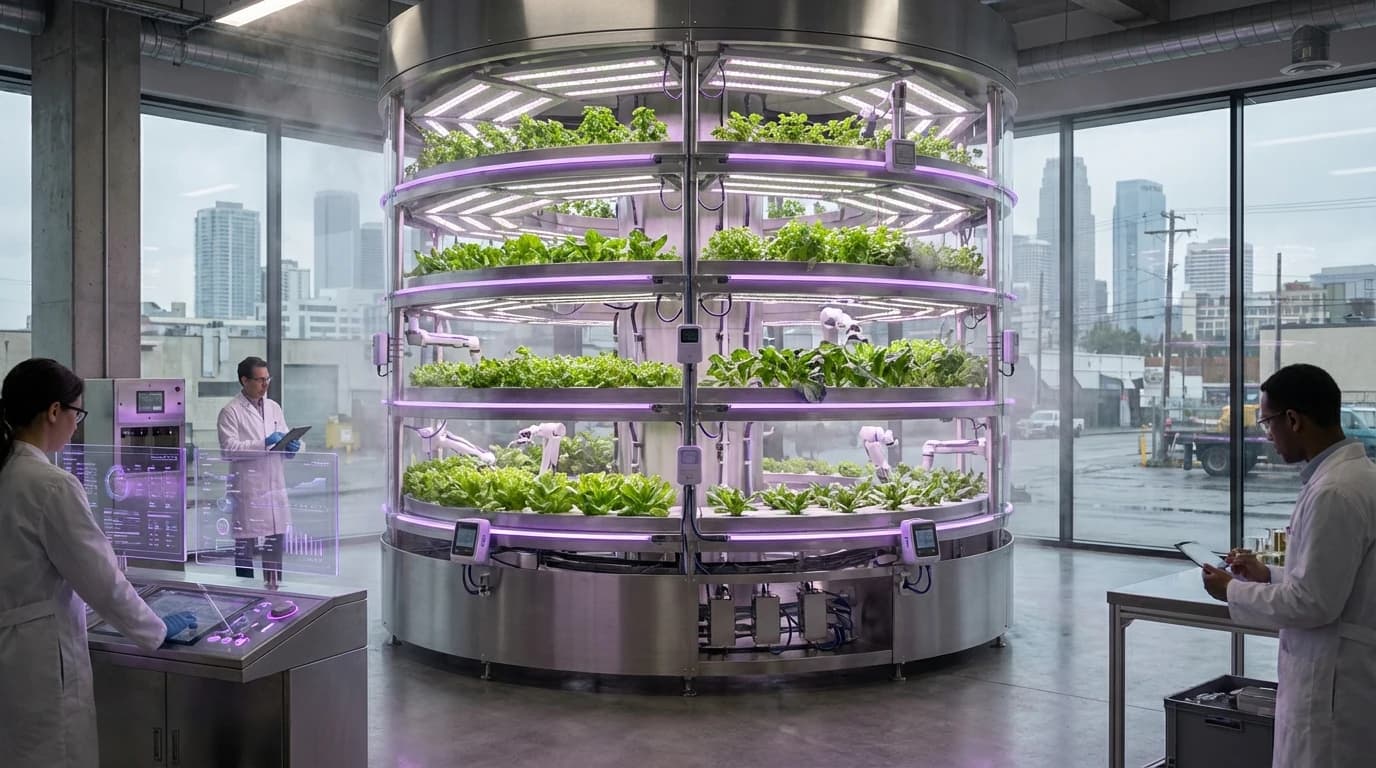
Circular vertical farming combines vertical farming—growing crops in stacked layers in controlled environments—with circular economy principles that minimize waste and maximize resource efficiency. These systems use rotating platforms or moving growing systems to optimize light exposure, employ advanced LED lighting that can be tuned to specific wavelengths, and integrate comprehensive sensor networks that monitor and control all growing conditions. The circular aspect involves recycling water and nutrients in closed-loop systems, converting crop residues and waste into energy through anaerobic digestion, and using that energy to power the facility, creating a self-sustaining agricultural system.
The technology addresses multiple challenges in agriculture: land use, water consumption, transportation distance, weather dependence, and waste generation. Circular vertical farms can produce food year-round in urban locations, use 95% less water than traditional farming, eliminate pesticides, and reduce transportation emissions. The circular design further reduces resource consumption and waste. Applications include urban food production, production of high-value crops like leafy greens and herbs, research into optimal growing conditions, and food production in areas with limited arable land. Companies like AeroFarms, Plenty, and various vertical farming firms are developing these systems.
At TRL 7, circular vertical farming systems are commercially operational, though economics and scalability continue to evolve. The technology faces challenges including high initial capital costs, energy consumption for lighting and climate control, limited crop types that are economically viable, and ensuring the circular systems are truly closed-loop. However, as energy costs decrease, LED efficiency improves, and circular systems mature, the economics become more favorable. The technology could transform food production by enabling local, sustainable agriculture in urban areas, reducing the environmental impact of farming, and creating resilient food systems that are independent of weather and climate, potentially making fresh produce available year-round in cities while using minimal resources and generating minimal waste.
A top-tier university for agricultural research, specifically in greenhouse and vertical farming innovation.
United Kingdom · Company
A vertical farming company specifically known for co-locating with bio-energy plants to utilize waste heat.
A vertical farming company using proprietary software (BoweryOS) to monitor plants and optimize resources.
A vertical farming technology company that uses vertical planes to grow leafy greens with high resource efficiency.
A Japanese vertical farming pioneer known for its 'Techno Farm' automated production system.
A technology company providing vertical farming infrastructure (Growth Towers) to other growers.
An indoor farming company that operates fully automated vertical farms.
A technology provider developing aeroponic irrigation systems for indoor farming.
Denmark · Company
Operates one of Europe's largest vertical farms, utilizing wind power and closed-loop water systems.
Provides end-to-end indoor farming solutions and biological research.
A vertical farming company aiming to grow protein-rich crops (soy/wheat) indoors.
Published forecasts about this technology, graded against what happened in Hindsight.
Indoor Farms
This page is a narrower case of it.
Indoor Plant Factories
This page is a narrower case of it.
Signals turns a topic into a sourced research record you can inspect and rerun. Your first scan is free, and this one starts with Circular Vertical Farming already loaded, so edit it or scan as is.