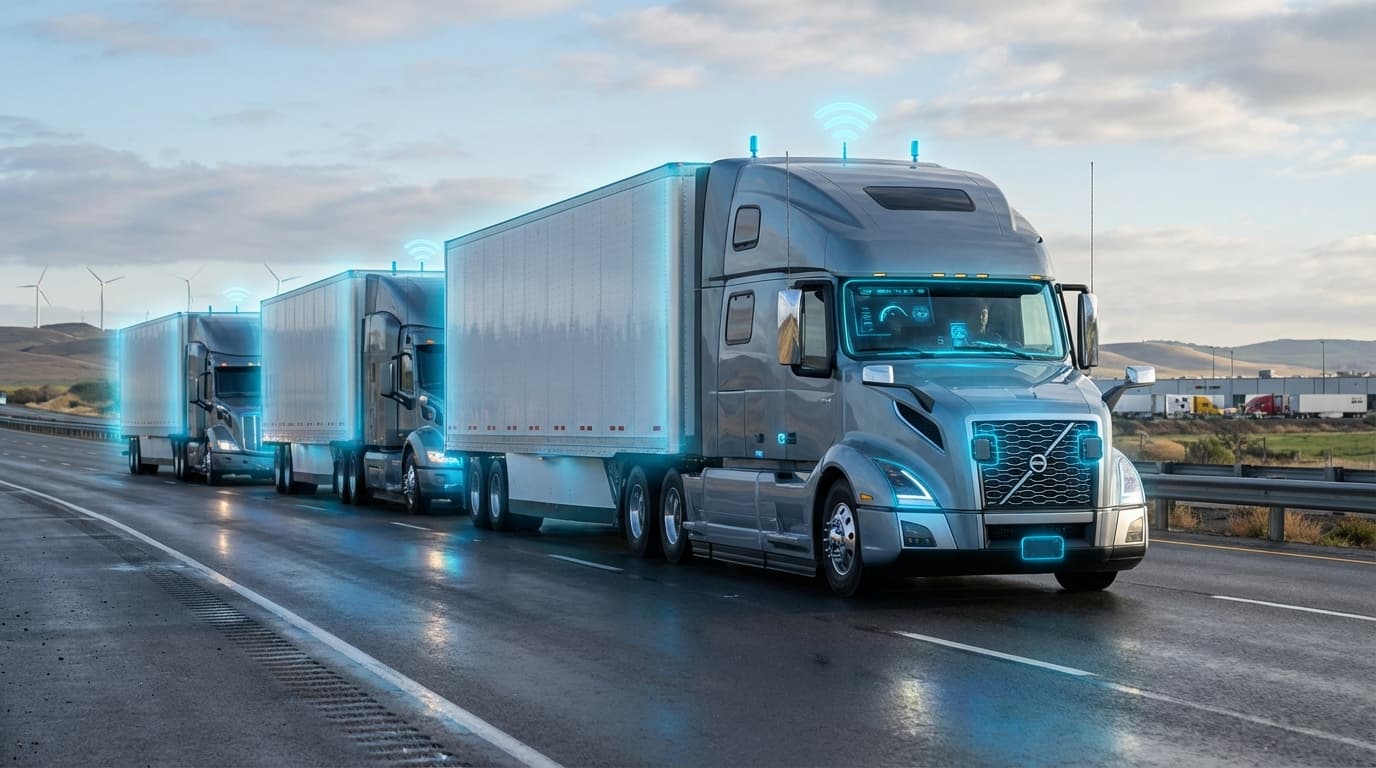
Truck Platooning
Truck platooning represents an advanced form of connected vehicle technology that enables multiple heavy-duty trucks to travel in close formation on highways, linked through a combination of Cooperative Adaptive Cruise Control (CACC) systems and vehicle-to-vehicle (V2V) communication protocols. Unlike traditional adaptive cruise control, which relies solely on onboard sensors, CACC integrates wireless communication between vehicles to share real-time data about speed, acceleration, braking, and road conditions. The lead truck in the platoon is operated by a human driver who sets the pace and makes strategic decisions, while following trucks use automated systems to maintain precise spacing—often as close as 10 to 15 meters—and mirror the lead vehicle's movements with millisecond response times. This tight formation exploits the aerodynamic phenomenon known as drafting or slipstreaming, where following vehicles experience significantly reduced air resistance, similar to how cyclists or race car drivers benefit from riding in each other's wake.
The freight transportation industry faces mounting pressure to reduce operational costs, lower carbon emissions, and address persistent driver shortages, challenges that truck platooning directly addresses. By reducing aerodynamic drag, platooning can decrease fuel consumption by 4-10% for following trucks and 3-5% for the lead vehicle, translating to substantial cost savings given that fuel typically represents 30-40% of trucking operational expenses. Beyond economic benefits, this technology enhances highway safety by reducing human error in following distances and reaction times, as automated systems can respond to braking events far faster than human drivers. The technology also optimises highway capacity by allowing trucks to travel closer together without compromising safety, potentially alleviating congestion on heavily trafficked freight corridors. For logistics companies managing large fleets, platooning enables more efficient route planning and can help mitigate driver fatigue by reducing the cognitive load on drivers in following positions.
Several major truck manufacturers and technology companies have conducted extensive pilot programs across North America, Europe, and Asia, with some commercial deployments already underway on specific highway corridors. Early implementations have focused on controlled environments such as dedicated freight routes between distribution centres or port-to-warehouse connections, where predictable traffic patterns and highway conditions make platooning most viable. Regulatory frameworks are gradually evolving to accommodate this technology, with some jurisdictions establishing guidelines for minimum following distances and requiring human drivers to remain alert and ready to take control in all platoon vehicles. As the technology matures, industry observers anticipate integration with broader intelligent transportation systems, including smart highway infrastructure that can designate platooning lanes and coordinate multiple platoons for optimal traffic flow. The continued development of truck platooning aligns with the transportation sector's broader shift toward automation and electrification, positioning it as a stepping stone toward fully autonomous freight networks while delivering immediate benefits in efficiency and sustainability.
Related Organizations

Research center at UC Berkeley focusing on intelligent transportation systems.

Major manufacturer of heavy trucks and buses, actively testing MCS on their next-generation electric trucks.

Dutch organization for applied scientific research, actively investigating molten metal pyrolysis for industrial hydrogen.

Leading international provider of commercial vehicles and transport solutions.
Global manufacturer of trucks, buses, and construction equipment.


Manufacturer of braking systems for rail and commercial vehicles.

Autonomous trucking technology company developing the PlusDrive system.

A global technology company supplying systems for passenger cars and commercial vehicles, including autonomous shuttle systems (via 2getthere acquisition).

Freight technology company developing autonomous electric trucks, with signed MOUs for deployment in UAE logistics.
Supporting Evidence
Research this in Signals
Signals turns a topic into a sourced research record you can inspect and rerun. Your first scan is free, and this one starts with Truck Platooning already loaded, so edit it or scan as is.