Generative Urban Design
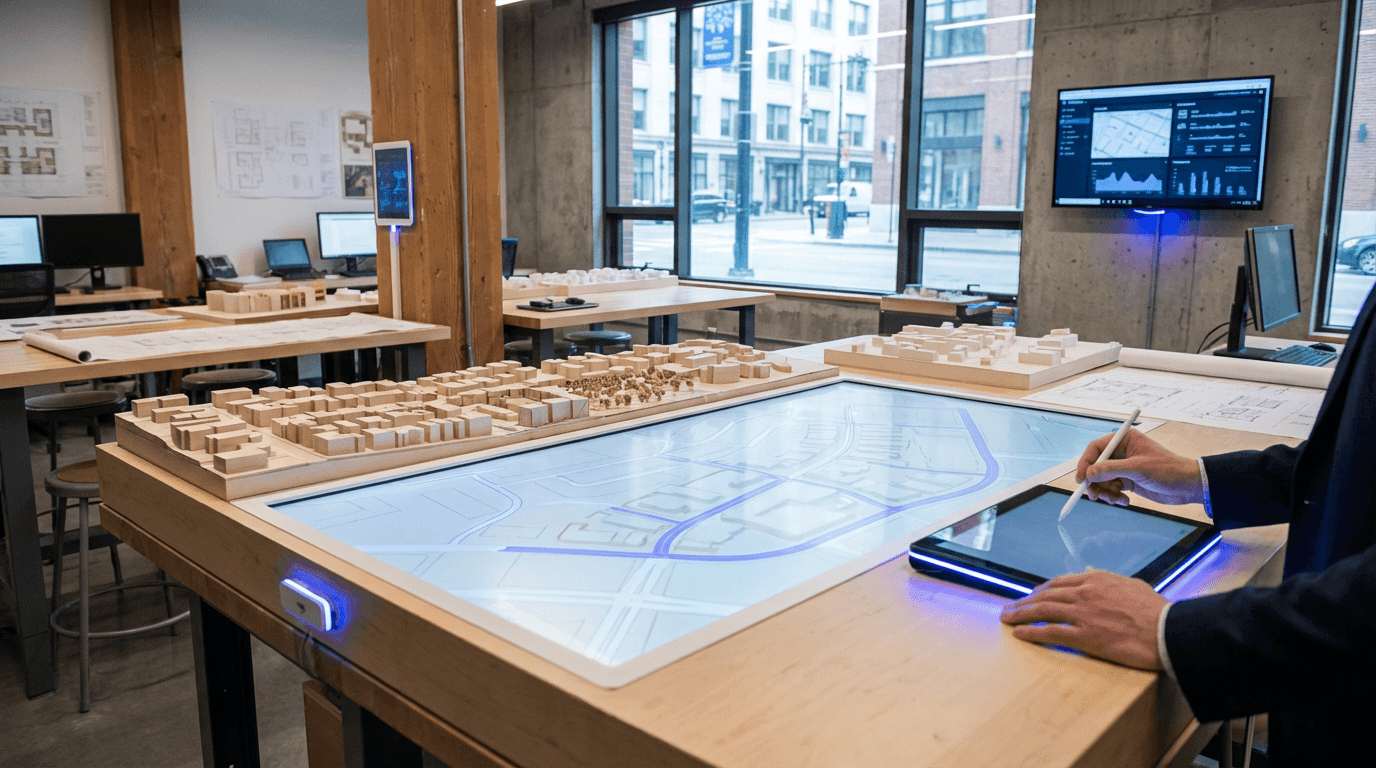
Urban planning has traditionally been a time-intensive process requiring planners to manually balance competing priorities such as population density, green space allocation, transportation networks, sunlight exposure, and community amenities. Each design iteration demands extensive analysis and stakeholder consultation, often taking months or years to refine. Generative urban design addresses this challenge by employing artificial intelligence and computational algorithms to rapidly explore vast solution spaces that would be impossible for human planners to evaluate manually. At its technical core, this approach uses machine learning models trained on successful urban environments, combined with parametric design principles and optimization algorithms. Planners input specific constraints and objectives—such as minimum sunlight hours for residential units, maximum walking distances to public transit, desired building height distributions, or carbon footprint targets—and the system generates thousands of potential neighborhood configurations that satisfy these requirements. Advanced implementations incorporate physics simulations for wind flow and thermal comfort, network analysis for pedestrian and vehicle movement, and even predictive models for social interaction patterns based on spatial arrangements.
The implications for the construction and real estate industries are substantial, particularly in addressing the growing pressure to build sustainable, livable communities at scale. Traditional master planning processes often result in suboptimal compromises because the sheer complexity of variables makes it difficult to identify truly optimal solutions within reasonable timeframes. Generative urban design enables developers and municipal authorities to explore far more possibilities before committing to construction, reducing the risk of costly design flaws that only become apparent after buildings are occupied. This technology also facilitates more meaningful community engagement by allowing stakeholders to see multiple viable alternatives and understand the trade-offs between different priorities. For instance, residents can visualize how increasing building heights in one area might preserve more ground-level green space, or how different street grid patterns affect neighborhood walkability. The approach also supports adaptive reuse and infill development by helping planners identify optimal configurations for irregularly shaped parcels or sites with complex existing conditions.
Early implementations of generative urban design have appeared in both private development projects and municipal planning departments, particularly in regions experiencing rapid urbanization. Some architecture and engineering firms have begun integrating these tools into their workflows for large-scale mixed-use developments, using them to test scenarios during the conceptual design phase. Research institutions and urban planning departments are exploring applications ranging from climate-resilient neighborhood design to equitable distribution of amenities across socioeconomic groups. As computational power increases and AI models become more sophisticated, this technology is likely to evolve from a specialized tool for large projects into a standard component of urban planning practice. The trajectory points toward increasingly integrated systems that can simultaneously optimize for environmental performance, social equity, economic viability, and aesthetic quality—transforming how cities grow and adapt to meet the challenges of the coming decades while maintaining the human-centered focus essential to creating truly livable communities.
Related Organizations

Owner of the Arnold renderer, which integrates AI denoising to optimize high-end VFX workflows for film and TV.

A generative design tool originally from Sidewalk Labs (now Google) that optimizes master plans for multiple outcomes.

Provides real-time generative design software for building feasibility, solving site plans for mixed-use, industrial, and residential developments instantly.

An AI platform that assesses land plots for development potential and checks designs against local planning rules instantly.

An AI-powered web-based design tool that generates building configurations based on sustainability targets and site data.

A research program focused on sustainable urbanization, developing tools for simulation and generative planning.

A cloud platform for generating building designs using open standards and community-contributed generative functions.

Research group developing evidence-based, data-driven, and computer-aided approaches to urban design (e.g., CityScope).

A platform for urban planning that includes generative design features to rapidly prototype city scale projects and calculate feasibility.

Parametric urban design software that integrates with SketchUp and Rhino to calculate urban control parameters in real-time.
Supporting Evidence
Research this in Signals
Signals turns a topic into a sourced research record you can inspect and rerun. Your first scan is free, and this one starts with Generative Urban Design already loaded, so edit it or scan as is.