








Mobility Simulation
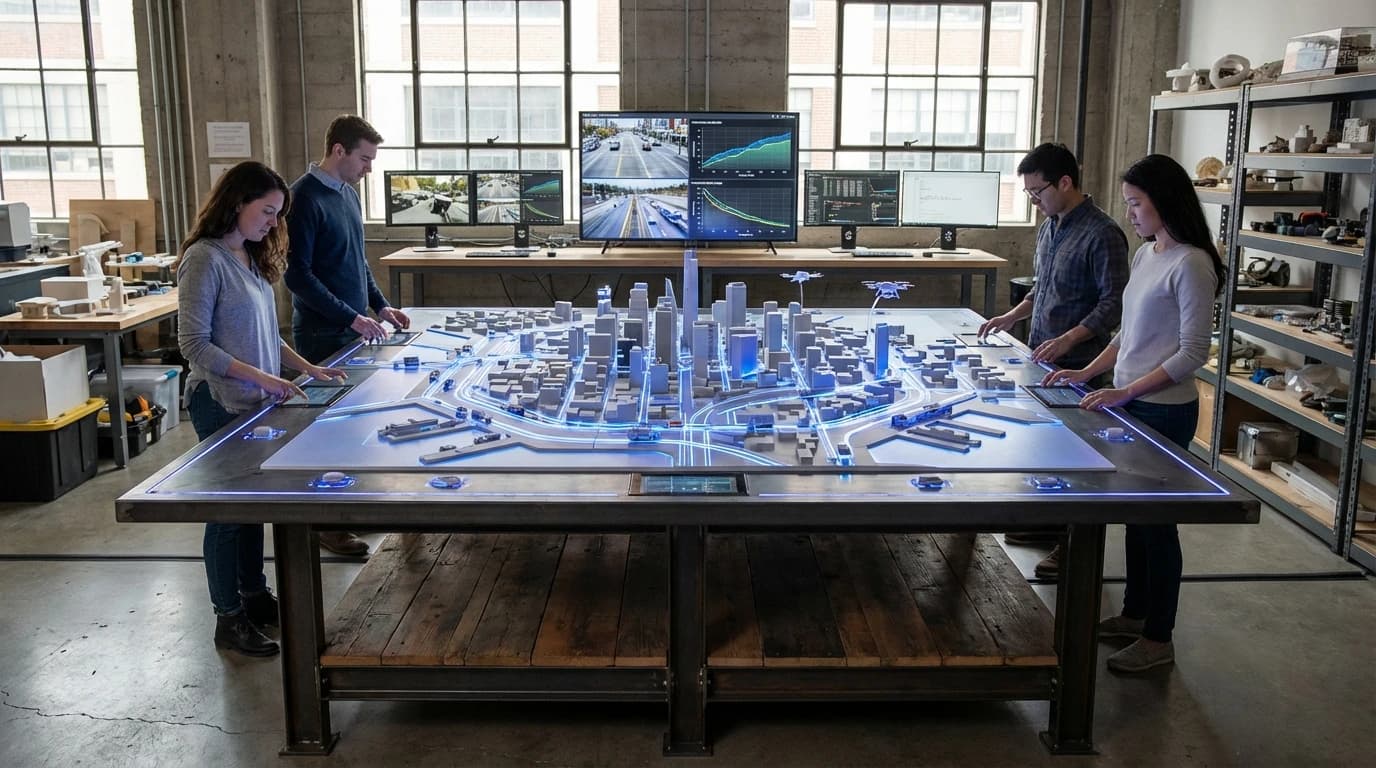
Mobility Simulation & Optimization
City-scale models that optimize traffic flow, curb allocation, and multimodal transport networks
Urban mobility presents one of the most complex challenges facing modern cities, where competing demands for limited street space create persistent conflicts between private vehicles, public transit, freight delivery, pedestrians, and emerging micromobility services. Traditional transportation planning methods often rely on static models and historical data that struggle to capture the dynamic interplay between these modes or predict how interventions in one area might cascade through the entire system. The result is frequently suboptimal infrastructure investments, policies that solve one problem while creating others, and missed opportunities to improve both mobility efficiency and quality of life. Mobility simulation and optimization addresses these limitations by creating comprehensive digital twins of urban transportation networks that can model complex interactions across multiple modes, time periods, and policy scenarios before any physical changes occur.
At its core, this technology integrates diverse data streams—including real-time traffic sensors, transit ridership patterns, GPS traces from delivery vehicles, bike-share usage logs, and pedestrian counts—into unified computational models that simulate how people and goods move through urban space. These platforms employ agent-based modeling techniques that represent individual travelers and their decision-making processes, allowing planners to observe emergent patterns that arise from millions of daily mobility choices. Advanced algorithms then optimize across multiple objectives simultaneously, seeking solutions that might reduce congestion while also improving air quality, enhancing safety for vulnerable road users, and maintaining accessibility for essential services. The systems can test interventions ranging from dedicated bus lanes and protected bike infrastructure to dynamic curb pricing and coordinated traffic signal timing, quantifying trade-offs and identifying synergies that would be impossible to discern through intuition alone.
Cities worldwide are increasingly deploying these platforms to inform high-stakes infrastructure decisions and policy reforms. Transportation agencies use them to evaluate congestion pricing schemes by modeling how different fee structures would shift travel patterns across income groups and neighborhoods, ensuring equity considerations are embedded in revenue-generating policies. Freight and logistics optimization modules help cities designate loading zones and delivery windows that minimize conflicts with peak commuter traffic while maintaining efficient goods movement. Some municipalities have begun integrating these tools into participatory planning processes, allowing residents to explore different scenarios and understand the rationale behind proposed changes to their streets. As urban populations grow and new mobility services continue to proliferate, these simulation platforms are becoming essential infrastructure themselves—not physical assets but analytical capabilities that enable cities to adapt their transportation systems with greater confidence, precision, and responsiveness to evolving needs.
TRL
3/9Conceptual
Impact
4/5
Investment
3/5
Category
Software
Related Organizations
Software company for traffic planning and transport logistics.
Developer
Provides integrated mobility modeling software that combines travel demand modeling, static and dynamic traffic assignment, and mesoscopic/microscopic simulation.
Developer
Home to the developers of MATSim (Multi-Agent Transport Simulation), an open-source framework for large-scale mobility simulation.
Researcher
A data platform that models the built environment and human movement patterns to help public agencies make informed decisions.
Developer
Provides a mobility data platform for cities to manage shared mobility services and curb space digitally.
Developer
A collaborative platform for transportation planning, street design, and mobility management (acquired by Via).
Developer

Argonne National Laboratory
United States · Research Lab
U.S. Department of Energy multidisciplinary science and engineering research center.
Researcher
Develops computer vision technology that attaches to utility poles to analyze curb activity, automate payment, and enforce parking regulations.
Developer
A collaborative mobility data platform helping cities and operators better integrate and manage shared mobility.
Developer
What was expected
Published forecasts about this technology, graded against what happened in Hindsight.
Supporting Evidence
Evidence data is not available for this technology yet.
Research this in Signals
Scan Mobility Simulation & Optimization for yourself.
Signals turns a topic into a sourced research record you can inspect and rerun. Your first scan is free, and this one starts with Mobility Simulation & Optimization already loaded, so edit it or scan as is.