Autonomous Heavy Equipment
The construction industry has long grappled with challenges that autonomous heavy equipment is uniquely positioned to address: persistent labor shortages, workplace safety hazards, and the need for precision in increasingly complex projects. Traditional construction sites rely heavily on skilled operators to manage excavators, haul trucks, dozers, and loaders—roles that are physically demanding, potentially dangerous, and difficult to fill in many markets. Autonomous heavy equipment leverages advanced sensor arrays including LiDAR, GPS, radar, and computer vision systems to perceive the surrounding environment in three dimensions. These machines process real-time data through sophisticated autonomy software stacks that enable path planning, obstacle detection, and task execution without continuous human control. The technology builds upon decades of automation in mining and agriculture, adapted specifically for the dynamic, unstructured environments typical of construction sites where conditions change daily and precision requirements vary by task.
The fundamental value proposition extends beyond simply replacing human operators. Autonomous construction equipment addresses critical industry pain points including inconsistent productivity, safety incidents, and the difficulty of maintaining quality standards across large-scale projects. These systems can operate continuously across multiple shifts without fatigue, maintaining consistent performance levels that human operators cannot sustain over extended periods. When integrated with building information modeling (BIM) and project management platforms, autonomous fleets execute optimized work sequences that minimize material movement, reduce fuel consumption, and accelerate project timelines. The technology proves particularly valuable in hazardous scenarios such as demolition sites, contaminated soil remediation, or environments with extreme temperatures where human presence poses significant risk. Furthermore, the constant stream of telemetry data—tracking equipment location, fuel usage, material volumes, and operational efficiency—feeds into analytics systems that provide project managers with unprecedented visibility into site operations, enabling proactive decision-making and continuous process improvement.
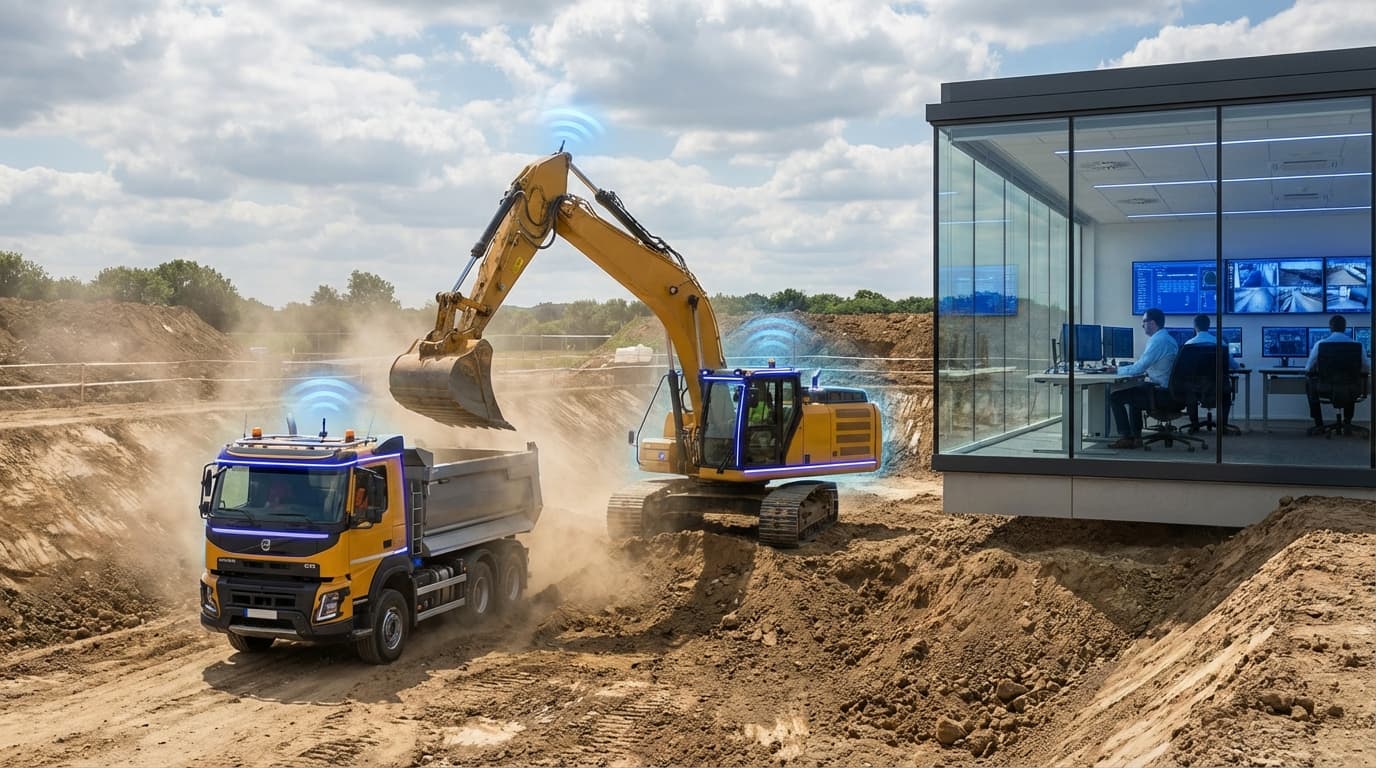
Early deployments indicate that autonomous heavy equipment is transitioning from controlled pilot programs to broader commercial adoption, particularly in large-scale earthmoving and mining operations where the technology demonstrates clear return on investment. Major equipment manufacturers have developed semi-autonomous and fully autonomous variants of standard construction machinery, with some systems already operating on infrastructure projects and in quarries. The technology typically begins with remote operation capabilities, where operators control machines from climate-controlled command centers, before progressing to full autonomy for repetitive tasks like material hauling along predetermined routes. As the construction industry faces mounting pressure to improve productivity, enhance worker safety, and meet aggressive sustainability targets, autonomous heavy equipment represents a convergence of robotics, artificial intelligence, and construction domain expertise. The trajectory suggests a future where construction sites operate as orchestrated systems of cooperative machines, with human workers focusing on supervisory roles, complex problem-solving, and tasks requiring adaptability that current autonomous systems cannot yet match.
Related Organizations

World's leading manufacturer of construction and mining equipment.

Industrial giant using thermoelectric generators via its subsidiary KELK to harvest waste heat in steel and manufacturing plants.

Provides autonomous vehicle software for mining and construction equipment.


Turns construction equipment into semi-autonomous robots controlled remotely.

Major international builder of heavy equipment.



Hitachi Construction Machinery
Japan · Company
Manufacturer of construction and mining machinery.
Supporting Evidence
Research this in Signals
Signals turns a topic into a sourced research record you can inspect and rerun. Your first scan is free, and this one starts with Autonomous Heavy Equipment already loaded, so edit it or scan as is.