Holographic Reference Kiosks
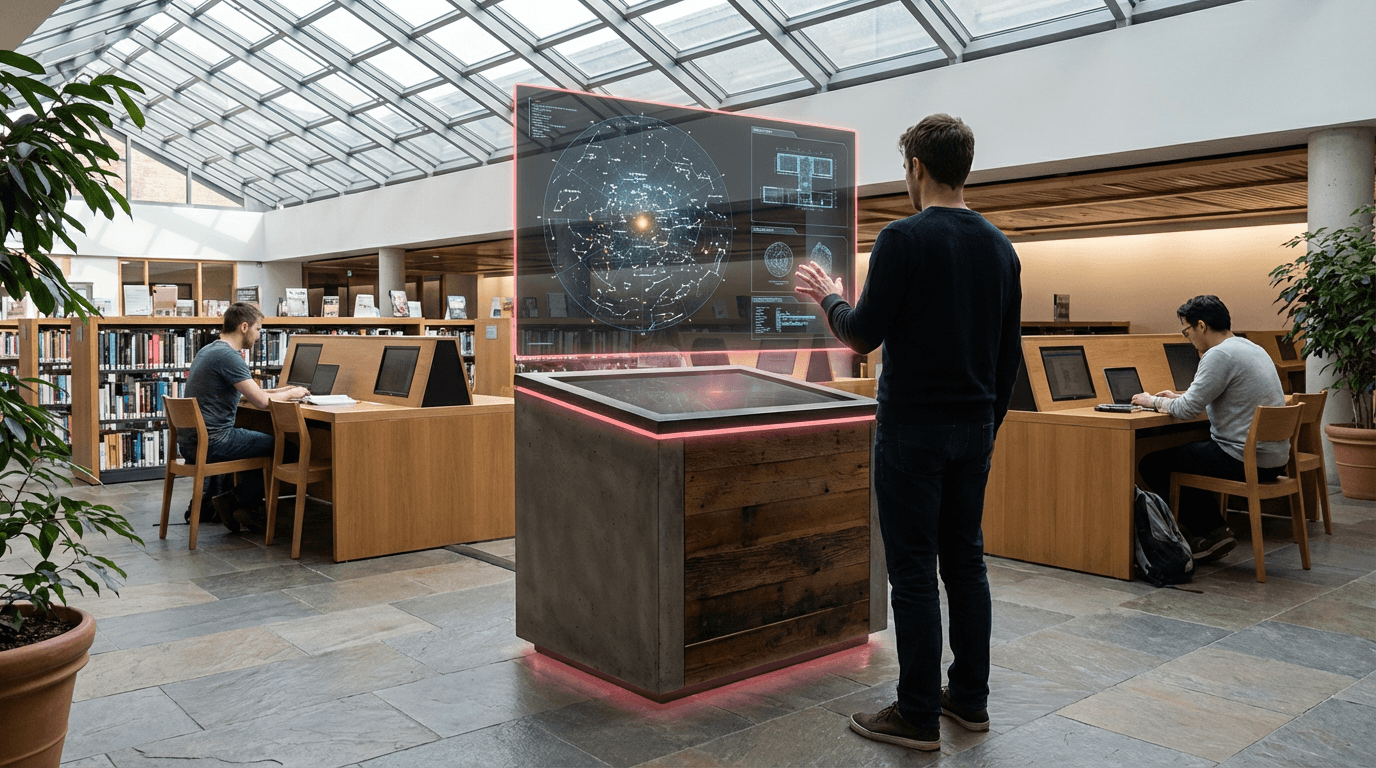
Holographic reference kiosks represent a new category of public-access display technology that projects three-dimensional images into free space, enabling viewers to examine digital objects from multiple angles without requiring headsets or specialized eyewear. Unlike traditional flat-screen terminals, these systems employ light-field displays, volumetric projection arrays, or tensor holography techniques to create the illusion of depth and dimensionality. The underlying mechanisms typically involve precisely controlled light sources—such as arrays of LEDs or laser diodes—combined with optical elements like lenticular lenses, rotating mirrors, or photophoretic traps that manipulate photons to form coherent 3D imagery visible from various viewing positions. Touch-sensitive air interfaces or gesture-recognition cameras allow users to manipulate these floating images intuitively, rotating artifacts, peeling back layers of complex datasets, or zooming into microscopic details. By eliminating the barrier of personal devices or wearables, these kiosks democratize access to advanced visualization capabilities, transforming passive browsing into active spatial exploration.
Libraries and cultural institutions face persistent challenges in making specialized collections accessible to diverse audiences. Rare manuscripts, archaeological specimens, scientific models, and archival materials are often too fragile for handling, too complex for two-dimensional reproduction, or too expensive to display in multiple locations simultaneously. Holographic reference kiosks address these limitations by enabling high-fidelity digital surrogates that preserve the tactile and spatial qualities of physical objects while remaining infinitely reproducible and manipulable. This technology unlocks new possibilities for comparative study, allowing patrons to juxtapose artifacts from different collections, overlay contextual information directly onto 3D models, or witness dynamic processes—such as protein folding, architectural evolution, or astronomical phenomena—that unfold across time scales impossible to observe directly. For educational institutions, these kiosks serve as focal points for collaborative learning, where groups can gather around a shared holographic display to discuss and annotate complex subjects together, bridging the gap between digital archives and embodied learning experiences.
Early deployments in academic libraries and museum settings suggest growing interest in holographic kiosks as permanent fixtures within knowledge infrastructure. Pilot installations have demonstrated their effectiveness for disciplines ranging from anatomy and engineering to art history and paleontology, where three-dimensional understanding is essential. Research institutions are exploring their use for visualizing genomic data, molecular structures, and climate models, transforming abstract datasets into graspable forms. As display resolution improves and production costs decline, these systems are likely to expand beyond specialized research environments into public libraries, community centers, and educational facilities. The trajectory of holographic reference kiosks aligns with broader movements toward experiential learning, open access to cultural heritage, and the spatial computing paradigm that seeks to integrate digital information more naturally into physical environments. By anchoring digital discovery in shared, communal spaces rather than isolating it behind personal screens, this technology promises to reshape how institutions facilitate knowledge exploration and foster collaborative inquiry in an increasingly data-rich world.
Related Organizations

Manufactures self-contained holographic display units (Epic and M) for beaming life-size volumetric avatars for events and communications.

Develops desktop and large-format holographic displays that generate 45-100 views simultaneously for glasses-free 3D.


Developer of holographic display technologies (Dreamoc, DeepFrame) used in mixed reality installations.

Manufactures 3D holographic display systems based on spinning LED rotors.

Provides lightfield display hardware and software solutions for mobile devices, tablets, and automotive cockpits.

Magnetic 3D
United States · Company
Provides glasses-free 3D display solutions for digital signage and retail.

Supporting Evidence
Research this in Signals
Signals turns a topic into a sourced research record you can inspect and rerun. Your first scan is free, and this one starts with Holographic Reference Kiosks already loaded, so edit it or scan as is.