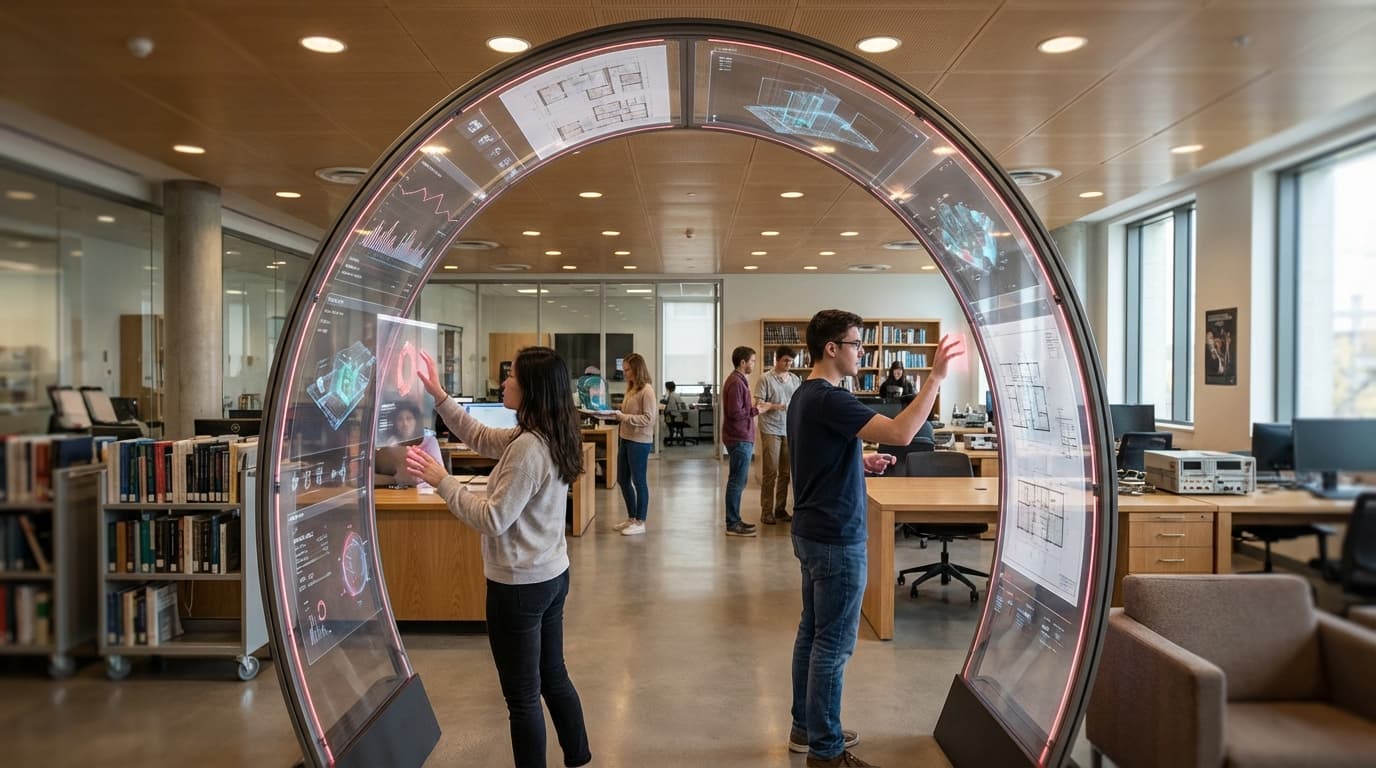
Spatial Computing Displays
Spatial computing displays represent a convergence of extended reality (XR) technologies and advanced projection systems designed to transform how users interact with information in three-dimensional space. These systems encompass a range of form factors, from head-mounted displays (HMDs) like augmented reality glasses and virtual reality headsets to handheld tablets with spatial awareness capabilities, and room-scale installations featuring holographic projection surfaces or volumetric displays. The underlying technology relies on sophisticated spatial mapping sensors, real-time rendering engines, and gesture recognition systems that track user position and movement within physical environments. By combining depth-sensing cameras, infrared trackers, and simultaneous localization and mapping (SLAM) algorithms, these displays create persistent digital overlays that respond to physical architecture, allowing virtual content to appear anchored to real-world coordinates. Advanced implementations may incorporate light field displays or holographic waveguides that enable multiple viewers to perceive three-dimensional content without requiring individual headsets, making collaborative exploration of digital information more natural and accessible.
The fundamental challenge these displays address is the inherent limitation of two-dimensional screens in representing complex, interconnected knowledge structures. Traditional interfaces force users to navigate hierarchical menus and scroll through linear documents, creating cognitive barriers when exploring vast archives, understanding temporal relationships, or grasping the multidimensional connections within knowledge graphs. Spatial computing displays overcome these constraints by leveraging human spatial memory and our innate ability to navigate three-dimensional environments. In library and archival contexts, this technology enables institutions to present collections in ways that reflect their conceptual relationships rather than merely their physical or digital filing systems. Researchers can literally walk around a timeline, examining historical documents from multiple vantage points, or step inside a network visualization to understand how ideas and individuals connect across time and disciplines. This spatial approach to information architecture also addresses accessibility challenges, as institutions can layer multiple interpretive frameworks onto the same physical space, allowing different audiences to experience collections through customized lenses without requiring separate physical exhibitions.
Early implementations of spatial computing displays in cultural heritage institutions have demonstrated promising applications, with several major research libraries piloting mixed-reality reading rooms where rare manuscripts can be examined alongside contextual materials that would be impossible to display simultaneously in physical form. Museums have deployed room-scale holographic installations that allow visitors to explore archaeological sites in three dimensions or visualize the provenance networks of artifacts across centuries. These deployments indicate growing institutional recognition that spatial interfaces may fundamentally reshape how communities engage with preserved knowledge, moving beyond passive consumption toward active exploration and discovery. As display technologies mature and become more affordable, industry observers note a trajectory toward persistent spatial computing environments where physical and digital collections coexist seamlessly, enabling new forms of scholarship that leverage both embodied navigation and computational analysis. This evolution aligns with broader movements toward experiential learning and participatory archives, suggesting that spatial computing displays will become essential infrastructure for institutions seeking to make their collections more discoverable, contextual, and intellectually generative in an increasingly digital age.
Related Organizations

Develops desktop and large-format holographic displays that generate 45-100 views simultaneously for glasses-free 3D.

Developing 'Apple Intelligence', a personal intelligence system integrated into iOS/macOS that uses on-device context to mediate tasks and information.

AR headset manufacturer utilizing dynamic dimming and eye-tracking for optimized rendering.

Manufacturer of 'bionic display' headsets that use a high-density focus display inside a peripheral context display.


Holographic collaboration system for professional 3D workflows.

Developer of holographic display technologies (Dreamoc, DeepFrame) used in mixed reality installations.

Manufacturer of consumer AR glasses (Air, Light) that tether to phones or computing pucks.

R&D company focusing on tracked holographic 3D displays, with significant investment from Volkswagen.
Supporting Evidence
Research this in Signals
Signals turns a topic into a sourced research record you can inspect and rerun. Your first scan is free, and this one starts with Spatial Computing Displays already loaded, so edit it or scan as is.