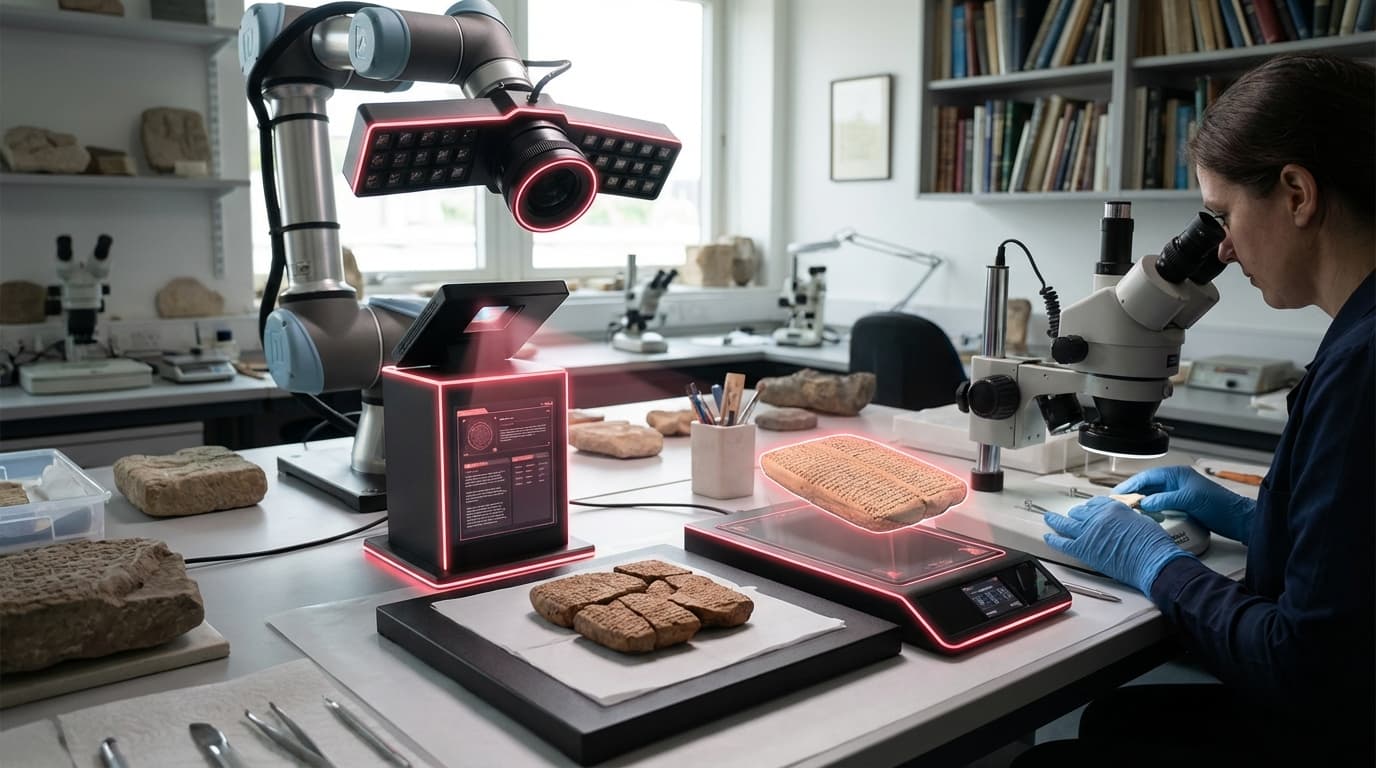
Generative Restoration Engines
Generative Restoration Engines represent a sophisticated application of deep learning to the preservation and reconstruction of cultural heritage materials. These systems employ neural networks trained on extensive datasets of historical artifacts, enabling them to analyze patterns, styles, and contextual relationships within damaged or incomplete works. The technology operates through multiple specialized architectures: convolutional neural networks for visual restoration, recurrent networks for sequential data like text and audio, and transformer models that can capture long-range dependencies across different media types. When presented with a fragment—whether a torn manuscript page, a degraded film reel, or a corrupted audio recording—these engines generate probabilistic reconstructions by drawing on learned patterns from thousands of similar historical materials. The process involves not merely filling gaps but understanding the artistic conventions, linguistic patterns, or technical characteristics of the period and medium in question.
For archives, libraries, and cultural institutions, these engines address a fundamental challenge that has long constrained preservation efforts: the irreversible degradation of physical and digital media. Traditional restoration methods require painstaking manual work by specialized conservators, a process that is both time-intensive and limited by the availability of expert knowledge. Generative Restoration Engines dramatically accelerate this work while maintaining scholarly rigor through their ability to offer multiple plausible reconstructions rather than a single authoritative version. This probabilistic approach acknowledges uncertainty while providing researchers with working versions of materials that might otherwise remain inaccessible. The technology also enables institutions to prioritize their limited conservation resources more effectively, using AI-assisted restoration for initial access while reserving human expertise for the most significant or ambiguous cases. Furthermore, these systems create new possibilities for comparative analysis, allowing scholars to examine how different reconstruction hypotheses might alter interpretations of historical texts, artworks, or recordings.
Early deployments of generative restoration technology have emerged in major cultural institutions, where pilot programs focus on specific collections such as damaged photographic archives, incomplete musical scores, or fragmentary ancient texts. Research initiatives suggest that these engines perform particularly well when trained on domain-specific datasets, such as the works of a particular period or geographic region, rather than attempting universal restoration capabilities. The technology has proven especially valuable for materials where physical intervention carries risks of further damage, offering a non-invasive pathway to accessibility. As these systems mature, they are increasingly integrated into broader digital preservation workflows, working alongside traditional conservation methods rather than replacing them. The trajectory points toward more sophisticated models that can handle multimodal restoration—simultaneously reconstructing visual, textual, and audio elements of complex artifacts while maintaining historical authenticity and scholarly transparency about the probabilistic nature of their reconstructions.
Related Organizations

Developers of the Gemini family of models, which are trained from the start to be multimodal across text, images, video, and audio.



Software company specializing in AI-based image and video enhancement.

Software giant and founder of the Content Authenticity Initiative (CAI).

A public university in Venice, Italy.

Developing foundation models for robotics (Project GR00T) and vision-language models like VILA.

A European cooperation network for technology and cultural heritage.

Government agency driving Singapore's Smart Nation initiative.

Supporting Evidence
Research this in Signals
Signals turns a topic into a sourced research record you can inspect and rerun. Your first scan is free, and this one starts with Generative Restoration Engines already loaded, so edit it or scan as is.