Interactive Living Archives
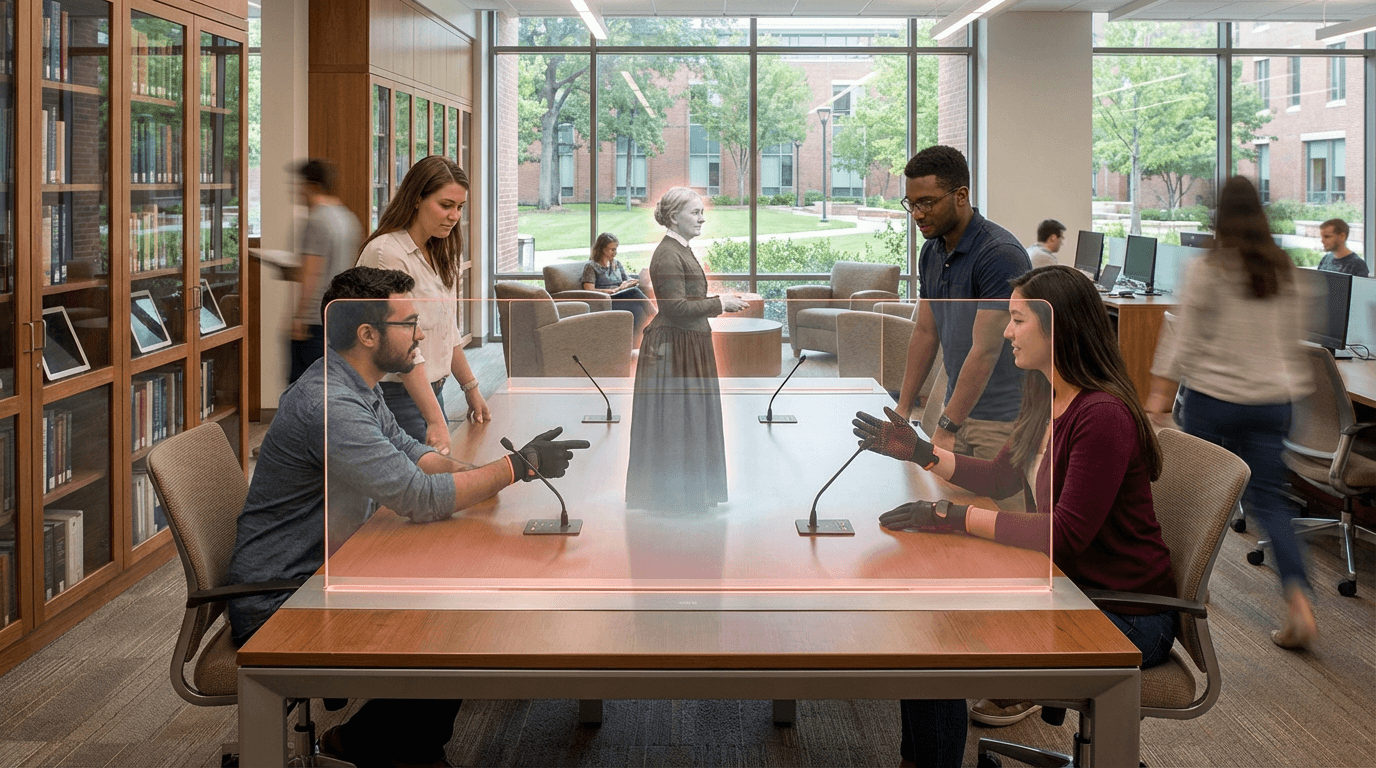
Interactive Living Archives represent a convergence of natural language processing, historical scholarship, and digital preservation, creating AI-powered conversational agents that embody the intellectual essence of historical figures. The technology operates by training large language models on comprehensive datasets comprising an individual's complete written works, correspondence, speeches, interviews, and other documented materials. Through fine-tuning techniques, these models learn to replicate not just the factual knowledge but also the rhetorical patterns, argumentative structures, and conceptual frameworks characteristic of the historical subject. The resulting AI personas can engage in open-ended dialogue, responding to queries in ways that reflect the subject's documented perspectives while maintaining transparency about the probabilistic nature of their responses. Advanced implementations incorporate temporal awareness, allowing the system to distinguish between ideas the historical figure expressed at different life stages, and can acknowledge the limits of what can be inferred from available sources.
This approach addresses fundamental challenges in how institutions preserve and provide access to historical knowledge. Traditional archives, while invaluable, create barriers between researchers and primary sources through physical access limitations, the specialized skills required to navigate archival materials, and the time-intensive nature of historical research. Interactive Living Archives democratize engagement with historical thought by offering an intuitive conversational interface that requires no specialized training to use. They enable educators to bring historical perspectives into classrooms in dynamic ways, allowing students to explore ideas through dialogue rather than passive reading. For cultural heritage institutions, these systems offer new models for public engagement, transforming static collections into interactive experiences that can spark curiosity and deepen understanding. The technology also supports comparative historical analysis, as researchers can pose identical questions to multiple historical personas, revealing contrasts in thought across different periods, cultures, or intellectual traditions.
Early implementations have emerged in museum settings and educational platforms, where institutions experiment with creating conversational agents based on figures ranging from scientists and philosophers to artists and political leaders. These deployments typically emphasize transparency about the AI-mediated nature of the interaction, often displaying source citations alongside responses to maintain scholarly rigor. Research libraries are exploring how such systems might complement traditional reference services, offering preliminary guidance that directs users toward relevant primary sources for deeper investigation. The technology aligns with broader movements toward participatory archives and digital humanities, where computational methods open new pathways for engaging with cultural memory. As language models become more sophisticated and institutions develop ethical frameworks for representing historical voices, Interactive Living Archives may evolve into standard components of knowledge infrastructure, fundamentally reshaping how future generations encounter and learn from the past while raising important questions about authenticity, interpretation, and the responsibilities inherent in digitally resurrecting historical perspectives.
Related Organizations

Develops 'Dimensions in Testimony', an interactive biography system that often utilizes holographic and AR display technologies to allow visitors to converse with survivors at memorial sites.

Creates conversational video AI that allows people to record their life stories for future generations to interact with.

An app that records personal stories and uses AI to let loved ones ask questions about those memories later.

A company developing AI-driven interactive avatars that allow users to 'train' their digital selves before death.

A consumer mobile app that uses LLMs to allow users to have text-based conversations with simulated historical figures.

Develops 'Creative Reality' technology that animates still photos into talking avatars, widely used in e-learning applications.

A platform for creating AI characters with distinct personalities, memories, and contextual awareness for games and virtual worlds.
Supporting Evidence
Research this in Signals
Signals turns a topic into a sourced research record you can inspect and rerun. Your first scan is free, and this one starts with Interactive Living Archives already loaded, so edit it or scan as is.