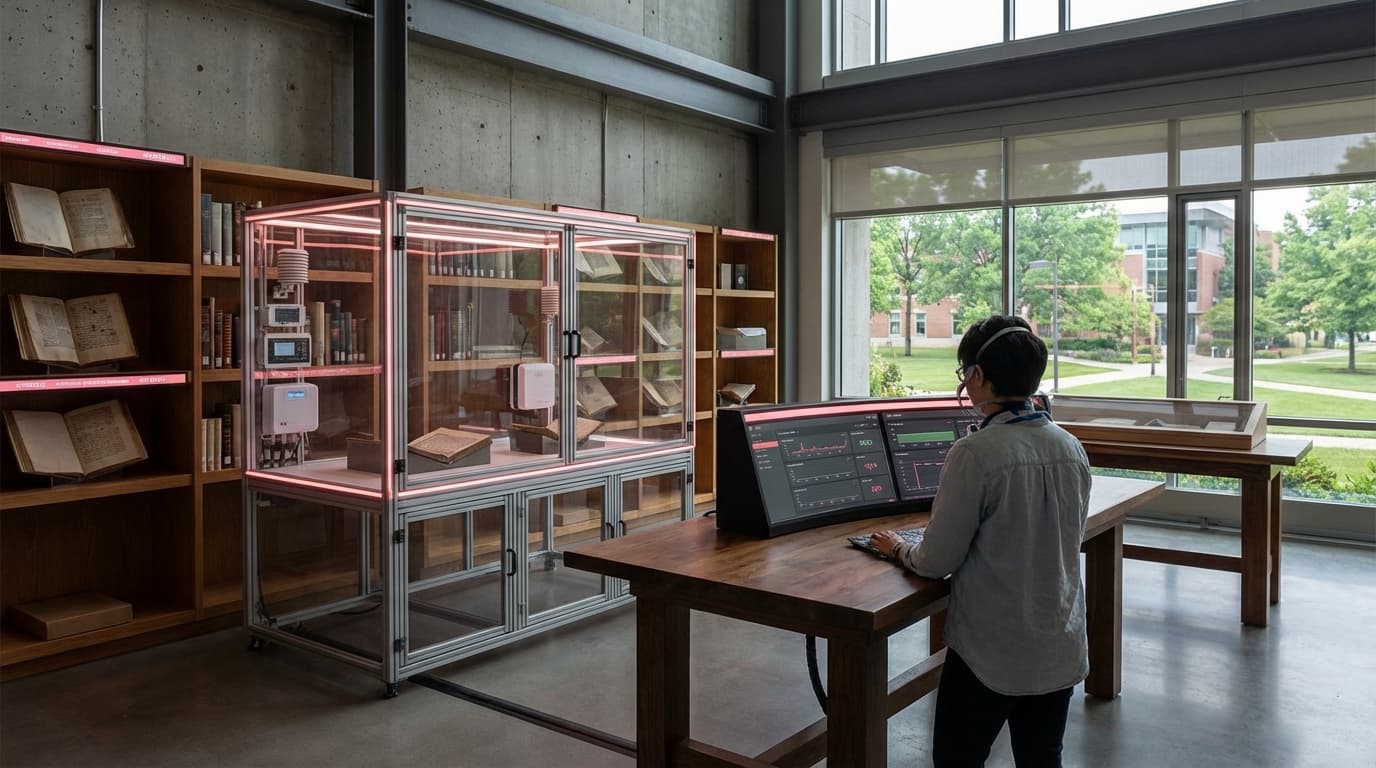
Ambient Preservation Sensing
Physical collections in libraries, museums, and archives face constant threats from environmental factors that accelerate deterioration—fluctuating temperature and humidity levels, exposure to ultraviolet light, airborne pollutants, and even subtle vibrations from nearby infrastructure. Traditional preservation methods rely on periodic manual inspections and static climate control systems that operate on fixed schedules, often missing critical environmental changes that occur between checks. This reactive approach can result in irreversible damage to rare books, manuscripts, artworks, and historical artifacts before problems are detected. Ambient Preservation Sensing addresses these limitations by deploying networks of low-power Internet of Things (IoT) sensors throughout collection spaces, creating a continuous monitoring infrastructure that captures real-time environmental data. These sensor networks typically incorporate multiple measurement capabilities—temperature and humidity sensors, light meters that detect both visible and UV wavelengths, air quality monitors for pollutants like volatile organic compounds and particulates, and accelerometers that register vibrations. The data streams from these distributed sensors feed into edge computing modules equipped with machine learning algorithms that can identify patterns indicating emerging preservation risks.
For institutions managing valuable physical collections, this technology transforms preservation from a periodic maintenance task into a proactive, data-driven operation. The continuous monitoring capability allows preservation staff to detect environmental anomalies immediately rather than discovering damage weeks or months later during routine inspections. Machine learning models trained on historical degradation patterns can predict which items face elevated risk based on their specific material composition and current environmental exposure, enabling targeted interventions before deterioration becomes visible. The system's ability to trigger adaptive responses—automatically adjusting HVAC settings, closing blinds to reduce light exposure, or alerting staff to investigate unusual conditions—creates a responsive preservation environment that adapts to changing conditions. This approach proves particularly valuable for institutions with limited preservation budgets, as it optimizes resource allocation by directing attention and climate control efforts precisely where they are needed rather than maintaining uniform conditions across entire facilities.
Early deployments in research libraries and museum storage facilities demonstrate the practical value of ambient preservation sensing, with institutions reporting improved detection of environmental threats and reduced energy consumption through more targeted climate control. The technology integrates with existing building management systems while providing preservation-specific analytics that standard facilities monitoring cannot deliver. As sensor costs continue to decline and edge AI capabilities advance, these systems are becoming accessible to smaller institutions that previously lacked resources for sophisticated environmental monitoring. The broader trend toward smart buildings and digital preservation strategies positions ambient preservation sensing as an essential infrastructure component for any institution committed to long-term collection stewardship, bridging the gap between traditional conservation practices and modern data analytics to ensure that physical cultural heritage remains accessible for future generations.
Related Organizations

Develops wireless environmental monitoring sensors and software specifically designed for museum and archive collections.

A private international research institute dedicated to advancing conservation practice, including environmental management guidelines.

A university-based research center dedicated to the preservation of cultural heritage collections, known for developing the eClimateNotebook software.

A special operating agency within the Department of Canadian Heritage that advances conservation science.

Manufactures high-end environmental monitoring systems specifically marketed toward the heritage and pharmaceutical sectors.

A global leader in weather, environmental, and industrial measurements.

Develops Bluetooth sensor beacons for environmental logging, used in galleries and logistics.

Japanese manufacturer of wireless data loggers and cloud-based monitoring systems.
Supporting Evidence
Research this in Signals
Signals turns a topic into a sourced research record you can inspect and rerun. Your first scan is free, and this one starts with Ambient Preservation Sensing already loaded, so edit it or scan as is.