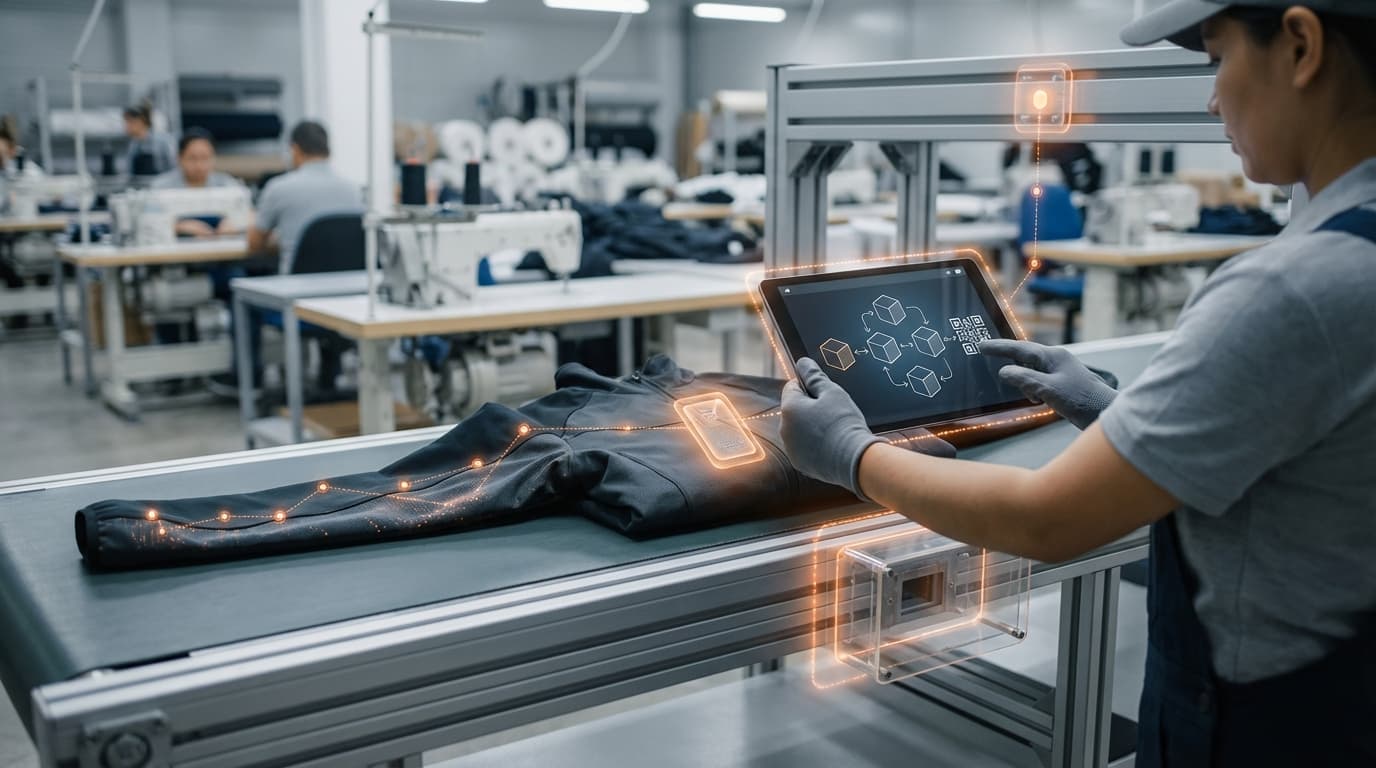
Decentralized Product Passports for Garment Traceability
Decentralized product passports use blockchain or distributed ledger technology to create tamper-proof digital identities for physical garments that contain comprehensive information about the product's journey from raw materials through manufacturing, distribution, and ownership transfers. These digital records are cryptographically secured and stored across distributed networks, making them resistant to tampering or deletion, and can be accessed by anyone with the appropriate credentials or public keys.
This innovation addresses the need for verifiable supply chain transparency and product authenticity in an industry plagued by counterfeiting and opaque supply chains. By providing immutable, accessible records, decentralized passports enable consumers to verify claims about sustainability, ethical production, and authenticity, while also supporting circular economy initiatives by tracking products through resale and recycling. The EU's Digital Product Passport regulation will require such systems for textiles starting in 2026, driving adoption across the industry.
The technology is becoming essential infrastructure for brands seeking to prove their sustainability and ethical claims, as well as for consumers who want to make informed purchasing decisions. However, implementation faces challenges including data entry complexity, the need for all supply chain participants to participate, and questions about data privacy and access control. As these challenges are addressed and regulations mandate adoption, decentralized product passports could transform how we track, verify, and value fashion products throughout their lifecycle.
Related Organizations

An open-source protocol for digital product passports using NFTs to prove ownership and authenticity, specifically targeting the luxury sector.

Founded by LVMH, Prada, and Cartier to provide a unified blockchain solution for luxury product tracking and authenticity certificates.

Software company creating the Digital ID for physical products.

Blockchain traceability platform specifically for the fashion industry, tracking sustainable fibers from source to retail.

Enterprise blockchain platform focusing on supply chain management and IoT integration for product lifecycle tracking.

Developed 'atma.io', a connected product cloud that assigns unique digital IDs to billions of items, bridging physical tags (RFID/QR) with digital data.

Uses blockchain and Zero-Knowledge Proofs to share product data (like chemical content) without revealing sensitive supplier information.

AI and blockchain-powered platform for supply chain transparency and product traceability in fashion.
GS1
Belgium · Consortium
Global standards organization (barcodes) now developing the 'GS1 Digital Link' to connect physical products to the web and digital passports.

Operates the SPIN platform, which allows brands to tokenize garments on blockchain for traceability and circular business models.
Supporting Evidence
Research this in Signals
Signals turns a topic into a sourced research record you can inspect and rerun. Your first scan is free, and this one starts with Decentralized Product Passports for Garment Traceability already loaded, so edit it or scan as is.