Spiritual & Ritual Technology Platforms
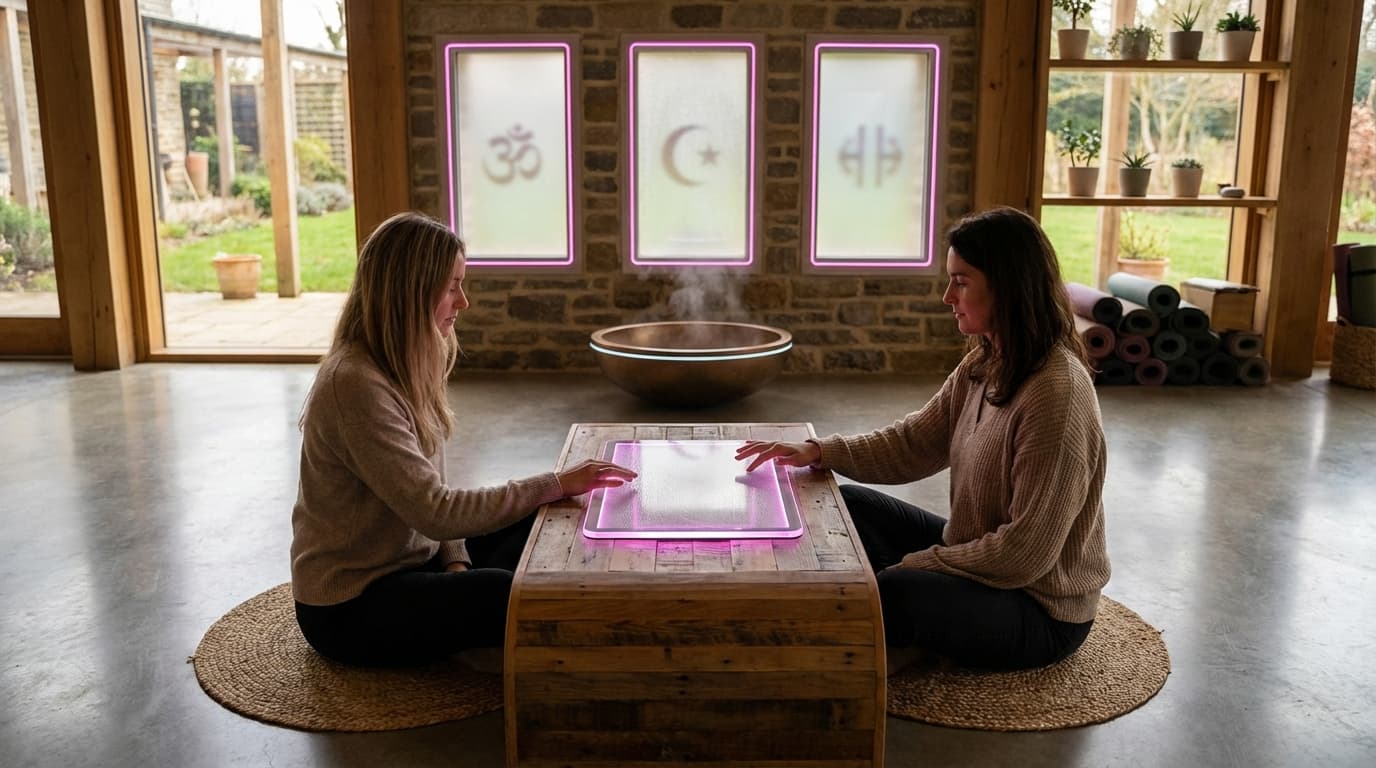
Spiritual and ritual technology platforms represent a convergence of digital connectivity and sacred practice, creating virtual environments where individuals and communities can engage in prayer, meditation, and religious observance regardless of physical location. These systems employ real-time communication technologies, synchronized audio-visual environments, and carefully designed interfaces that honor the contemplative nature of spiritual practice. Unlike conventional video conferencing tools, these platforms incorporate features specifically tailored to religious contexts: timed meditation sessions with ambient soundscapes, virtual prayer circles with spatial audio that simulates physical gathering, synchronized ritual calendars across time zones, and digital spaces designed to evoke sacred architecture or natural settings conducive to reflection. Some implementations integrate biometric feedback to help users achieve meditative states, while others provide structured frameworks for interfaith dialogue or couples' devotional practices. The technical architecture must balance the need for reliable connectivity with the creation of distraction-free environments that support genuine spiritual experience rather than merely replicating it.
The fundamental challenge these platforms address is the increasing geographic dispersion of religious communities and the difficulty of maintaining consistent spiritual practices in modern life. Traditional religious institutions have long struggled with declining physical attendance, particularly among younger generations and those who relocate for work or education. For couples in interfaith or long-distance relationships, maintaining shared spiritual practices has historically required significant coordination and compromise. These platforms enable new forms of religious participation that were previously impossible: a Muslim family scattered across continents can break fast together during Ramadan, Christian prayer partners can maintain daily devotions despite living in different cities, and Buddhist practitioners can join meditation sessions led by teachers thousands of miles away. The technology also creates opportunities for spiritual exploration and interfaith engagement that transcend traditional geographic and institutional boundaries, allowing users to participate in diverse traditions and learn from teachers they might never encounter in person.
Early implementations of these platforms have emerged across various faith traditions, from Christian prayer apps that connect users for real-time intercession to meditation platforms offering live sessions with instructors from multiple Buddhist lineages. Some religious organizations have developed proprietary systems for their communities, while others utilize adapted commercial platforms with features like virtual candle lighting, digital prayer walls, or synchronized scripture reading. The COVID-19 pandemic accelerated adoption significantly, as religious communities sought ways to maintain connection during physical distancing, revealing both the potential and limitations of digital spiritual practice. Research in religious studies and psychology suggests that while these platforms cannot fully replicate the embodied experience of physical gathering, they can support meaningful spiritual connection and practice, particularly when designed with theological and phenomenological sensitivity. As younger generations increasingly expect digital options for all aspects of life, and as global migration continues to disperse religious communities, these platforms are likely to become permanent features of religious life rather than temporary substitutes. The trajectory points toward more sophisticated implementations that better integrate ritual objects, sacred texts, and communal practices while maintaining the intimacy and authenticity that spiritual seekers require.
Related Organizations

A Catholic prayer and meditation app that provides audio-guided contemplative prayer and community challenges.

A social networking platform specifically designed for faith communities and prayer requests.

A church that exists entirely in the metaverse (AltspaceVR, VRChat), conducting baptisms and services virtually.

Developer of the world's most popular Bible app, facilitating shared reading plans, prayer circles, and digital community worship.

A Christian daily worship app designed to create consistent habits of connection with God.

The leading mobile application for the Muslim community, providing prayer times, Qibla direction, and community features.
The official app of the Plum Village monastic community, offering guided meditations and chants.

An open-source digital library of Jewish texts with tools for interlinked study and community source sheet creation.

An AI-powered astrology app that focuses on social compatibility and shared horoscopes.

A meditation app with a strong focus on community and spiritual teachers rather than just secular mindfulness.
Supporting Evidence
Research this in Signals
Signals turns a topic into a sourced research record you can inspect and rerun. Your first scan is free, and this one starts with Spiritual & Ritual Technology Platforms already loaded, so edit it or scan as is.