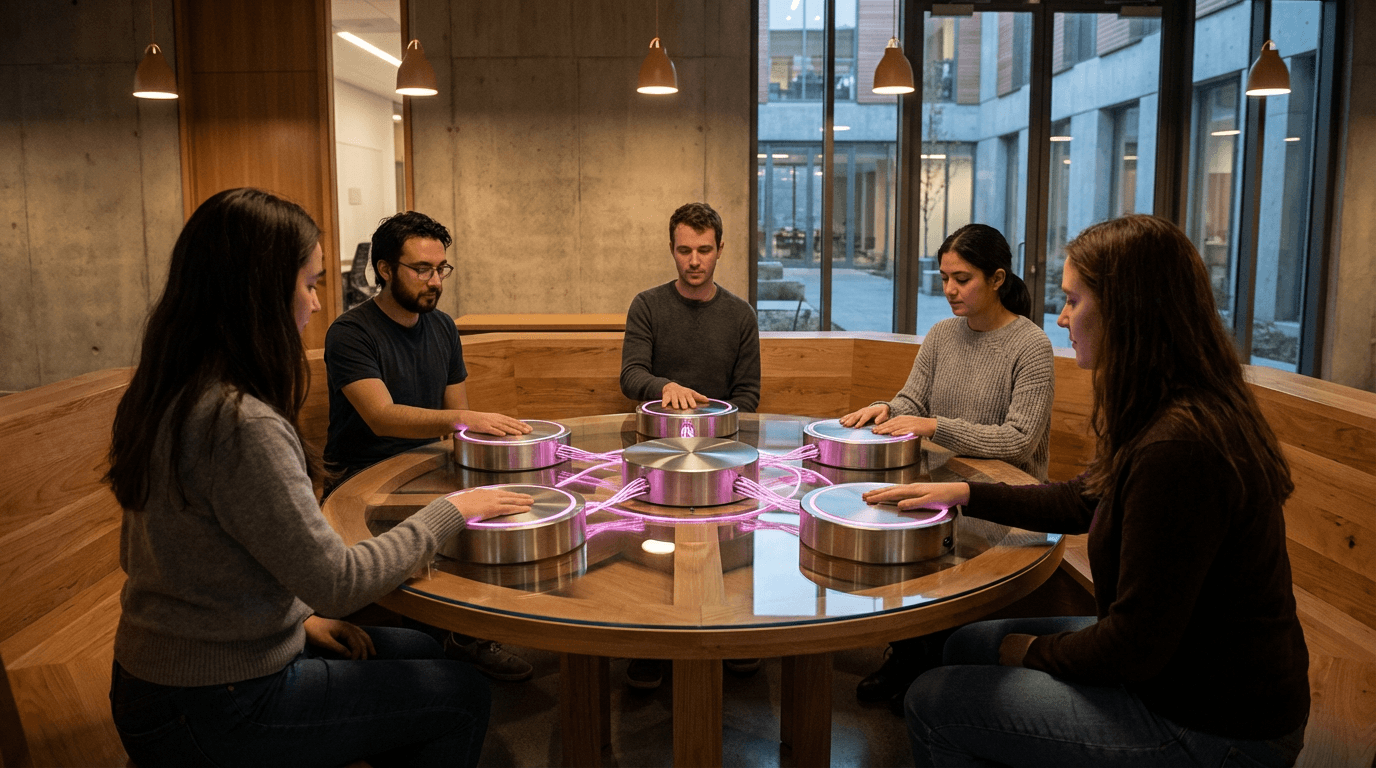
Collective Ritual Hardware
Collective ritual hardware represents a convergence of networked technology and embodied spiritual practice, creating physical devices that synchronize across geographic distances to facilitate shared ceremonial experiences. These systems typically consist of internet-connected objects—ranging from candles that flicker in unison, bells that chime simultaneously, drums that transmit rhythmic patterns, to haptic wearables that deliver coordinated tactile sensations—all designed to create a sense of co-presence during religious observances, memorial services, or community celebrations. The underlying architecture relies on low-latency communication protocols that ensure precise temporal synchronization, allowing participants separated by continents to light candles at the exact same moment, feel the same vibration pattern during a prayer sequence, or hear coordinated soundscapes that mirror traditional in-person gatherings. Unlike purely digital interfaces that confine interaction to screens, these devices engage multiple sensory modalities and occupy physical space in participants' homes or gathering places, creating what researchers describe as "distributed embodiment"—the sensation of sharing physical ritual actions despite spatial separation.
The fundamental challenge these technologies address is the erosion of communal bonds within increasingly dispersed populations, particularly among diaspora communities, military families, and religious groups whose members have scattered across the globe. Traditional religious and cultural practices have historically depended on physical co-location, creating barriers for those who cannot regularly attend services due to distance, mobility limitations, or time zone differences. This geographic fragmentation often leads to weakened community ties, loss of cultural transmission across generations, and diminished access to the psychological and social benefits that collective rituals provide. Collective ritual hardware offers a solution by maintaining the embodied, multisensory dimensions of shared practice while transcending spatial constraints. For religious institutions facing declining in-person attendance, these systems enable new hybrid models of congregation that preserve ritual authenticity while accommodating modern mobility patterns. They also create opportunities for intergenerational connection, allowing elderly community members who cannot travel to participate fully in ceremonies alongside younger relatives in distant cities.
Early implementations of collective ritual hardware have emerged across various faith traditions and secular communities, from networked Shabbat candles that allow Jewish families to observe the Sabbath together across time zones, to synchronized meditation bells used by distributed Buddhist sanghas, to haptic memorial devices that connect mourners during anniversary commemorations. Indigenous communities have begun exploring these technologies as tools for cultural preservation, enabling geographically dispersed tribal members to participate in traditional ceremonies that might otherwise be inaccessible. The development trajectory suggests movement toward increasingly sophisticated multisensory integration, with prototypes incorporating synchronized scent diffusion, temperature changes, and even coordinated movement of physical objects. As remote work and global migration continue to reshape how communities form and maintain bonds, collective ritual hardware represents a broader trend toward what scholars term "technologically mediated intimacy"—the use of physical computing to preserve embodied social practices in an increasingly distributed world. This evolution points toward future urban environments where physical and digital community spaces interweave, allowing residents to maintain meaningful connections to multiple geographic and cultural communities simultaneously without sacrificing the tangible, sensory richness that makes ritual practices psychologically and socially powerful.
Related Organizations

Developer of the Bond Touch bracelets that allow users to send haptic touches to partners over long distances.

Creator of 'Friendship Lamps', Wi-Fi connected lamps that light up in a specific color when a paired lamp is touched.

Developers of Pillow Talk, a wristband and speaker system that transmits a partner's heartbeat to a pillow for sleep intimacy.

A connected wooden box that spins when a message arrives via app, creating a physical ritual for digital messaging.

Creators of the HB Ring, a premium smart ring that allows wearers to feel and see their partner's real-time heartbeat.

Research organization developing sensors and techniques for 'heart coherence' and group synchronization.

Home of the Affective Computing research group led by Rosalind Picard.

Online retailer that actively curates, commissions, and popularizes long-distance relationship technologies (like the Long Distance Touch Lamp).
Supporting Evidence
Research this in Signals
Signals turns a topic into a sourced research record you can inspect and rerun. Your first scan is free, and this one starts with Collective Ritual Hardware already loaded, so edit it or scan as is.