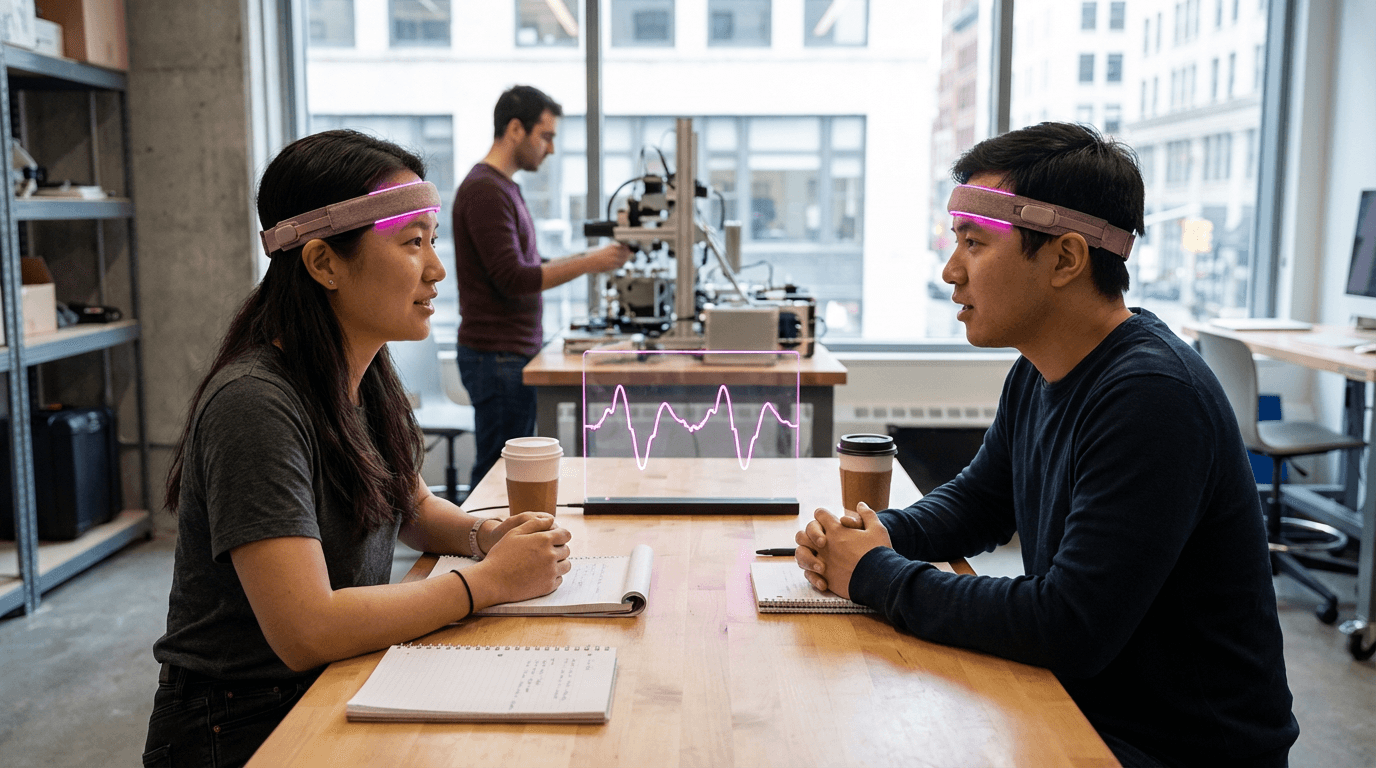
Social Neurofeedback Wearables
Social neurofeedback wearables represent an emerging class of brain-computer interfaces that measure and display interpersonal neural synchrony through consumer-grade electroencephalography (EEG) sensors. These devices typically consist of lightweight headbands or discrete forehead sensors that detect electrical activity patterns across the prefrontal cortex and other accessible brain regions. Unlike clinical-grade EEG systems that require conductive gel and dozens of electrodes, these wearables employ dry-contact sensors and simplified electrode arrays optimized for detecting broader patterns of attention, emotional arousal, and cognitive load. The core technical innovation lies in their ability to process multiple users' brain signals simultaneously, applying pattern-matching algorithms to identify moments when participants' neural activity exhibits coherence or synchronization—a phenomenon researchers associate with shared focus, empathetic connection, and collaborative flow states. Real-time feedback is delivered through ambient LED color changes, gentle vibrations, smartphone visualizations, or audio cues that indicate when group members are achieving heightened interpersonal alignment.
The primary challenge these devices address is the inherent invisibility of interpersonal connection quality in therapeutic, educational, and professional contexts. Traditional approaches to assessing relationship dynamics, team cohesion, or therapeutic rapport rely heavily on subjective self-reports or behavioral observation, which can be influenced by social desirability bias and lack moment-to-moment granularity. Social neurofeedback wearables provide an objective, continuous measure of interpersonal attunement that can reveal patterns invisible to conscious awareness. In couples therapy settings, this technology enables partners to recognize when they achieve genuine mutual understanding versus surface-level agreement, potentially accelerating therapeutic progress. For collaborative teams, these systems can identify which environmental conditions, communication styles, or task structures promote genuine cognitive alignment rather than mere physical co-presence. The technology also opens new possibilities for training empathy, improving conflict resolution skills, and optimizing group learning environments by making the abstract concept of "being on the same wavelength" tangible and measurable.
Early commercial deployments have appeared in wellness centers, corporate team-building programs, and meditation studios, where facilitators use the technology to guide participants toward states of collective calm or focused attention. Research institutions are exploring applications in autism therapy, where neurofeedback may help individuals develop stronger interpersonal attunement skills through repeated practice with immediate feedback. Some educational technology companies are piloting these systems in collaborative learning environments, using synchrony metrics to assess and enhance peer learning effectiveness. As the technology matures, industry observers anticipate integration with virtual reality platforms for remote collaboration, potential applications in family therapy and conflict mediation, and expanded use in performance contexts where ensemble coordination matters—from musical groups to surgical teams. The convergence of miniaturized sensors, improved signal processing algorithms, and growing acceptance of wearable health technology positions social neurofeedback as part of a broader trend toward quantifying and optimizing human connection, though questions remain about privacy, data interpretation, and the risk of over-relying on technological mediation in inherently human experiences.
Related Organizations

Creators of the Muse headband, a consumer EEG device used for meditation and cognitive research.

Produces EEG headsets and the BCI-OS platform, allowing developers to build applications that respond to cognitive stress and facial expressions.
Creates open-source brain-computer interface tools and the Galea headset (integrating with VR) for researching physiological responses.

Develops semi-dry and dry EEG wearable devices for human behavior research and neurotechnology applications.

Creators of 'The Crown', a wearable EEG device focused on inducing and maintaining flow states for productivity and study.

Develops mobile, smartphone-connected EEG devices for outdoor and social research.
Produces dry electrode EEG systems based on technology licensed from Quantum Applied Science and Research (QUASAR).

Develops high-performance BCI hardware, including the 'Unicorn' hybrid black interface for developers.

Manufacturer of biosensor chips (ThinkGear) and the MindWave headset, enabling low-cost consumer EEG.
Supporting Evidence
Research this in Signals
Signals turns a topic into a sourced research record you can inspect and rerun. Your first scan is free, and this one starts with Social Neurofeedback Wearables already loaded, so edit it or scan as is.