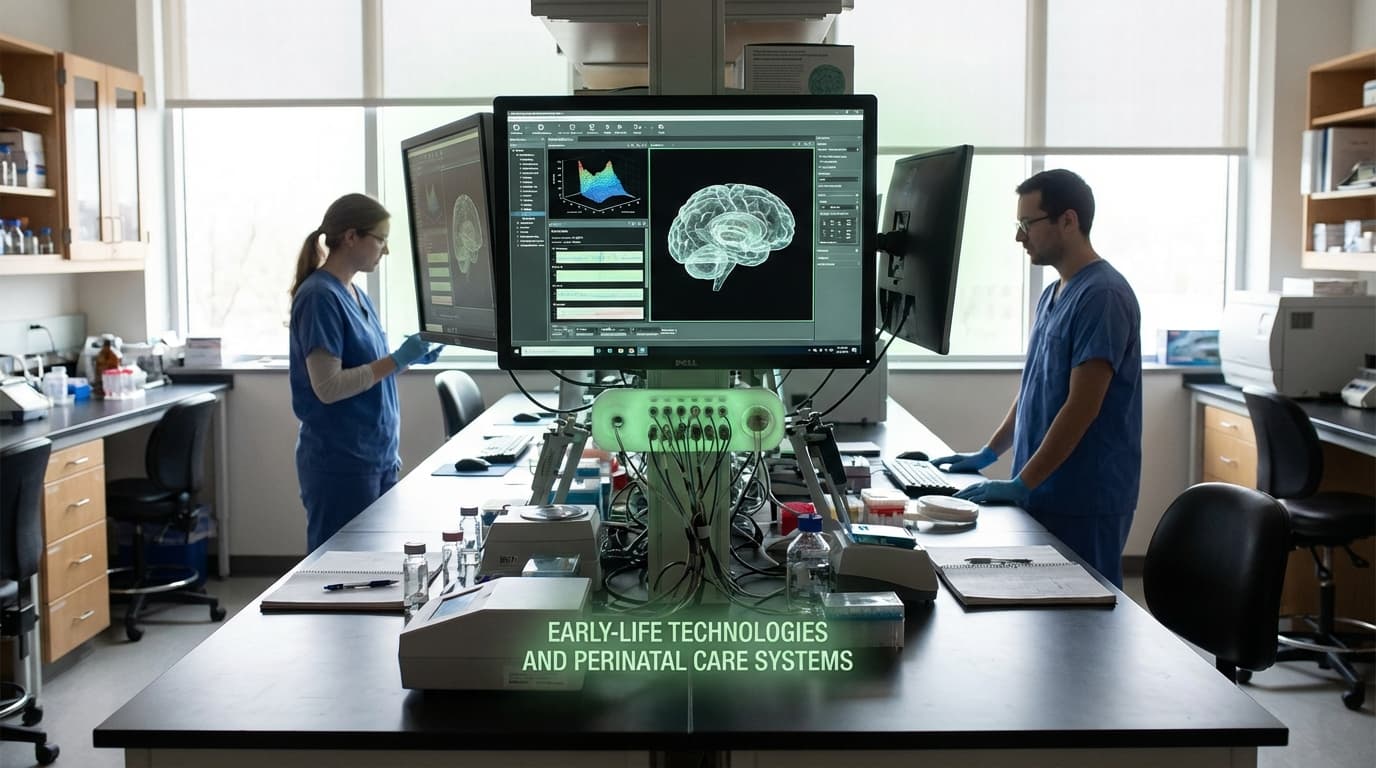
Early Neurodevelopmental Prediction Models
Early neurodevelopmental prediction models represent a convergence of advanced imaging technologies, biosignal analysis, and machine learning algorithms designed to identify potential developmental challenges in the earliest stages of life. These systems integrate multiple data streams—including structural and functional brain imaging from MRI and fMRI scans, electroencephalography (EEG) recordings that capture neural activity patterns, quantitative movement analysis through video-based tracking systems, and eye-tracking data that measures social gaze behaviors and visual attention. By processing these diverse inputs through sophisticated algorithms, the models can detect subtle patterns and biomarkers that may indicate elevated risk for conditions such as autism spectrum disorder, cerebral palsy, attention deficit disorders, and various cognitive delays. The technical foundation relies on deep learning architectures capable of identifying complex, nonlinear relationships across heterogeneous data types that would be imperceptible to human observation alone.
The healthcare challenges these models address are substantial and long-standing. Traditional developmental screening typically occurs months or even years after birth, when behavioral symptoms become apparent—often well past critical windows for intervention. This delayed identification means that therapeutic interventions begin later than optimal, potentially limiting their effectiveness. Early prediction models shift this paradigm by enabling risk stratification during the neonatal period or early infancy, when neural plasticity is at its peak and interventions may have maximal impact. For healthcare systems, this capability promises more efficient resource allocation, directing intensive monitoring and early intervention services toward infants with the highest risk profiles. For families, earlier awareness creates opportunities for proactive support, specialized care planning, and connection with appropriate therapeutic resources before developmental trajectories become entrenched.
Research institutions and specialized pediatric centers have begun piloting these predictive systems, with early deployments indicating promising accuracy in identifying at-risk populations. Clinical trials are exploring how prediction outputs can guide personalized intervention protocols, tailoring therapeutic approaches to individual risk profiles and specific developmental domains. The technology aligns with broader movements toward precision medicine and preventive healthcare, particularly as healthcare systems increasingly recognize the long-term cost-effectiveness of early intervention. As datasets grow larger and more diverse, incorporating longitudinal outcomes data, these models are expected to become more refined and clinically actionable. The trajectory points toward integration with routine neonatal care protocols, where multimodal assessment could become standard practice for high-risk populations, fundamentally transforming how developmental health is monitored and supported from the very beginning of life.
Related Organizations

A major collaboration (KCL, Imperial, Oxford) creating a 4D map of the developing brain to predict neurodevelopmental outcomes.

Home to the Fetal-Neonatal Neuroimaging and Developmental Science Center (FNNDSC).

Develops the EarliPoint Evaluation, an FDA-cleared tool using eye-tracking to diagnose autism and developmental delays in children as young as 16 months.

An open-source pipeline specifically designed to segment and analyze infant brain MRI data for developmental research.

Produces a rapid response EEG system used in NICUs to detect non-convulsive seizures which are predictors of poor neurodevelopmental outcomes.
Develops a single-channel EEG sensor and cloud analytics platform for brain activity monitoring, with applications in neurological disorder detection.

Cloud platform for medical imaging AI, supporting research into pediatric brain development and disease progression.

Provides camera systems and engagement software specifically for NICUs to connect families and remote care teams.
Supporting Evidence
Research this in Signals
Signals turns a topic into a sourced research record you can inspect and rerun. Your first scan is free, and this one starts with Early Neurodevelopmental Prediction Models already loaded, so edit it or scan as is.