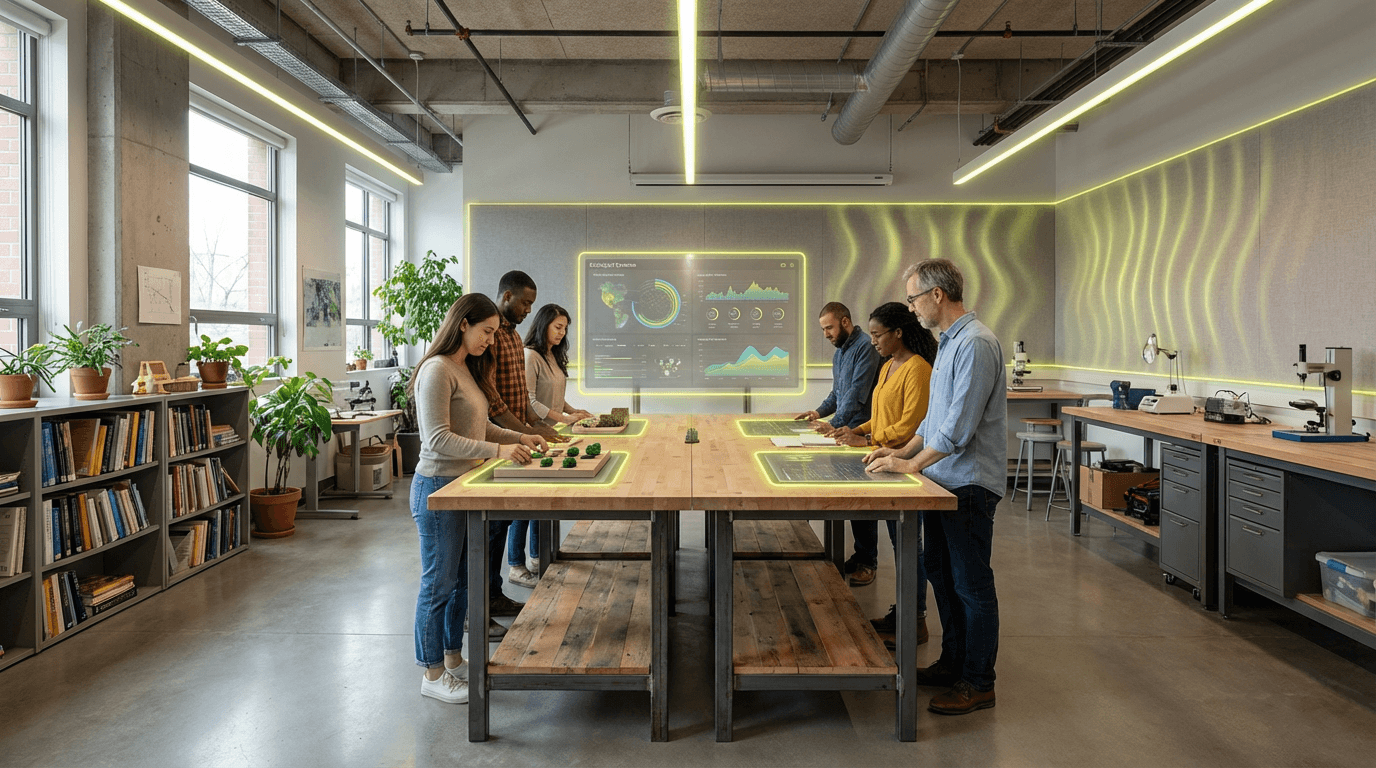
Ambient Learning Environments
Ambient learning environments are intelligent physical spaces equipped with smart furniture, displays, lighting systems, and environmental controls that adapt in real-time to support optimal learning conditions for individual learners or groups. Smart desks and interactive whiteboards adjust content presentation, difficulty, and pacing based on learner profiles and real-time performance data, while environmental systems modulate lighting (color temperature, intensity, direction), sound (background noise, music, acoustic properties), temperature, and air quality to create conditions that support focus, creativity, or collaboration as needed. These multi-sensory environments recognize that physical surroundings significantly impact cognitive performance and learning outcomes, and use sensor data and AI to optimize these conditions dynamically.
This innovation addresses the one-size-fits-all limitation of traditional learning spaces, where fixed environments may not support optimal learning for all individuals or all types of tasks. By creating adaptive, responsive environments, these systems can enhance focus, reduce distractions, support different learning styles, and improve overall learning outcomes. Research institutions and forward-thinking educational facilities are exploring these capabilities, with some smart classrooms and learning spaces already incorporating adaptive environmental controls.
The technology is particularly significant for creating inclusive learning environments that can adapt to diverse needs, including neurodivergent learners who may be particularly sensitive to environmental factors. As sensor technology improves and costs decrease, ambient learning environments could become standard in educational settings. However, ensuring privacy, managing complexity, and demonstrating clear educational benefits remain challenges. The technology represents an important evolution in learning space design, but requires careful implementation and research to validate its effectiveness.
Related Organizations

A global leader in furniture and spatial solutions specifically designed to create active, adaptive learning environments.

A network of 34 European Ministries of Education that runs the 'Future Classroom Lab' in Brussels.

An AI technology company focused on bringing voice-activated AI assistants to the classroom.

A company that designs and equips high-impact learning environments for K-12 schools.

A global leader in interactive displays (ActivPanel) and lesson delivery software (ActivInspire) for K-12 classrooms.

Parent company of Philips Hue, which offers the 'Hue Sync' protocol to align smart lighting with HDMI video signals.

Manufacturer of the ViewBoard interactive displays and myViewBoard software ecosystem.


A company specializing in wireless presentation and collaboration solutions.
Supporting Evidence
Research this in Signals
Signals turns a topic into a sourced research record you can inspect and rerun. Your first scan is free, and this one starts with Ambient Learning Environments already loaded, so edit it or scan as is.