Cognitive-Sensing Learning Devices
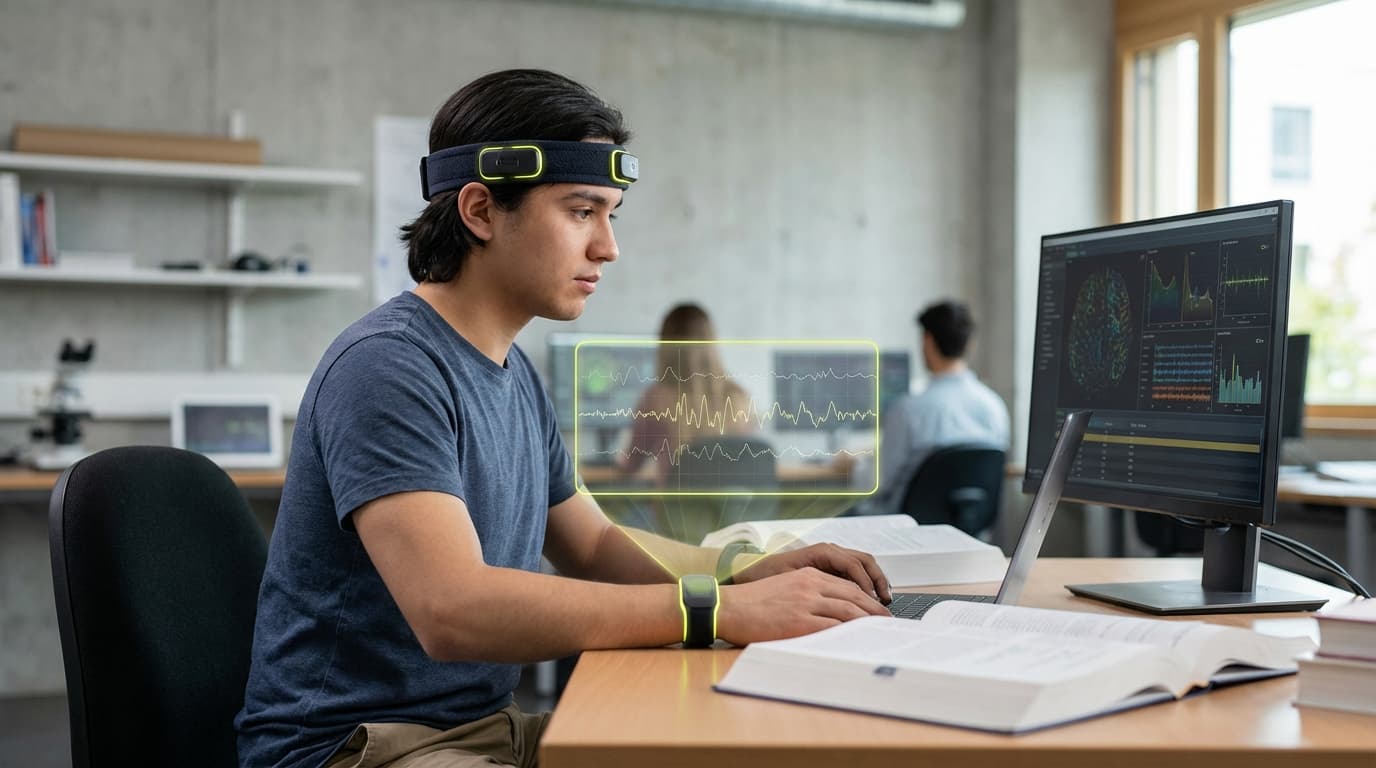
Cognitive-sensing learning devices are wearable technologies—headbands, earbuds, and other form factors—that use multimodal biosignal sensors to measure attention, cognitive load, emotional state, and learning readiness in real-time. These devices integrate lightweight EEG (electroencephalography) sensors, fNIRS (functional near-infrared spectroscopy) for brain oxygenation, eye-tracking for pupil dilation and gaze patterns, heart rate variability monitors, and sometimes galvanic skin response sensors to create comprehensive profiles of cognitive and emotional states. Classroom-scale systems extend this capability with environmental sensors that monitor air quality, lighting, temperature, and noise levels, while computer vision systems track student movement, posture, and collaboration patterns, creating rich datasets about learning environments and individual cognitive states.
This innovation addresses the challenge of understanding and optimizing learning in real-time, where educators and learners currently have limited visibility into cognitive states, attention levels, and environmental factors affecting learning. By providing continuous, objective measurements of cognitive and emotional states, these devices enable adaptive learning systems that can adjust content difficulty, pacing, and presentation based on real-time cognitive load and attention. Companies like Muse, Emotiv, and various educational technology startups are developing these capabilities, with some systems already being tested in research settings and pilot programs.
The technology is particularly significant for personalized and adaptive learning, where understanding individual cognitive states could enable truly responsive educational experiences. As sensors become more accurate, comfortable, and affordable, cognitive sensing could become standard in educational settings. However, ensuring privacy, managing data responsibly, avoiding over-surveillance, and translating measurements into meaningful educational interventions remain important challenges. The technology represents an exciting frontier in educational technology, but requires careful implementation to maximize benefits while protecting student privacy and autonomy.
Related Organizations

Produces EEG headsets and the BCI-OS platform, allowing developers to build applications that respond to cognitive stress and facial expressions.

Creators of the Muse headband, a consumer EEG device used for meditation and cognitive research.

Develops BCI-enabled headphones that detect focus and intent to control digital experiences.

Develops BMI technology including the FocusCalm headband and prosthetic hands.

Home of the Affective Computing research group led by Rosalind Picard.
Creates open-source brain-computer interface tools and the Galea headset (integrating with VR) for researching physiological responses.

Develops semi-dry and dry EEG wearable devices for human behavior research and neurotechnology applications.

Manufacturer of biosensor chips (ThinkGear) and the MindWave headset, enabling low-cost consumer EEG.

The global leader in eye-tracking technology, providing the sensor stack required for dynamic foveated rendering.

HP
United States · Company
Partnering with Google to commercialize Project Starline hardware for enterprise meeting rooms.
Supporting Evidence
Research this in Signals
Signals turns a topic into a sourced research record you can inspect and rerun. Your first scan is free, and this one starts with Cognitive-Sensing Learning Devices already loaded, so edit it or scan as is.