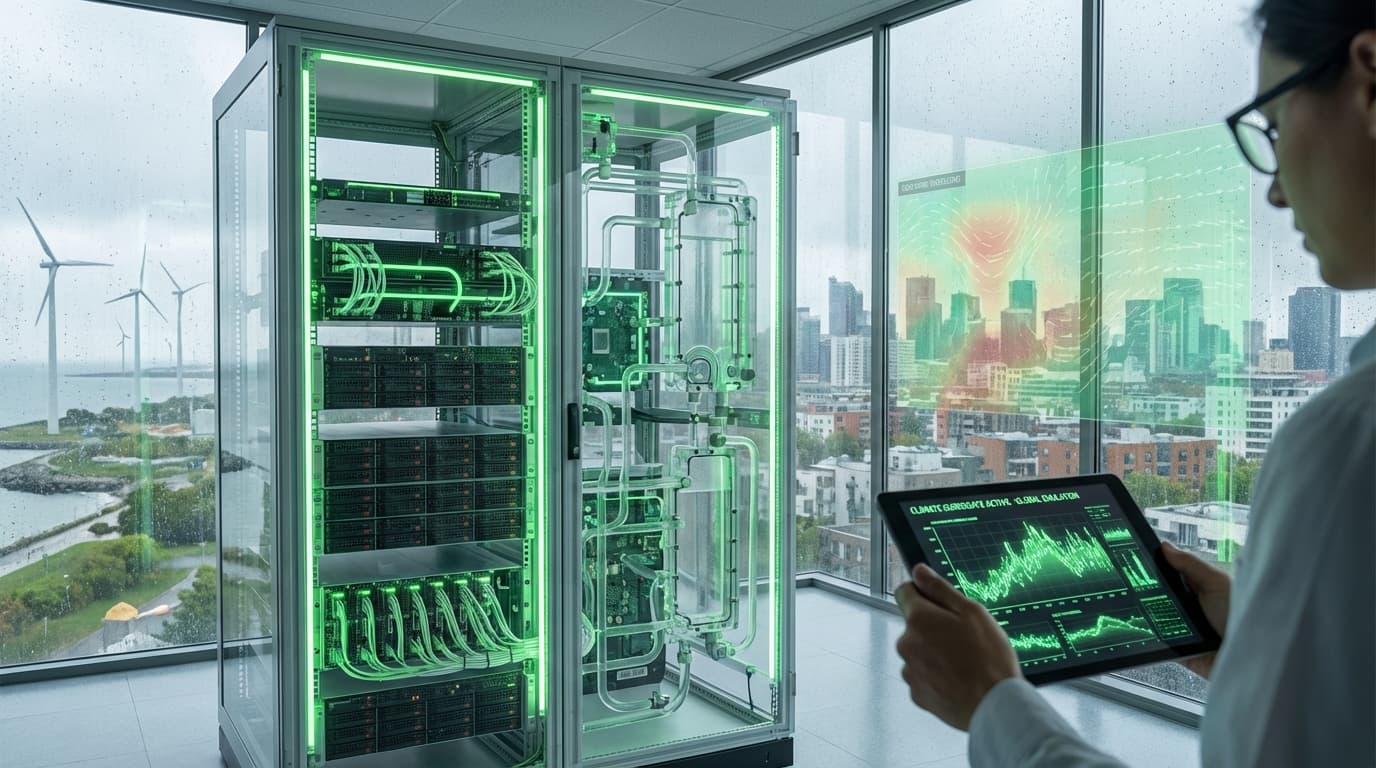
Climate Model Emulators and Surrogates
Machine-learning climate emulators learn the input-output behavior of full Earth system models—temperature, precipitation, ocean currents—by training on petabytes of HPC simulations. Once trained, they run on laptops or cloud GPUs, producing thousands of scenarios in seconds. Developers build neural operators and physics-informed networks that respect conservation laws, while uncertainty quantification layers flag when extrapolation strays beyond the training envelope. Emulators feed interactive scenario tools for planners, allowing them to tweak emissions, aerosols, or land-use assumptions and instantly see localized impacts.
Policymakers use these surrogates to co-design mitigation pathways, utilities stress-test resource plans, and insurance firms embed them into catastrophe models. Because emulators are lightweight, they enable participatory workshops and educational platforms that would be impossible with supercomputer-bound GCMs. They also accelerate parameter tuning for next-gen physical models, acting as differentiable components within hybrid simulations.
Still at TRL 4–5, emulators face skepticism from some scientists who demand transparency, traceability, and bias testing. Initiatives like ClimateBench and ECMWF’s AI4Climate define benchmarks, while open-source projects (FourCastNet, NeuralGCM) publish architectures and weights. As validation frameworks mature, emulators will augment—not replace—physical models, expanding access to high-quality climate intelligence.
Related Organizations
United Kingdom · Consortium
An independent intergovernmental organisation supported by 35 states, actively researching quantum computing applications for numerical weather prediction.

Developers of the Gemini family of models, which are trained from the start to be multimodal across text, images, video, and audio.

Developing foundation models for robotics (Project GR00T) and vision-language models like VILA.

Focuses on supply chain resilience by applying AI to climate models to predict impacts on agriculture and logistics.


Through Copilot and the 'Recall' feature in Windows, Microsoft is integrating persistent memory and agentic capabilities directly into the operating system.

Creator of Semantic Scholar and various open-source models for scientific text processing.

Provides watsonx.governance for managing AI risk and compliance.

Provides climate risk analytics using cloud computing and AI to model extreme weather risks for asset planning.

Operates proprietary radar satellites and uses generative AI ('Gale') for weather intelligence.
Supporting Evidence
Research this in Signals
Signals turns a topic into a sourced research record you can inspect and rerun. Your first scan is free, and this one starts with Climate Model Emulators and Surrogates already loaded, so edit it or scan as is.