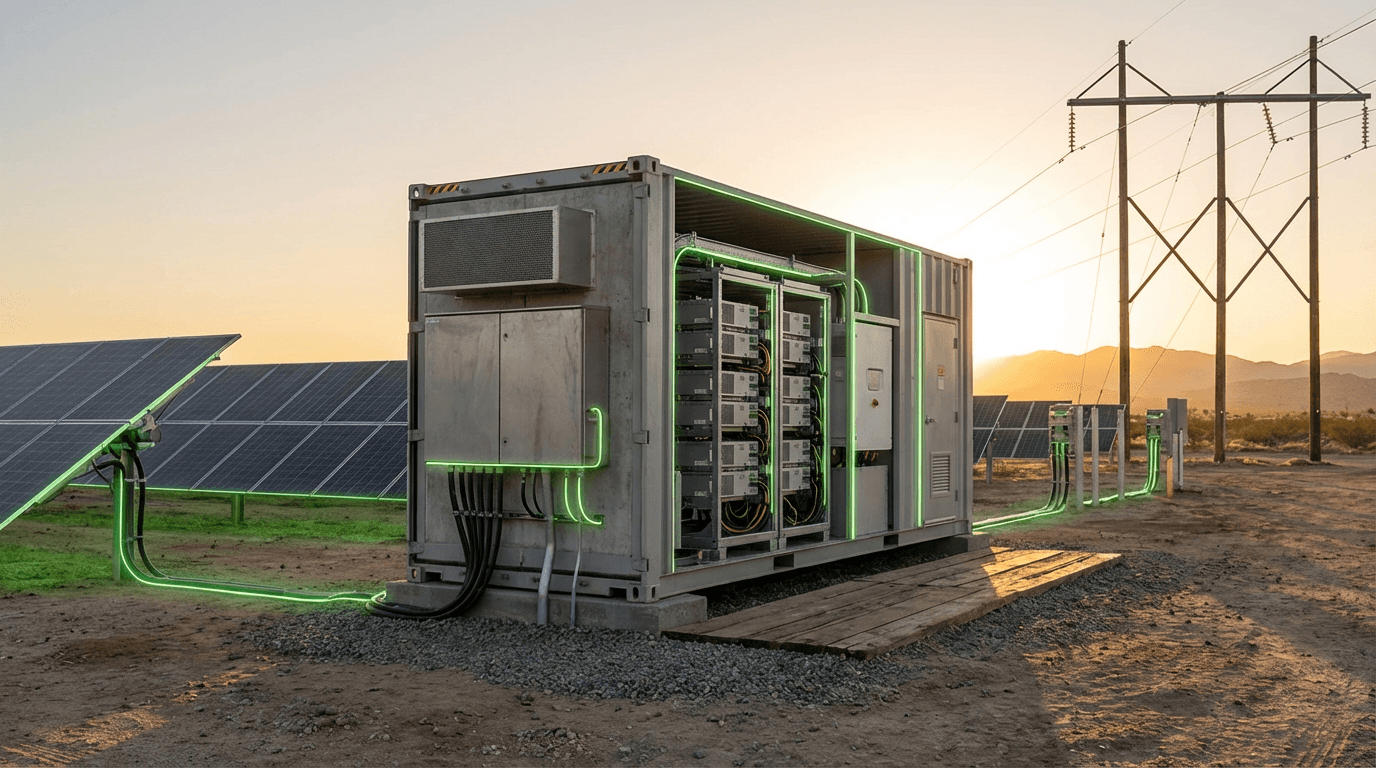
Grid-Forming Inverters
Grid-forming (GFM) inverters behave like virtual synchronous machines: they set voltage and frequency, inject virtual inertia, and ride through faults without relying on spinning mass. Advanced control loops emulate droop characteristics, allowing batteries, solar, and wind plants to keep weak grids stable and even black-start distribution feeders. Manufacturers such as Hitachi Energy, SMA, Tesla, and Fluence now ship firmware upgrades that turn existing power electronics into GFM resources, while HVDC converters and offshore wind substations adopt similar controls.
Regions pushing renewables above 70% instantaneous penetration—Australia’s National Electricity Market, Ireland’s grid, and parts of California—mandate GFM capability to avoid curtailing clean power. Microgrids use GFMs to island communities after hurricanes, and military bases deploy them for resilient power. The technology also underpins future “inverter-dominant” grids where synchronous generators are rare, enabling event ride-through, harmonic damping, and synthetic inertia services previously provided by turbines.
GFM inverters are TRL 6–7; scaling requires updated grid codes, system protection studies, and operator training. Utilities are funding large demonstration projects (UK’s Stability Pathfinder, US DOE’s GFM consortium) to validate performance, while standards (IEEE 2800, ENTSO-E) define testing protocols. As policies reward inertia and fast frequency response, expect grid-forming modes to become a default specification for new storage and renewables plants.
Related Organizations

Maintains the efficiency charts for solar cells and conducts foundational research on perovskite stability.

A leading inverter manufacturer offering grid-forming solutions (e.g., Sunny Central Storage) for island grids and large-scale storage.

Automotive and energy company developing custom AI silicon for autonomous driving.

The energy portfolio of GE (formerly GE Digital), offering Asset Performance Management (APM) software powered by AI.

A global leader in HVDC technology, specifically HVDC Light (VSC), supplying converter stations for major interconnectors worldwide.
China · Company
Global inverter supplier offering storage solutions with virtual synchronous generator (VSG) technology.

Manufactures utility-scale smart inverters designed for energy storage, featuring grid-forming modes.

Manufacturer of solar and storage inverters, supplying equipment for major grid-forming projects (e.g., in Australia and UK).
Supporting Evidence
Research this in Signals
Signals turns a topic into a sourced research record you can inspect and rerun. Your first scan is free, and this one starts with Grid-Forming Inverters already loaded, so edit it or scan as is.