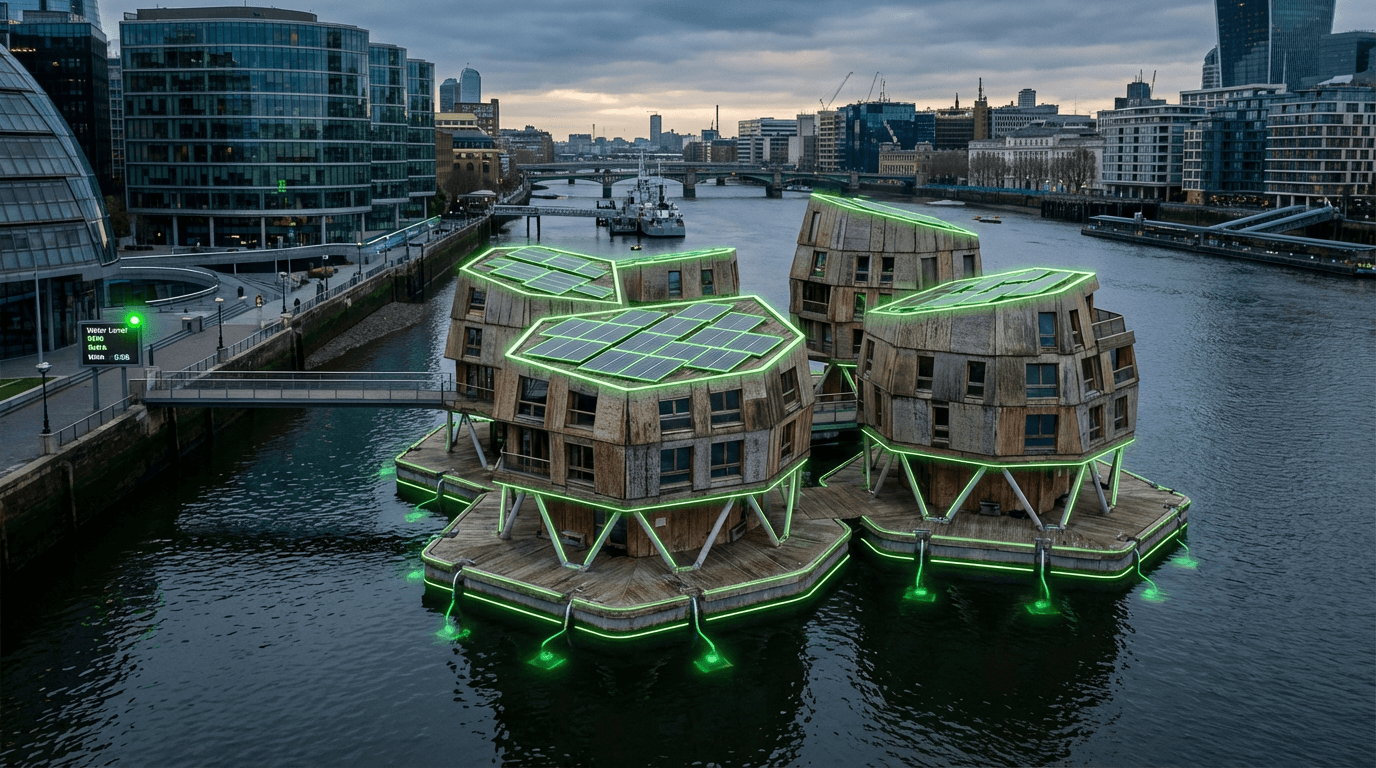
Climate-Adaptive Infrastructure
Climate-adaptive infrastructure uses passive radiative-cooling coatings, phase-change materials, and reflective membranes to keep buildings and streets up to 5–10 °C cooler without energy input. Porous pavements, sponge-city bioswales, and smart stormwater tunnels absorb cloudbursts, while modular floating neighborhoods, amphibious foundations, and elevated microgrids allow coastal communities to ride out sea-level rise. Sensors embedded in bridges, levees, and rail track monitor thermal expansion and scour, triggering predictive maintenance before failures occur.
Cities from Abu Dhabi to Singapore pilot white roofs, high-albedo paving, and heat-resilient transit shelters to protect vulnerable populations. Developers in the Netherlands and Southeast Asia build floating schools, parks, and logistics hubs that can moor near shore or relocate as tides change. Industrial players deploy passive cooling coatings on warehouses and data centers to shave peak load and meet net-zero commitments. Infrastructure funds increasingly include resilience metrics in ROI models, favoring retrofits that extend asset life under extreme weather.
Technology ranges from TRL 6 to 8, but codes and financing must catch up. Insurers are beginning to offer premium discounts for adaptive features, and regulators are updating design standards (ASCE 7-22, EU climate-proofing guidelines). As loss-and-damage costs escalate, climate-adaptive infrastructure will shift from pilot to mandate, reshaping urban design and civil engineering.
Related Organizations

Develops radiative cooling panels that reject heat into deep space, cooling fluids below ambient temperature without electricity.

A blue tech company building floating cities, including a prototype in Busan, South Korea, designed to withstand floods and sea-level rise.
Israel · Startup
Develops a nanotechnological coating that uses anti-Stokes fluorescence to cool surfaces under direct sunlight.

A social enterprise and design firm focused on floating urban development and maritime technology to address climate change.

An architectural firm exclusively dedicated to floating urbanization, designing floating foundations and modular structures for housing and public services.

Engineering consultancy famous for 'Blue-Green Infrastructure' projects in Copenhagen and globally to manage cloudbursts.

Global leader in innovative and sustainable building solutions.

Home to the Manfra Group, which grows the ultra-pure semiconductor nanowires needed for topological qubits.
United States · Company
Produces StreetBond and Cool Community Project initiatives to coat roads with solar-reflective paint.

Supporting Evidence
Research this in Signals
Signals turns a topic into a sourced research record you can inspect and rerun. Your first scan is free, and this one starts with Climate-Adaptive Infrastructure already loaded, so edit it or scan as is.