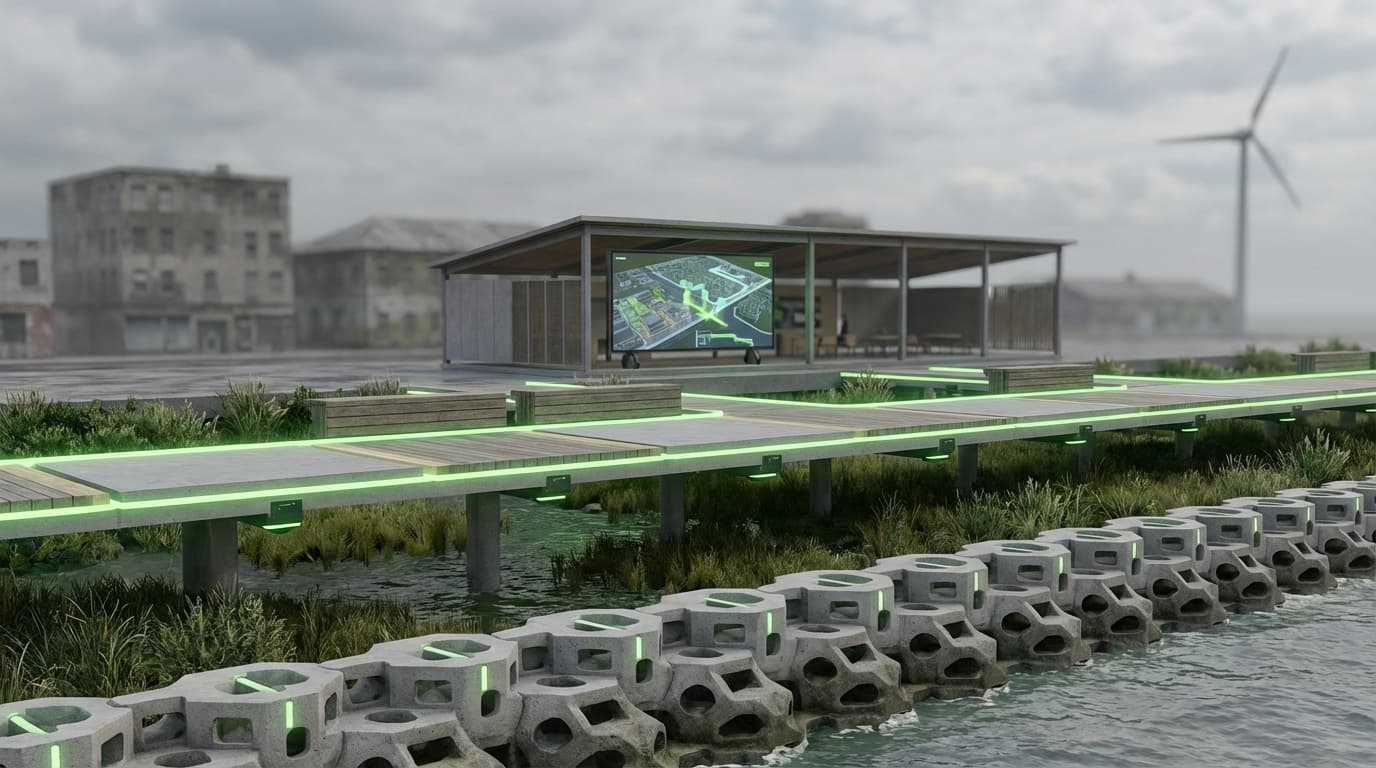
Managed Retreat and Adaptive Urban Design
Managed retreat toolkits integrate hazard maps, property records, cultural heritage surveys, and social vulnerability indices to identify neighborhoods where relocation or redesign is the safest option. Scenario planners combine flood, fire, and heat projections with transportation and employment data to map recipient sites, ensuring residents retain access to livelihoods and services. Modular housing, resilient utilities, and greenfield infrastructure packages help receiving communities absorb newcomers quickly without overloading systems.
Financing models blend federal grants, insurance payouts, community land trusts, and resilience bonds so residents can move before disasters strike, not after. Legal frameworks standardize buyouts, tenant protections, and land swaps, while participatory design processes keep cultural ties intact—memorials, community centers, or co-ops that preserve identity. Cities like Auckland, Rotterdam, New Orleans, and Shishmaref are piloting relocation districts, while Pacific Island nations explore treaty-backed migration pathways.
This field is TRL 4: data exists, but governance, funding, and political will lag. Tool developers work with tribal governments, philanthropy, and multilateral banks to prove replicable models. As climate losses mount, jurisdictions that embrace proactive, justice-centered retreat will avoid chaotic displacement and build safer urban forms.
Related Organizations
United States · Government Agency
State agency overseeing the Coastal Master Plan, which includes structural protection and community relocation/buyouts.
United States · Nonprofit
A collaborative design initiative launched after Hurricane Sandy to develop scalable resilience solutions and policy frameworks.

Federal agency responsible for public engineering, including flood risk management and large-scale coastal adaptation projects.

Global infrastructure firm providing climate adaptation planning, coastal resilience engineering, and relocation strategies.
Arup
United Kingdom · Company
A multinational professional services firm dedicated to sustainable development, known for pioneering the use of BIM in complex engineering projects.

Administers grants (BRIC, HMGP) that fund property acquisitions (buyouts) and community resilience projects.

Nonprofit research group that makes climate risk data (Risk Factor) publicly available for every property in the US.
United States · Company
Design firm specializing in nature-based infrastructure and adaptive landscape design (e.g., Living Breakwaters).

Science and news organization providing open tools like Surging Seas to visualize sea-level rise impact.

Engineering consultancy famous for 'Blue-Green Infrastructure' projects in Copenhagen and globally to manage cloudbursts.
Supporting Evidence
Research this in Signals
Signals turns a topic into a sourced research record you can inspect and rerun. Your first scan is free, and this one starts with Managed Retreat and Adaptive Urban Design already loaded, so edit it or scan as is.