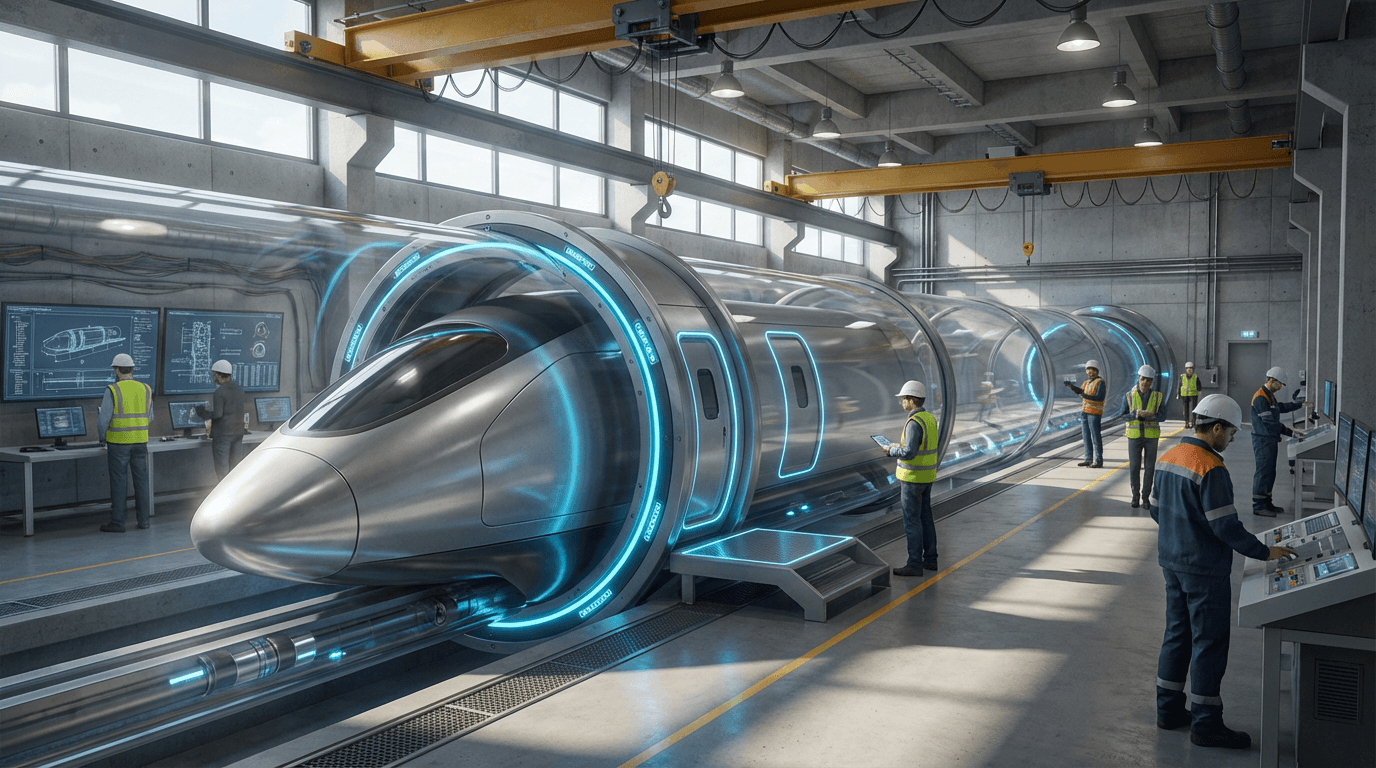
Hyperloop Corridors
The fundamental challenge facing modern intercity travel lies in the trade-off between speed, energy efficiency, and environmental impact. Traditional high-speed rail, while effective, remains constrained by air resistance and friction, limiting maximum velocities to around 300-350 km/h. Aviation offers greater speed but carries significant carbon costs and requires extensive airport infrastructure located far from city centers. Hyperloop corridors represent a paradigm shift in ground transportation, utilizing sealed low-pressure tubes to dramatically reduce air resistance while magnetic levitation eliminates mechanical friction. Passenger or cargo pods travel through these near-vacuum environments, theoretically reaching speeds exceeding 1,000 km/h. The system combines linear induction motors for propulsion with passive magnetic levitation, creating a transportation mode that promises the speed of air travel with the directness and energy efficiency of rail. The low-pressure environment—maintained at approximately 1/1000th of atmospheric pressure—allows pods to move with minimal drag, while the tube infrastructure protects the system from weather disruptions that commonly affect both aviation and conventional rail.
For the tourism and travel industry, hyperloop corridors address several critical pain points that have long constrained regional connectivity and destination accessibility. The technology promises to transform journey times between major metropolitan areas, potentially reducing trips that currently take three to four hours by conventional rail to under an hour. This compression of travel time could fundamentally alter tourism patterns, making day trips feasible across distances that previously required overnight stays and enabling travelers to access multiple destinations within a single vacation itinerary. The system's potential for frequent departures—similar to metro systems rather than traditional intercity rail schedules—could eliminate the rigid planning constraints that currently shape long-distance travel. Additionally, because hyperloop stations can be integrated directly into urban centers rather than requiring the extensive land footprints of airports, the technology promises true city-center to city-center connectivity, eliminating the time penalties associated with airport access and security procedures that often negate the speed advantages of short-haul flights.
Several test tracks and development programs have emerged globally, though full-scale commercial deployment remains in the pilot and demonstration phase. Early test facilities have successfully demonstrated core technical principles, including magnetic levitation in low-pressure environments and pod acceleration systems. Industry analysts note that the most promising near-term applications may focus on high-traffic corridors between major economic centers where existing infrastructure is saturated and land acquisition for conventional rail expansion proves prohibitively expensive. Research suggests that routes connecting airport hubs, seaports, and urban centers could provide initial proving grounds for the technology while delivering immediate value to freight and business travel markets. The broader trajectory of hyperloop development intersects with growing pressure to decarbonize transportation sectors and reduce short-haul aviation, positioning these systems as potential cornerstones of sustainable regional mobility networks. As urban populations concentrate in megacity regions and tourism demand continues growing, hyperloop corridors represent a forward-looking response to the dual imperatives of connectivity and environmental responsibility, potentially reshaping how travelers conceptualize distance and accessibility in the coming decades.
Related Organizations

European hyperloop technology company focusing on the European Hyperloop Center.

A research program at the Technical University of Munich developing a full-scale hyperloop demonstrator.
China Aerospace Science and Industry Corporation (CASIC)
China · Government Agency
A state-owned enterprise that designs, develops, and manufactures a range of spacecraft, launch vehicles, and defense systems.

A crowd-powered company developing hyperloop transportation systems.

South Korea's national railway research body.

Developing the TransPod Line, a new tube-transportation system to connect cities.

Spanish hyperloop company developing a scalable system with integrated propulsion.

Foundation for the development of vacuum transport technology.

Develops MagRail technology inspired by hyperloop, capable of running on existing railway tracks.

Focuses on developing energy-efficient hyperloop capsules and infrastructure.
Supporting Evidence
Research this in Signals
Signals turns a topic into a sourced research record you can inspect and rerun. Your first scan is free, and this one starts with Hyperloop Corridors already loaded, so edit it or scan as is.