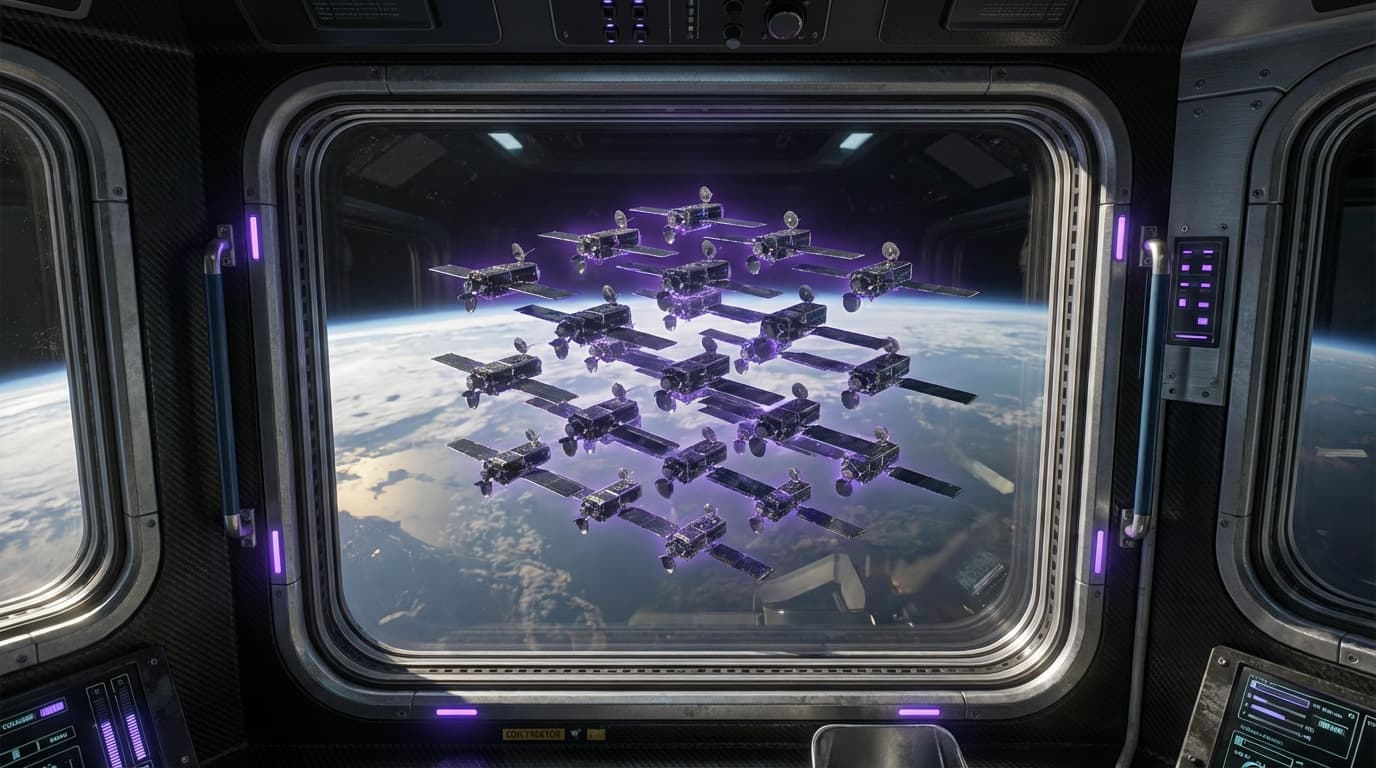
Swarm Coordination Protocols
Swarm coordination protocols provide networking and control software that enables groups of satellites, rovers, or drones to work together as coordinated formations, managing relative navigation, shared sensing, distributed decision-making, and fault tolerance. These systems allow swarms to maintain formation, share information, and coordinate actions even with intermittent communication, creating capabilities that exceed what individual vehicles can achieve alone.
This innovation addresses the challenge of coordinating multiple autonomous vehicles in space or on planetary surfaces, where communication may be limited and vehicles must work together to achieve mission objectives. By enabling distributed coordination, these protocols allow swarms to perform tasks like distributed sensing, coordinated mapping, or collaborative construction that require multiple vehicles working together. The technology is being developed for applications including satellite constellations, lunar rover teams, and inspection drone swarms.
The technology is particularly valuable for missions requiring distributed sensing or coordinated action, where multiple vehicles can provide capabilities that exceed individual systems. As space missions become more ambitious and require larger-scale operations, swarm coordination becomes essential. However, ensuring reliable coordination, managing communication constraints, and handling failures gracefully remain challenging. The technology represents an important capability for future space operations, enabling new mission concepts that leverage distributed systems.
Related Organizations

Conducts advanced demonstrations like LCRD (Laser Communications Relay Demonstration) and DSOC (Deep Space Optical Comm).

Academic lab focused on distributed space systems, formation flying, and autonomous relative navigation algorithms.

Develops nanosatellite platforms and has executed missions (GOMX-4) demonstrating inter-satellite links and formation flying.

A developer of active phased array communication systems for space.

Manufactures small satellite buses, including configurations adapted for high-drag VLEO missions.

Manufactures laser communication terminals for air, space, and mobile applications.

Major manufacturer for the Space Development Agency's transport layer, involving massive mesh-networked satellite formations.

Developer of 360 Reality Audio (360RA), an object-based spatial audio format used in live music broadcasting and streaming.

An Indian space technology company offering full-stack space engineering solutions.
Supporting Evidence
Research this in Signals
Signals turns a topic into a sourced research record you can inspect and rerun. Your first scan is free, and this one starts with Swarm Coordination Protocols already loaded, so edit it or scan as is.