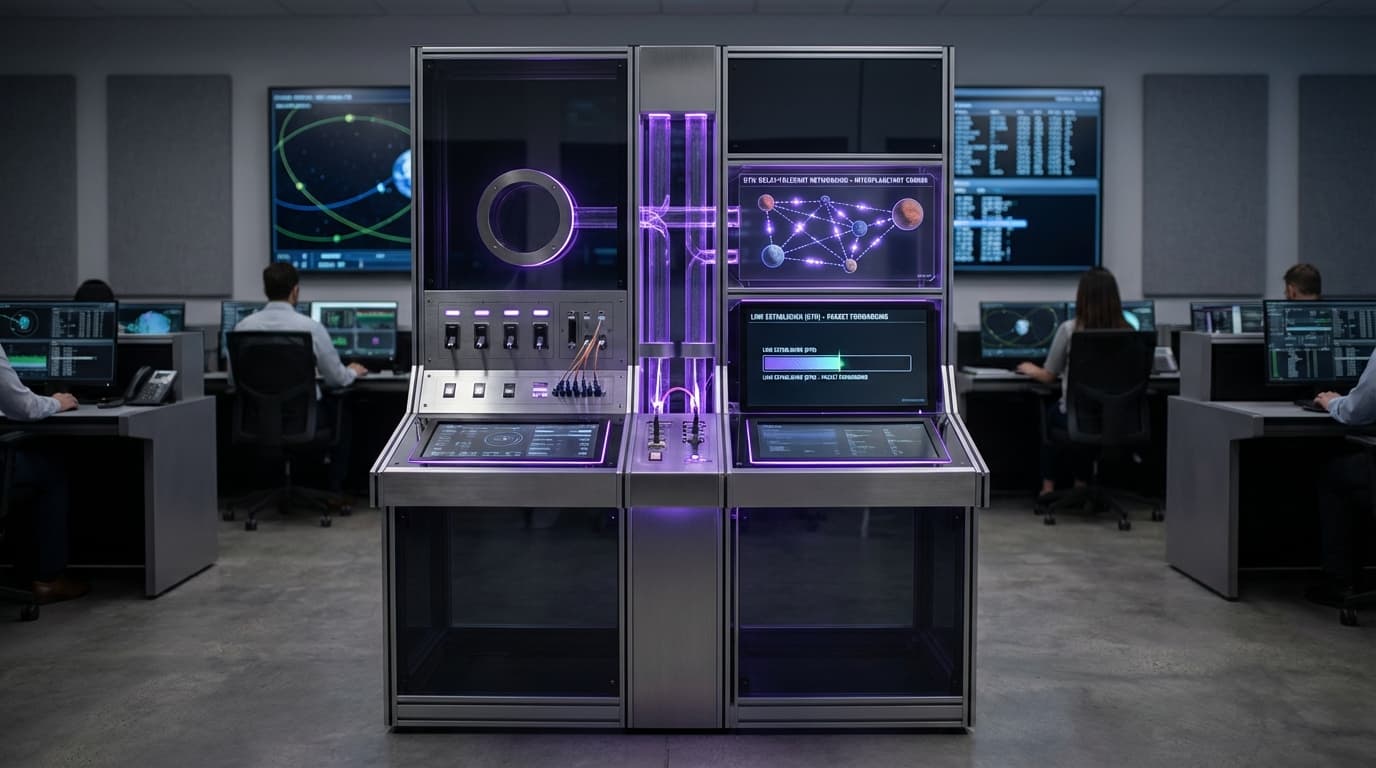
Interplanetary Comms Routing
Interplanetary communications routing uses delay-tolerant networking (DTN) protocols designed to handle the unique challenges of deep-space communication, including significant time delays (minutes to hours), intermittent connectivity, and high error rates. These systems use store-and-forward techniques, autonomous routing, and robust error correction to ensure reliable data transmission across interplanetary distances, enabling communication networks that can span from Earth to Mars and beyond.
This innovation addresses the fundamental challenge of interplanetary communication, where traditional internet protocols fail due to long delays and intermittent connectivity. By using delay-tolerant networking, these systems can route data through multiple relay nodes, store messages when connections are unavailable, and ensure delivery despite disruptions. The technology is essential for enabling communication networks that support human exploration and robotic missions throughout the solar system.
The technology is becoming essential infrastructure for interplanetary exploration, enabling communication networks that can support missions to Mars, the Moon, and beyond. As human exploration expands and missions become more distributed, reliable interplanetary communication becomes critical. The technology enables new mission concepts including distributed sensor networks, relay constellations, and coordinated multi-planet operations. However, ensuring reliability, managing routing complexity, and optimizing for the unique constraints of space communication remain ongoing challenges.
Related Organizations

Developed and operates the EMIT (Earth Surface Mineral Dust Source Investigation) hyperspectral instrument on the ISS.

An international organization developing standards for space data handling, including the Bundle Protocol for DTN.

A startup building 'SOLNET', a high-data-rate interplanetary communication network.

Leads the EAGLE-1 mission and the SAGA program to build a European quantum communication infrastructure in space.

Spun out of Google's Project Loon, they develop 'Spacetime', a software platform for orchestrating complex mesh networks in space.

The national aeronautics and space research center of Germany.

Designs and operates missions like Parker Solar Probe and STEREO that provide fundamental space weather data.

Provides secure content delivery software including Fazzt, which supports reliable multicasting over satellite.

A global networking leader that coined the term IoE, providing the infrastructure connecting people, data, and things.
Supporting Evidence
Research this in Signals
Signals turns a topic into a sourced research record you can inspect and rerun. Your first scan is free, and this one starts with Interplanetary Comms Routing already loaded, so edit it or scan as is.