Satellite Swarm Coordination
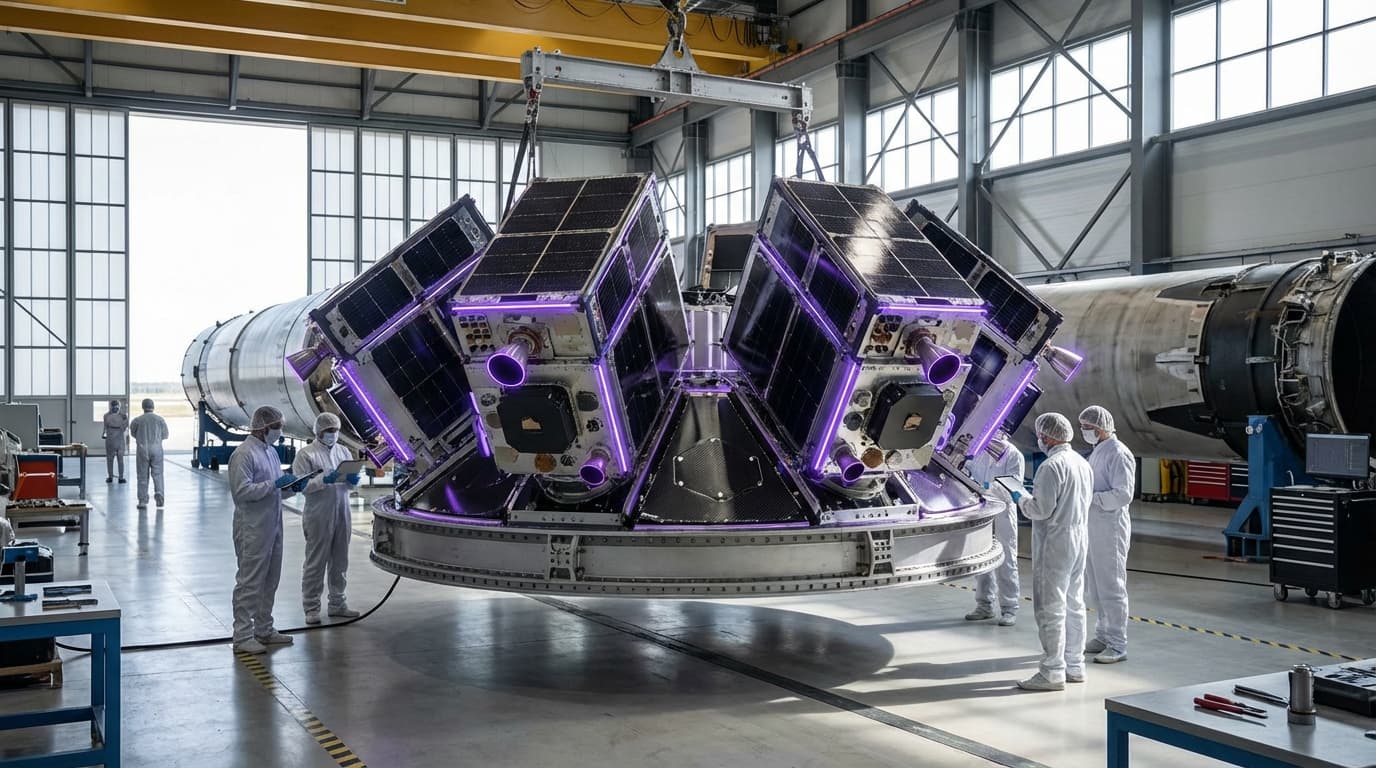
Satellite swarm coordination systems enable groups of satellites to operate as coordinated formations, sharing information, synchronizing actions, and working together to achieve mission objectives that exceed individual capabilities. These distributed autonomy frameworks allow swarms to perform shared sensing, cooperative mapping, synchronized maneuvers, and distributed decision-making, creating capabilities like synthetic aperture radar, distributed telescopes, or coordinated coverage patterns.
This innovation addresses the challenge of coordinating multiple satellites to work together effectively, where traditional approaches treat each satellite independently. By enabling swarm coordination, these systems unlock new mission concepts including distributed sensing, coordinated coverage, and collaborative operations that can provide capabilities impossible with individual satellites. The technology is being developed for applications in earth observation, telecommunications, and scientific missions.
The technology is particularly valuable for missions requiring distributed sensing or coordinated action, where multiple satellites can provide capabilities that exceed individual systems. As satellite constellations grow and missions become more ambitious, swarm coordination becomes essential for maximizing the value of large satellite fleets. However, ensuring reliable coordination, managing communication constraints, and handling failures gracefully remain challenging. The technology represents an important capability for future space operations, enabling new mission concepts that leverage distributed systems.
Related Organizations

Conducts advanced demonstrations like LCRD (Laser Communications Relay Demonstration) and DSOC (Deep Space Optical Comm).

The world's largest satellite constellation operator.

Leads the EAGLE-1 mission and the SAGA program to build a European quantum communication infrastructure in space.
Stanford Space Rendezvous Laboratory
United States · University
A research lab at Stanford University focused on distributed space systems.

A developer of active phased array communication systems for space.

Operates the Tanager constellation (hyperspectral) in partnership with Carbon Mapper.

A company providing satellite constellations as a service (CaaS).

A vertically integrated geospatial company that includes hyperspectral capabilities in its satellite fleet.

An Indian space technology company offering full-stack space engineering solutions.
Supporting Evidence
Research this in Signals
Signals turns a topic into a sourced research record you can inspect and rerun. Your first scan is free, and this one starts with Satellite Swarm Coordination already loaded, so edit it or scan as is.