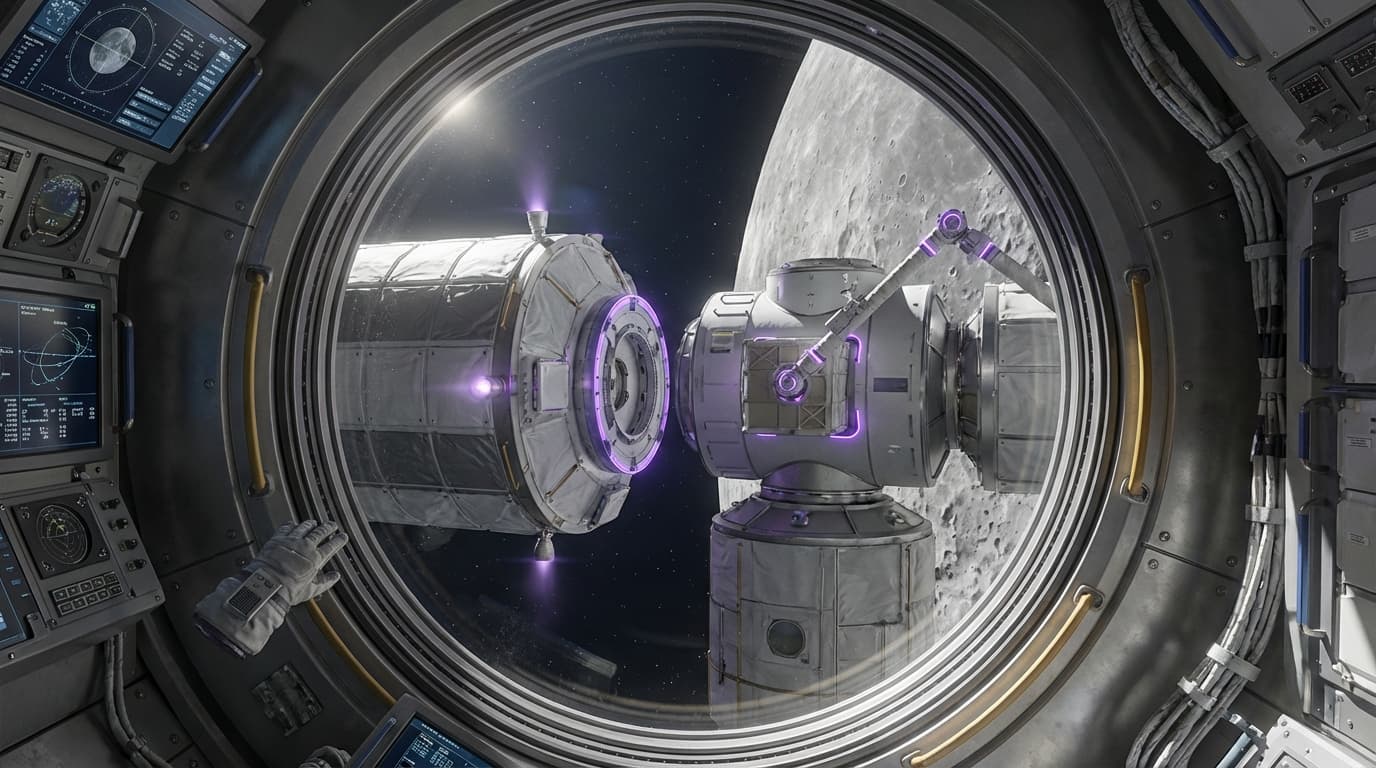
Lunar Gateway Modules
Lunar Gateway is an international space station in near-rectilinear halo orbit (NRHO) around the Moon, built through collaboration between NASA, ESA, JAXA, CSA, and other partners. The Gateway consists of multiple modules including pressurized habitats for crew, power and propulsion elements, docking ports, and logistics modules, serving as a staging point for lunar surface missions, a platform for scientific research, and a testbed for technologies needed for future Mars missions.
This innovation addresses the need for infrastructure in cislunar space to support sustainable lunar exploration and serve as a stepping stone for deeper space exploration. The Gateway provides a base for crewed missions to the lunar surface, enables scientific research in lunar orbit, and tests technologies and operations concepts needed for Mars missions. The international collaboration model demonstrates how complex space infrastructure can be built through partnerships.
The Gateway represents a new paradigm in space exploration, where permanent infrastructure in deep space enables sustained exploration rather than one-off missions. As the Gateway is built and becomes operational, it will enable new mission concepts, support lunar surface operations, and serve as a proving ground for Mars exploration technologies. However, the Gateway faces challenges including cost, complexity, and questions about its necessity versus direct-to-surface approaches. The technology represents an important step toward sustainable deep-space exploration, but its ultimate value will depend on how effectively it enables lunar and Mars missions.
Related Organizations
Leads the EAGLE-1 mission and the SAGA program to build a European quantum communication infrastructure in space.

Provides high-resolution Earth imagery and geospatial analytics.

Major defense contractor developing Reciprocal Quantum Logic (RQL) for cryogenic computing.

A major European satellite manufacturer leading the ASCEND feasibility study.

Developing Canadarm3, the robotic system for the Lunar Gateway.


Leading long-term research into SBSP, with plans to demonstrate power transmission from orbit by 2025.

The prime contractor for the European Robotic Arm (ERA) currently on the ISS.


Contracted by JAXA to develop the HTV-X cargo vehicle which will supply Gateway.
Supporting Evidence
Research this in Signals
Signals turns a topic into a sourced research record you can inspect and rerun. Your first scan is free, and this one starts with Lunar Gateway Modules already loaded, so edit it or scan as is.