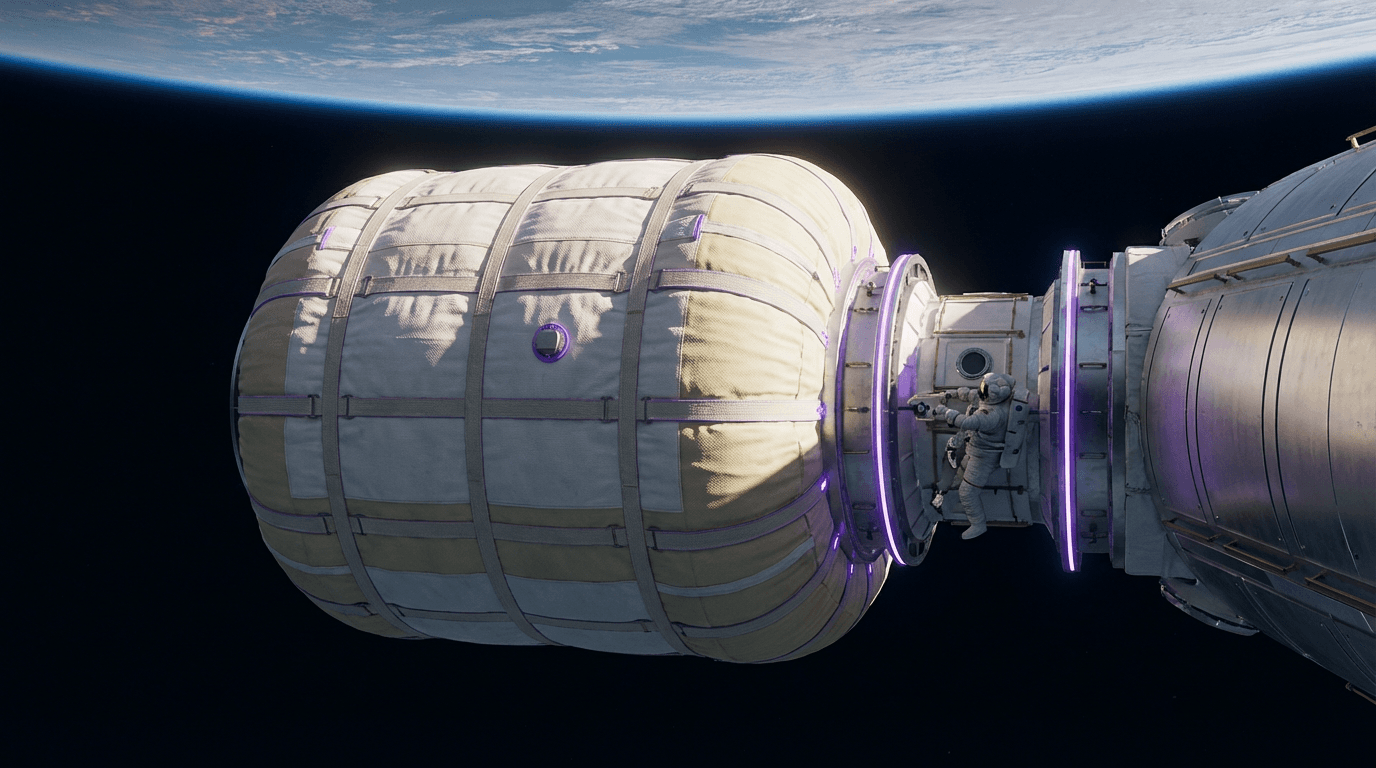
Inflatable Softgoods Habitats
Inflatable softgoods habitats are expandable habitation modules constructed from multi-layer flexible materials including Kevlar, Vectran, and other high-strength fabrics that can be launched in compact form and inflated on orbit to create large pressurized volumes. These structures offer significantly higher habitable volume-to-mass ratios than traditional rigid metal modules, providing more living space for the same launch mass, while the multi-layer construction provides superior protection against micrometeoroids and radiation compared to single-wall structures.
This innovation addresses the fundamental constraint of launch vehicle fairing sizes, which limit the size of rigid modules that can be launched. By using inflatable structures, these habitats can provide much larger living spaces than would be possible with rigid modules, improving crew comfort and mission capabilities. Bigelow Aerospace demonstrated this technology with the BEAM module on the ISS, and the concept is being developed for future space stations and planetary surface habitats.
The technology is particularly valuable for long-duration missions where crew comfort and living space are important, and for applications where launch mass is constrained. As space stations and planetary habitats are developed, inflatable modules could provide cost-effective ways to create large habitable volumes. However, the technology faces challenges including long-term durability, maintaining pressure integrity, and ensuring adequate protection against space hazards. The technology represents an important approach to creating space habitats, but requires continued development and validation to ensure long-term reliability and safety.
Related Organizations
ILC Dover
United States · Company
Specializes in high-performance flexible materials and softgoods, including space suits and inflatable habitat structures.

Developing the Dream Chaser spaceplane and LIFE habitats to support commercial space activities including manufacturing.

Startup developing scalable inflatable space habitats that aim to maximize volume while minimizing launch mass and cost.

Conducts advanced demonstrations like LCRD (Laser Communications Relay Demonstration) and DSOC (Deep Space Optical Comm).

A major European satellite manufacturer leading the ASCEND feasibility study.

Specializes in deployable fabric structures and inflatable habitats/shields for space applications.
Leads the EAGLE-1 mission and the SAGA program to build a European quantum communication infrastructure in space.

Developing 'EuroHab', an inflatable lunar habitat designed to sit on a lander, providing secondary habitation for astronauts.

Supporting Evidence
Research this in Signals
Signals turns a topic into a sourced research record you can inspect and rerun. Your first scan is free, and this one starts with Inflatable Softgoods Habitats already loaded, so edit it or scan as is.