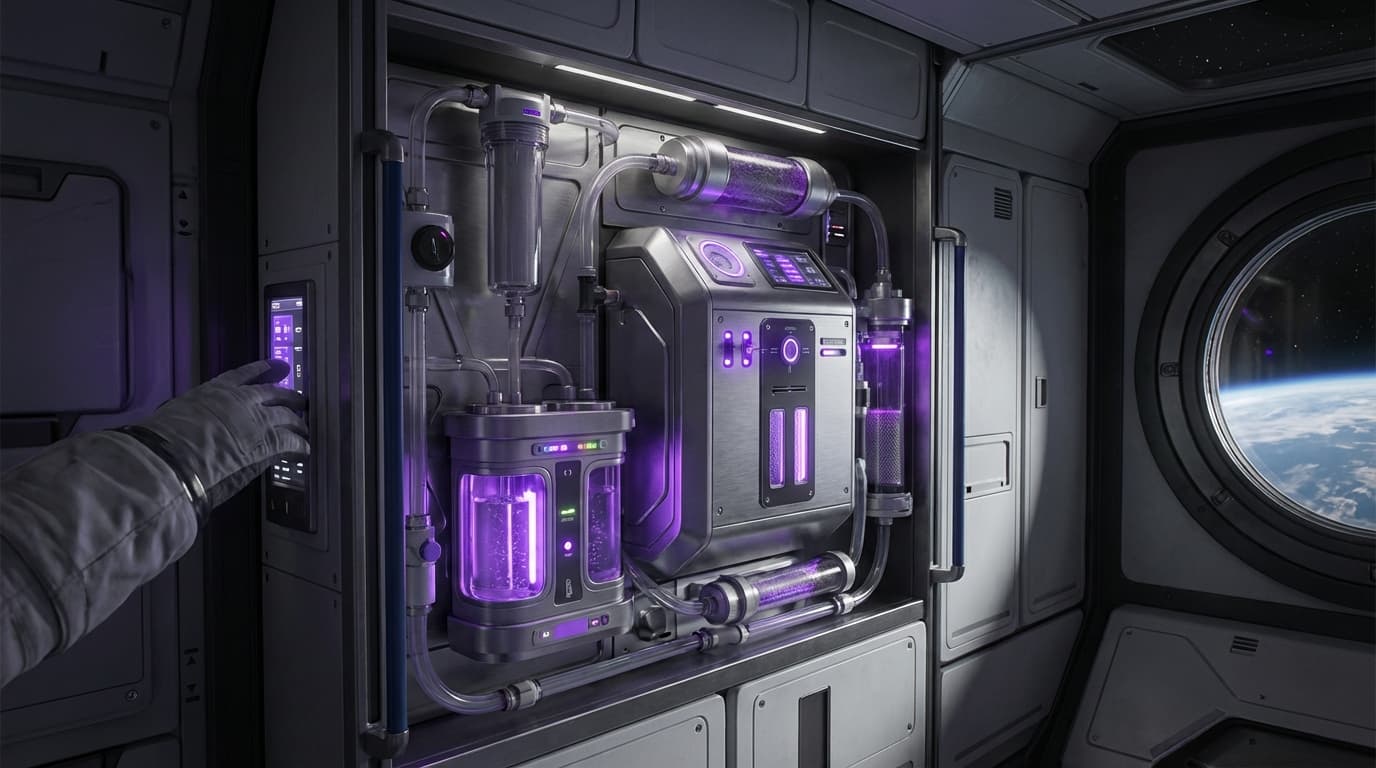
Closed-Loop Life Support Systems
Closed-loop life support systems are advanced Environmental Control and Life Support Systems (ECLSS) that recycle air, water, and waste to minimize or eliminate the need for resupply from Earth. These systems combine physico-chemical processes (like CO2 scrubbing, water purification, and waste processing) with bioregenerative subsystems (using plants or algae to produce oxygen and food) to create sustainable life support that can operate for extended periods without external inputs. The technology is critical for multi-year deep-space missions and permanent habitats on the Moon and Mars where resupply is impractical or impossible.
This innovation addresses the fundamental challenge of sustaining human life in space, where traditional approaches require continuous resupply of consumables from Earth, which becomes impractical for long-duration missions or distant destinations. By recycling resources, closed-loop systems dramatically reduce resupply requirements and enable missions that would be impossible otherwise. The ISS has demonstrated some closed-loop capabilities, and more advanced systems are being developed for future missions.
The technology is essential for enabling long-term human presence in space, where closed-loop life support becomes the foundation for sustainable space settlement. As missions extend to months or years and destinations become more distant, regenerative life support becomes critical. However, the technology faces challenges including system complexity, reliability over long periods, and the difficulty of achieving high recycling rates. The technology represents a fundamental capability for space exploration, but requires continued development to achieve the reliability and efficiency needed for long-duration missions. Success could enable sustainable human presence in space and serve as a model for resource management in closed environments.
Related Organizations

Leads the EAGLE-1 mission and the SAGA program to build a European quantum communication infrastructure in space.

A premier supplier of environmental control and life support systems (ECLSS).

Collins Aerospace
United States · Company
A major aerospace and defense contractor, a subsidiary of RTX Corporation.

The national aeronautics and space research center of Germany.

A global leader in industrial technology and aerospace manufacturing.

Developing the Dream Chaser spaceplane and LIFE habitats to support commercial space activities including manufacturing.

A major European satellite manufacturer leading the ASCEND feasibility study.

A company providing science, technology, and engineering solutions to governments and companies.
Supporting Evidence
Research this in Signals
Signals turns a topic into a sourced research record you can inspect and rerun. Your first scan is free, and this one starts with Closed-Loop Life Support Systems already loaded, so edit it or scan as is.