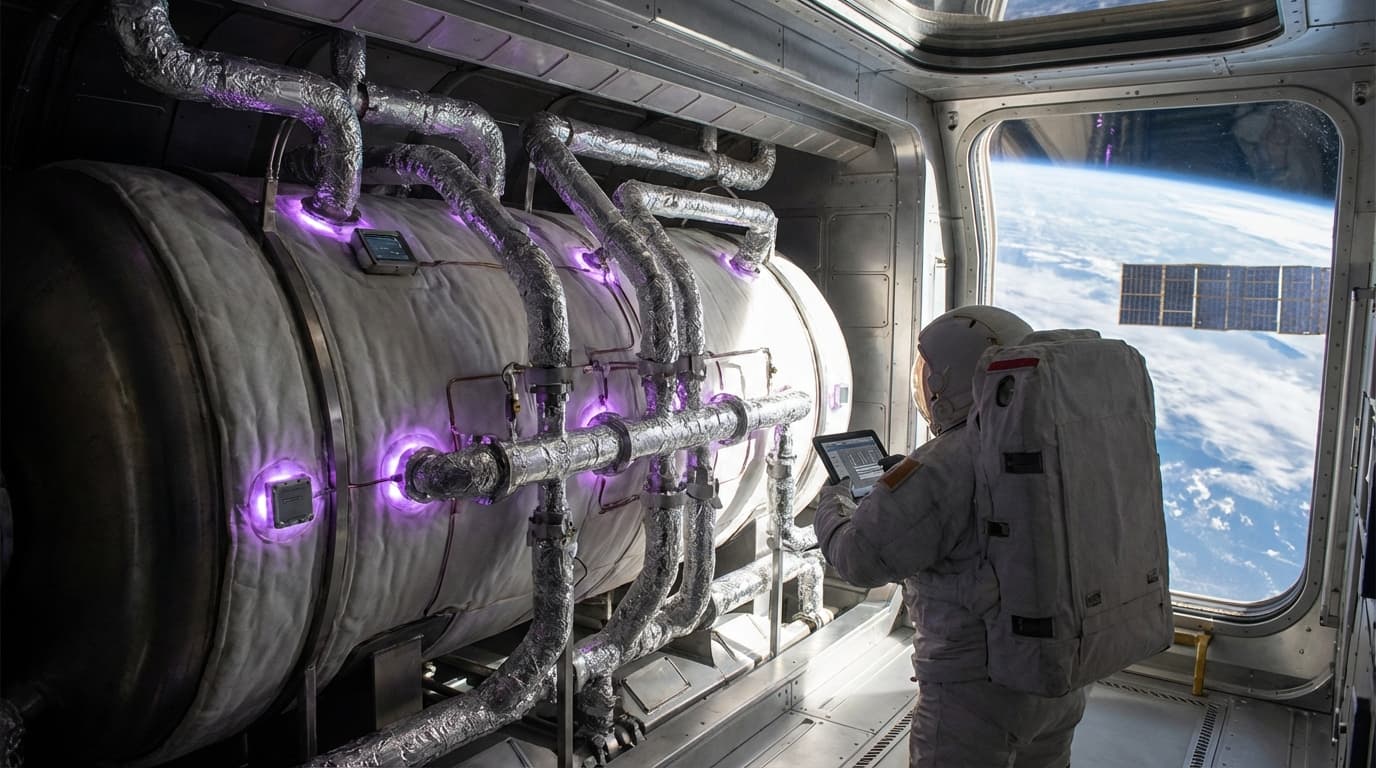
Zero-Boil-Off Cryogenic Storage
Zero-boil-off cryogenic storage systems use advanced cryocoolers, active thermal management, and sophisticated thermal shielding to prevent the evaporation of cryogenic propellants like liquid hydrogen and liquid oxygen over extended periods. Traditional cryogenic storage systems lose propellant through boil-off as heat leaks into the tanks, but zero-boil-off systems actively remove heat to maintain propellant temperature, eliminating losses. This capability is essential for long-duration deep space missions, nuclear thermal propulsion systems that require large amounts of cryogenic propellant, and in-situ resource utilization depots that must store propellant for extended periods.
This innovation addresses the fundamental challenge of storing cryogenic propellants in space, where even small heat leaks cause continuous boil-off that depletes propellant over time. For long-duration missions or propellant depots, this loss can be mission-critical. By eliminating boil-off, zero-boil-off systems enable missions and architectures that require long-term propellant storage. NASA and other organizations are developing these systems for applications including Mars missions and propellant depots.
The technology is essential for enabling long-duration deep space missions and sustainable space architectures where propellant must be stored for months or years. As space exploration expands and includes concepts like propellant depots and long-duration missions, zero-boil-off storage becomes critical. However, the technology faces challenges including power requirements for cryocoolers, system complexity, and reliability over long periods. The technology represents an important capability for future space missions, but requires continued development to ensure it can operate reliably for the extended periods needed for deep space exploration.
Related Organizations

Conducts advanced demonstrations like LCRD (Laser Communications Relay Demonstration) and DSOC (Deep Space Optical Comm).

Specializes in Cryogenic Fluid Management (CFM) systems and is developing the LOXSAT propellant depot demonstrator.


Deploys optical inter-satellite links (lasers) on Starlink satellites to reduce latency and ground station dependence.

Partnered with NASA to flight test LOFTID on an Atlas V rocket and studies engine recovery via inflatables.

World leader in gases, technologies, and services for industry and health.

Ball Aerospace (BAE Systems)
United States · Company
Manufacturer of spacecraft, components, and instruments (now part of BAE Systems).

Major defense contractor developing Reciprocal Quantum Logic (RQL) for cryogenic computing.

Engineering company specializing in composite cryogenic technology.

Supporting Evidence
Research this in Signals
Signals turns a topic into a sourced research record you can inspect and rerun. Your first scan is free, and this one starts with Zero-Boil-Off Cryogenic Storage already loaded, so edit it or scan as is.