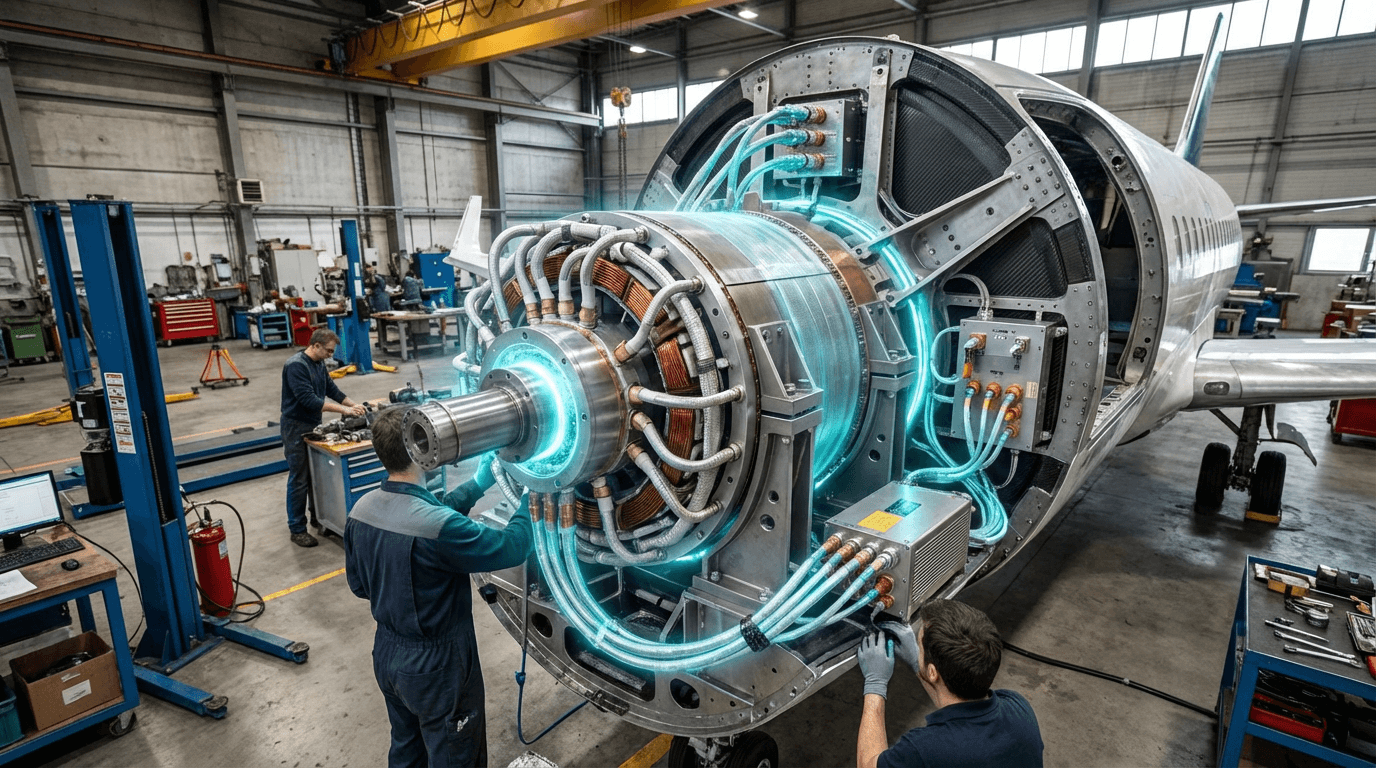
Superconducting Electric Motors & Generators
Superconducting electric motors and generators represent a fundamental shift in how electrical machines can be designed for aerospace propulsion. Unlike conventional copper-wound motors that generate significant heat through electrical resistance, superconducting machines use materials that, when cooled below a critical temperature, conduct electricity with zero resistance. This is typically achieved using high-temperature superconductors (HTS) such as rare-earth barium copper oxide (REBCO) or yttrium barium copper oxide (YBCO), which operate at cryogenic temperatures around 20-77 Kelvin. The elimination of resistive losses allows these machines to carry far higher current densities through their windings, producing dramatically stronger magnetic fields in a much smaller physical package. The result is power density improvements of 5-10 times compared to conventional motors, meaning a superconducting motor capable of producing several megawatts of power can weigh hundreds of kilograms less than its traditional counterpart.
This technology directly addresses one of the most significant barriers to electrifying large aircraft: the weight penalty of conventional electric propulsion systems. For regional jets and larger aircraft requiring multi-megawatt propulsion, traditional electric motors become prohibitively heavy, making hybrid-electric or fully electric configurations impractical. Superconducting machines break through this limitation, enabling hybrid-electric architectures where gas turbines generate electricity that drives superconducting motors, or turbo-electric configurations where multiple distributed propulsors are powered by centralized generators. This opens pathways to more efficient propulsion arrangements, such as boundary layer ingestion fans or distributed propulsion systems that would be impossible with conventional electric machines. The technology also enables new thermal management strategies, as the waste heat from gas turbines can potentially be redirected to useful purposes rather than simply expelled, improving overall system efficiency.
Research programs at major aerospace manufacturers and national laboratories are actively developing superconducting propulsion systems, with ground demonstrations of megawatt-class motors already completed. However, significant engineering challenges remain before commercial deployment. The cryogenic cooling systems required to maintain superconducting temperatures add weight and complexity, partially offsetting the mass savings from the motors themselves. Current research focuses on developing lighter, more efficient cryocoolers, improving thermal insulation systems that can withstand the vibration and thermal cycling of flight operations, and understanding how superconducting machines behave during electrical faults or sudden load changes. Integration with aircraft thermal management systems presents additional complexity, as the cryogenic cooling loops must coexist with conventional environmental control systems and avionics cooling. Despite these challenges, industry analysts note that superconducting propulsion remains one of the most promising pathways toward electrifying aircraft in the 1-5 megawatt power range, with potential applications in regional aircraft and military transport platforms emerging within the next decade as cryocooler technology matures and system integration challenges are resolved.
Related Organizations

Partner in the EuroQCI initiative, working on the space segment of the European quantum communication infrastructure.

Leads the SABERS (Solid-state Architecture Batteries for Enhanced Rechargeability and Safety) project.

World-leading provider of jet and turboprop engines.

Developing the K-RACER, a heavy-lift unmanned helicopter for logistics.

A major researcher and developer of QKD technology, holding numerous patents and deploying commercial QKD networks.

Home to artist-academic Ben Grosser, creator of 'Go Rando', a tool that obfuscates Facebook emotional profiling by randomizing reactions.

Advanced Magnet Lab (AML)
United States · Company
Specializes in advanced superconducting magnet technologies and applications.

Energy technologies company specializing in superconductor wire and coil technology.

A global leader in the production of Bismuth-based high-temperature superconducting wires.

Startup developing megawatt-class electric motors for commercial aviation.
Supporting Evidence
Research this in Signals
Signals turns a topic into a sourced research record you can inspect and rerun. Your first scan is free, and this one starts with Superconducting Electric Motors & Generators already loaded, so edit it or scan as is.