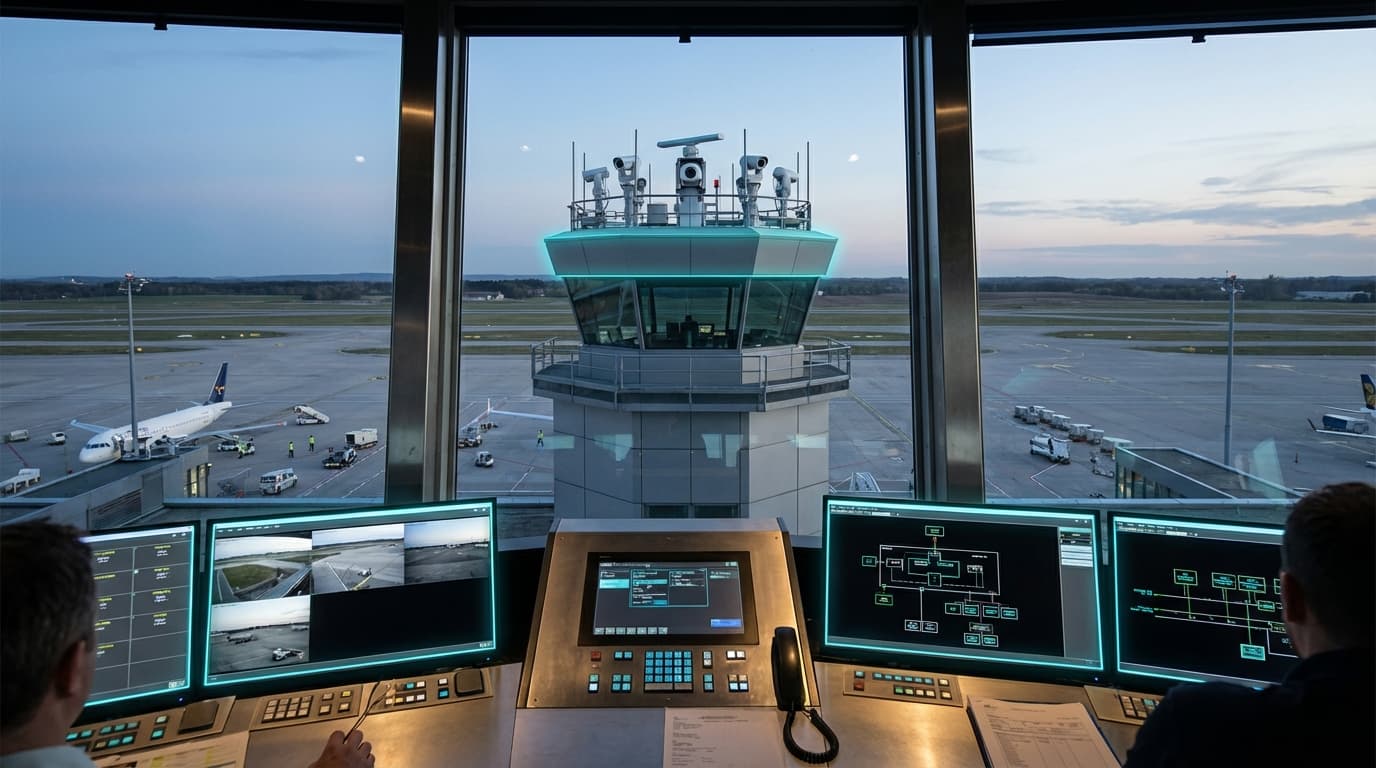
Remote / Digital Towers
Remote tower technology represents a fundamental shift in how air traffic control services are delivered, replacing the traditional requirement for controllers to be physically present in an airport tower with a sophisticated network of cameras, sensors, and digital displays that can be monitored from virtually anywhere. The system integrates multiple high-definition cameras positioned around the airfield—often providing 360-degree coverage—with infrared sensors for low-visibility conditions, radar data overlays, and weather information feeds. These inputs are synthesized into a panoramic display that recreates the controller's view, often with enhancements impossible in conventional towers, such as zoom capabilities, object tracking, and augmented reality labels identifying aircraft and vehicles. The underlying architecture relies on high-bandwidth, low-latency data transmission to ensure that controllers receive real-time information with minimal delay, while redundant communication pathways and fail-safe protocols are designed to maintain service continuity even if primary systems experience disruptions.
The aviation industry faces mounting pressure to provide safe, efficient air traffic services to a growing number of airports, many of which handle relatively low traffic volumes that make staffing a traditional control tower economically challenging. Remote tower solutions address this fundamental economics problem by enabling a single remote facility to serve multiple airports sequentially or even simultaneously, dramatically reducing the per-airport cost of providing professional ATC services. This capability is particularly transformative for regional airports, seasonal facilities, and airfields in remote locations where recruiting and retaining qualified controllers has historically been difficult. Beyond cost considerations, the technology introduces new resilience models: if a physical tower becomes unavailable due to weather, technical failure, or security concerns, operations can be seamlessly transferred to a backup remote facility. The system also enables more flexible workforce deployment, allowing controllers to work from centralized locations with better amenities and career development opportunities, potentially addressing longstanding recruitment challenges in the air traffic control profession.
Early deployments of remote tower technology have already moved beyond experimental phases in several countries, with operational installations serving both civilian and military airfields across Europe, Australia, and North America. These implementations range from single-airport configurations at smaller facilities to more ambitious multi-airport operations where controllers manage traffic at geographically dispersed locations from a unified center. The technology has demonstrated particular value during the pandemic and other disruptions, when the ability to maintain services without physical presence proved critical. However, the transition to remote operations has also highlighted important human factors considerations that require ongoing attention: controllers report that the digital environment can alter depth perception and situational awareness in subtle ways, necessitating careful interface design, comprehensive training programs, and rigorous validation protocols before systems enter service. Cybersecurity concerns also loom large, as the reliance on networked systems introduces potential vulnerabilities that traditional towers never faced. Looking forward, remote tower technology appears poised to become standard infrastructure for smaller airports while also providing backup capabilities for major facilities, contributing to a more resilient and economically sustainable air traffic management ecosystem as aviation continues its post-pandemic recovery and long-term growth trajectory.
Related Organizations

State-owned company operating most of the civil airports in Norway.

Norwegian technology company delivering remote tower systems in partnership with Avinor.


Defense company producing the Barracuda advanced camouflage systems.

Provider of Remote Digital Tower solutions utilizing AI for video processing and object detection on runways.


Supplier of communication and information systems for control centers, actively developing UTM solutions for Austria and Norway.

Spanish information technology and defense systems company.


Singapore's national aviation authority and ANSP.
Supporting Evidence
Research this in Signals
Signals turns a topic into a sourced research record you can inspect and rerun. Your first scan is free, and this one starts with Remote / Digital Towers already loaded, so edit it or scan as is.