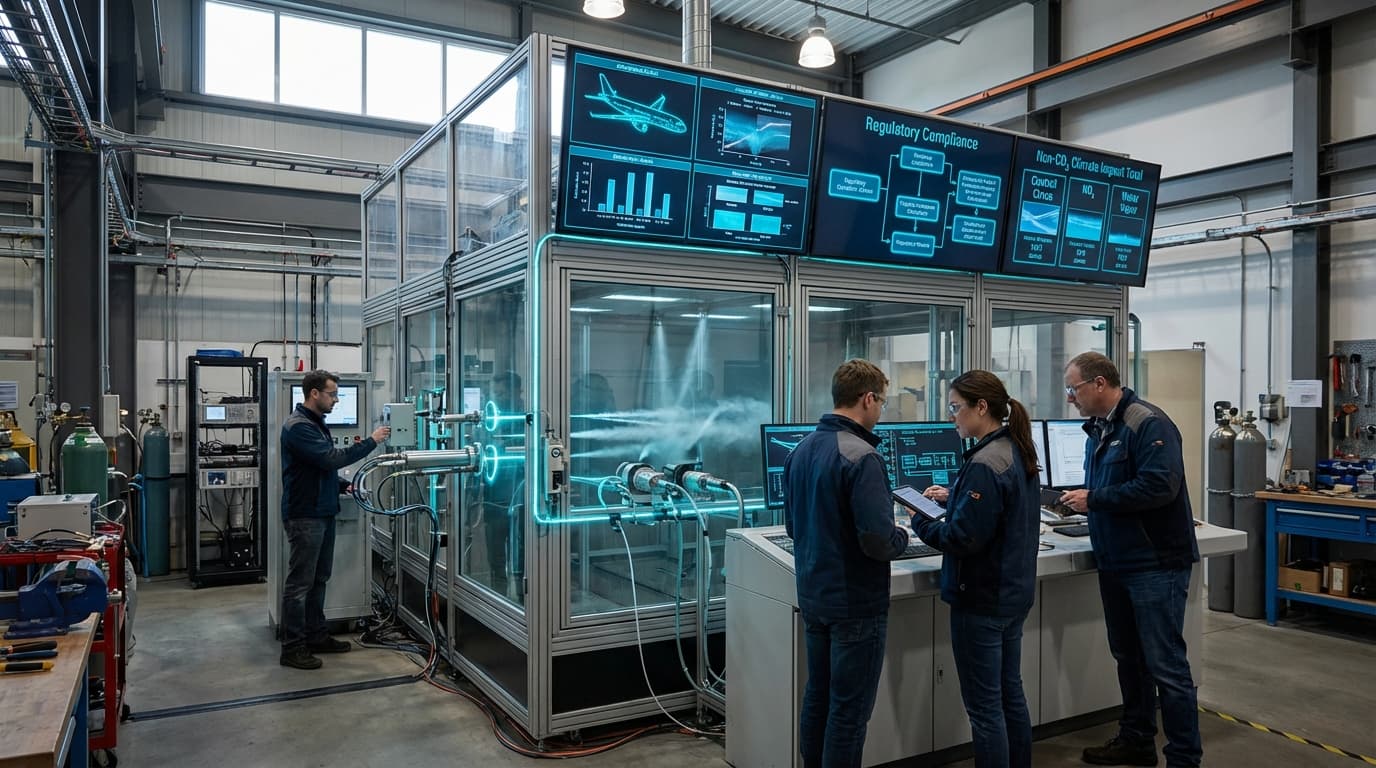
Non-CO₂ Climate Accounting & Policy
Aviation's contribution to climate change extends well beyond carbon dioxide emissions, encompassing a complex array of non-CO₂ effects that have historically been difficult to measure and regulate. Contrails—the condensation trails left by aircraft—can evolve into cirrus clouds that trap heat in the atmosphere, while nitrogen oxide (NOx) emissions influence ozone formation and methane concentrations at cruise altitudes. Water vapor released at high altitudes also contributes to radiative forcing. Research suggests that these non-CO₂ effects may account for roughly two-thirds of aviation's total climate impact, yet they remain largely absent from carbon accounting frameworks and regulatory structures. Unlike CO₂, which has a relatively straightforward relationship between emissions and warming, non-CO₂ effects vary dramatically based on altitude, time of day, geographic location, and atmospheric conditions. A contrail formed in ice-supersaturated regions during nighttime hours, for instance, can have a warming effect orders of magnitude greater than one formed under different conditions, creating a measurement and policy challenge that traditional emissions inventories cannot address.
The aviation industry faces mounting pressure to account for these effects in operational planning and regulatory compliance, particularly as net-zero commitments become more stringent. Current carbon offset schemes and emissions trading systems focus almost exclusively on CO₂, creating perverse incentives where airlines might optimize for fuel efficiency while inadvertently increasing contrail formation or NOx impacts. Emerging non-CO₂ accounting frameworks seek to integrate these effects into decision-making processes through improved atmospheric modeling, satellite observation networks, and real-time weather data. These systems enable more sophisticated trade-off analysis, where airlines can evaluate whether a slightly longer route that avoids ice-supersaturated regions might deliver better overall climate outcomes despite burning marginally more fuel. The challenge lies in translating complex, probabilistic climate science into actionable metrics that can be incorporated into flight planning software, air traffic management systems, and regulatory reporting requirements.
Early deployments indicate that contrail avoidance strategies could be implemented with minimal fuel penalties—industry analysts note that rerouting aircraft to avoid high-humidity atmospheric layers might increase fuel consumption by only one to two percent while potentially reducing contrail-related warming by fifty percent or more. Several airlines have begun pilot programs testing contrail prediction and avoidance algorithms, while regulatory bodies explore how to incorporate non-CO₂ effects into future policy frameworks without creating excessive complexity or uncertainty. The development of standardized measurement protocols and reporting mechanisms represents a critical step toward comprehensive climate accounting in aviation. As atmospheric science improves and computational tools become more sophisticated, non-CO₂ climate accounting is likely to transition from voluntary experimentation to mandatory compliance, fundamentally reshaping how airlines plan routes, schedule flights, and evaluate the true climate cost of air travel. This evolution reflects a broader recognition that effective climate policy must address the full spectrum of aviation's atmospheric impacts, not merely the most easily quantified components.
Related Organizations

Breakthrough Energy
United States · Consortium
Bill Gates-founded organization funding climate innovation.

The originators of the original NeRF paper and developers of MultiNeRF and immersive view technologies for Maps.

Conducts fundamental research on aviation emissions, including the atmospheric physics of contrails and trade-offs between CO2 and non-CO2 forcing.

Provides the DECISIONX platform for contrail prevention, enabling airlines to optimize flight plans to avoid ice-supersaturated regions.

Conducts extensive research on Hybrid Laminar Flow Control (HLFC) and suction systems.
Estuaire
France · Startup
Provides a data platform for aviation sustainability that includes contrail analysis and mitigation planning for airlines.

The Centre for Cold Matter develops portable quantum accelerometers for navigation without satellite support.

Sustainability rating and offset provider for private aviation.

UAE national airline running the 'Greenliner' sustainability program.

Pan-European civil-military organization dedicated to supporting European aviation.
Supporting Evidence
Research this in Signals
Signals turns a topic into a sourced research record you can inspect and rerun. Your first scan is free, and this one starts with Non-CO₂ Climate Accounting & Policy already loaded, so edit it or scan as is.