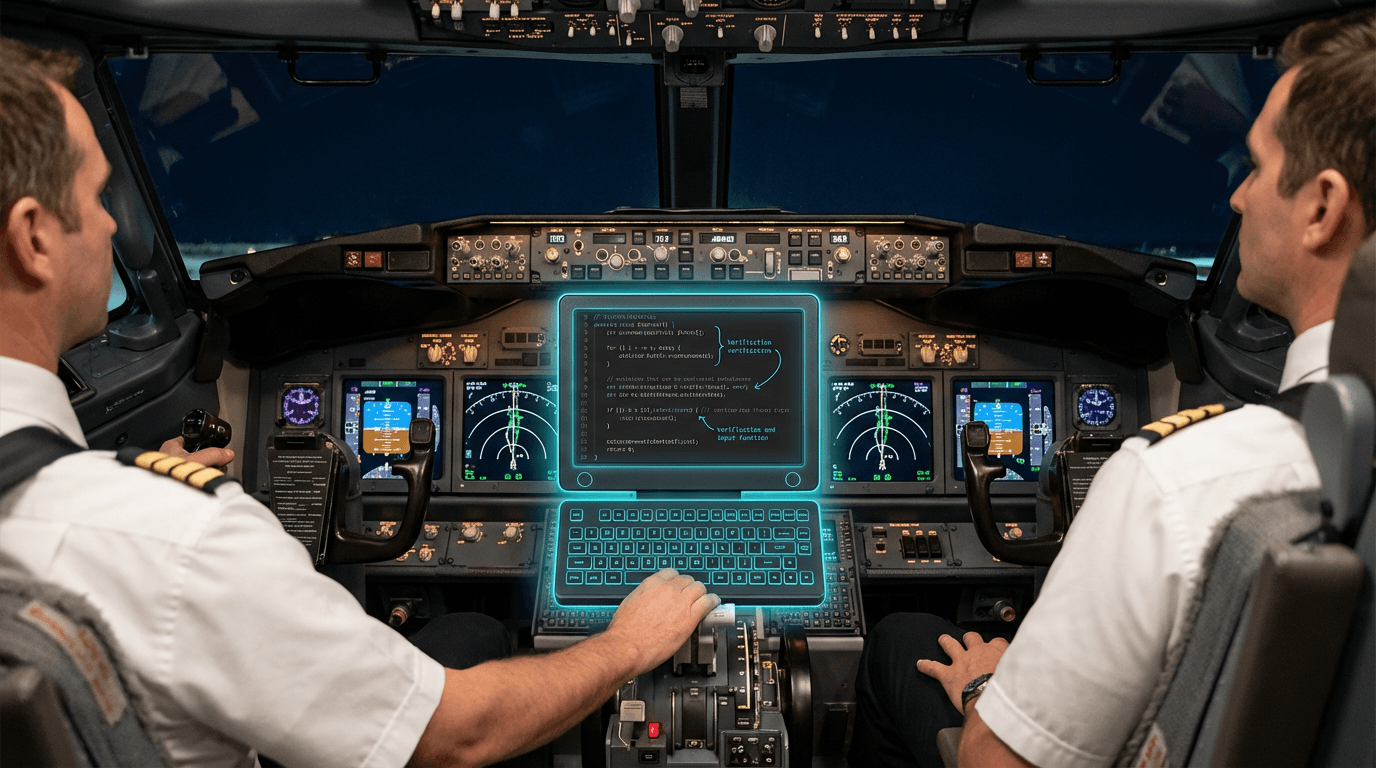
Formal Methods for Safety-Critical Software
Formal methods represent a rigorous, mathematically grounded approach to software verification that has become increasingly vital in aerospace applications where software failures can have catastrophic consequences. Unlike traditional testing, which can only demonstrate the presence of bugs through specific test cases, formal methods use mathematical logic to prove the absence of entire classes of defects. These techniques encompass model checking, which systematically explores all possible states of a system to verify properties like deadlock freedom or correct sequencing, and theorem proving, which employs logical deduction to establish that software behaves according to its specification under all conditions. In aviation software, this means proving that critical functions—such as autopilot mode transitions, fly-by-wire control laws, or collision avoidance algorithms—will perform correctly not just in tested scenarios but in every possible combination of inputs and states. The underlying mathematics relies on formal specification languages that precisely describe intended behavior, automated reasoning tools that can explore vast state spaces, and proof assistants that help engineers construct verifiable arguments about software correctness.
The aerospace industry faces mounting pressure to certify increasingly complex software systems under stringent safety standards such as DO-178C, which governs airborne software development. Traditional testing alone struggles to provide adequate assurance for modern aircraft systems that may contain millions of lines of code, intricate mode logic with hundreds of possible states, and autonomous decision-making capabilities that must handle unpredictable scenarios. Formal methods address this challenge by providing mathematical evidence of correctness that complements conventional testing strategies. For flight-critical systems—those whose failure could result in loss of life—formal verification can demonstrate properties such as the impossibility of certain hazardous states, guaranteed response times for safety functions, or the absence of integer overflow errors that have historically caused incidents. This capability is particularly valuable for complex mode management systems, where subtle interactions between different operational modes have been implicated in several aviation accidents. By proving that mode transitions always occur as intended and that no unintended states are reachable, formal methods reduce the risk of these insidious defects that are notoriously difficult to catch through testing alone.
Regulatory authorities including the FAA and EASA have begun recognizing formal methods as acceptable means of compliance for certain certification objectives, though integration into existing workflows remains an active area of development. Research programs and early industrial adopters have demonstrated successful application of formal verification to components such as autopilot logic, engine control software, and traffic collision avoidance systems. The primary obstacles to wider adoption include the specialized expertise required to apply these techniques, the computational resources needed to verify large systems, and the challenge of maintaining verification artifacts as software evolves through its lifecycle. Industry analysts note that hybrid approaches—combining formal methods for the most critical components with traditional testing for less critical functions—represent a pragmatic path forward. As aircraft incorporate more autonomous capabilities and software complexity continues to grow, the aerospace sector is gradually moving toward verification strategies where mathematical proof plays a central role alongside empirical testing, fundamentally changing how the industry establishes confidence in safety-critical software systems.
Related Organizations
Provides the SPARK Pro toolset, enabling formal verification of Ada code for high-assurance aerospace software.
Leads the SABERS (Solid-state Architecture Batteries for Enhanced Rechargeability and Safety) project.
Develops aiT, a tool that uses formal methods to determine Worst-Case Execution Time (WCET) for avionics software.
A computer science R&D firm specializing in formal verification and cryptography.

The French National Institute for Research in Digital Science and Technology, heavily involved in AI research and Scikit-learn.
Developer of MATLAB and Simulink, the foundational tools for Model-Based Design and control system digital twins.

Collins Aerospace
United States · Company
A major aerospace and defense contractor, a subsidiary of RTX Corporation.
Provides verification tools for multicore timing analysis in avionics, often integrating formal analysis techniques.

Non-profit research institute with a long history in AI, currently working on hybrid neuro-symbolic systems for DARPA and commercial use.

Provides advanced static analysis tools based on the Frama-C platform to mathematically guarantee code behavior.
Supporting Evidence
Research this in Signals
Signals turns a topic into a sourced research record you can inspect and rerun. Your first scan is free, and this one starts with Formal Methods for Safety-Critical Software already loaded, so edit it or scan as is.