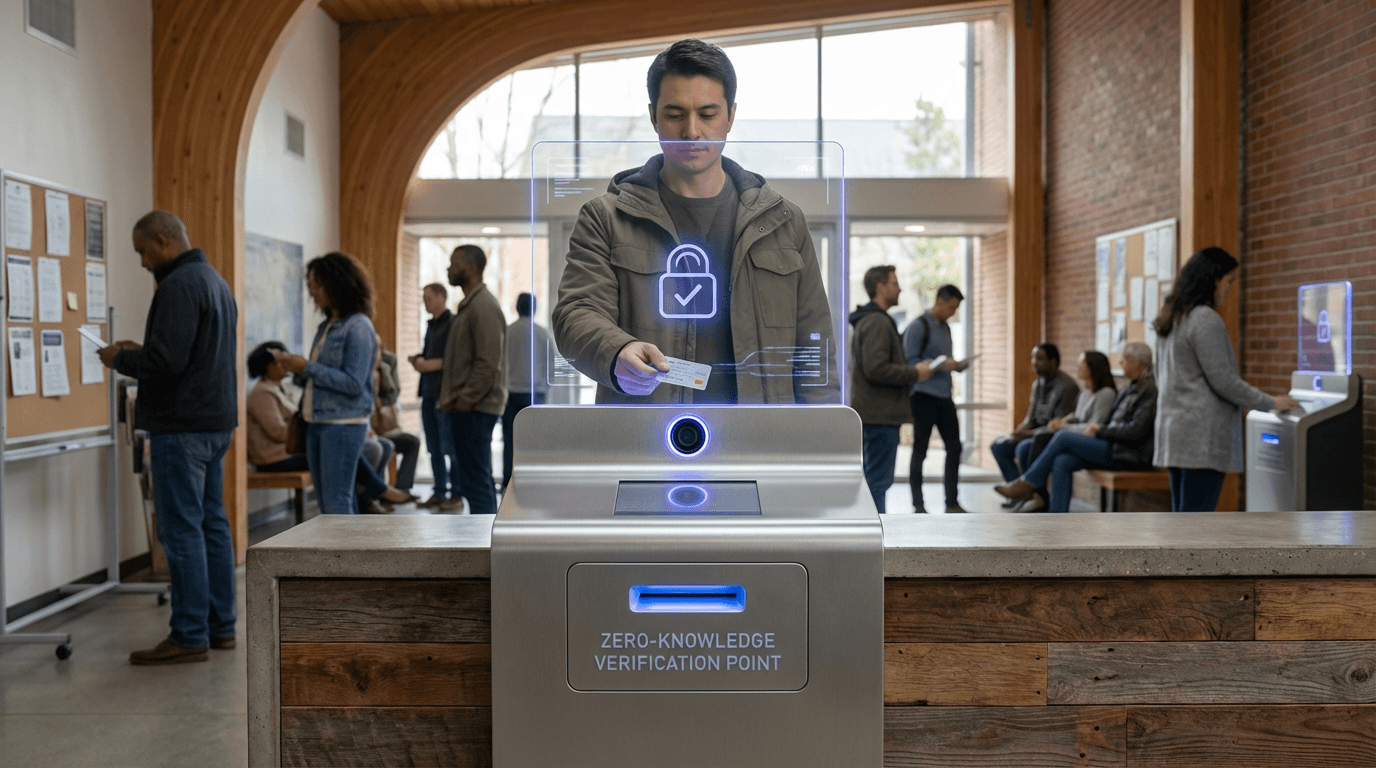
Zero-Knowledge Identity Frameworks
Zero-knowledge identity frameworks represent a fundamental shift in how citizens interact with digital governance systems, addressing the longstanding tension between verification requirements and privacy protection. These cryptographic protocols enable individuals to prove specific attributes about themselves—such as age eligibility, residency status, or professional credentials—without revealing the underlying personal data that establishes those facts. The technology builds on zero-knowledge proofs, a mathematical concept where one party (the prover) can convince another party (the verifier) that a statement is true without conveying any information beyond the validity of the statement itself. In practice, this means a citizen could demonstrate they are eligible to vote in a particular district without disclosing their exact address, or prove they meet age requirements for a service without revealing their date of birth. The framework typically involves cryptographic commitments, where personal data is mathematically transformed in ways that preserve verifiable properties while obscuring the original information.
The emergence of these frameworks addresses critical challenges in digital civic participation, particularly the privacy risks inherent in traditional identity verification systems. Conventional approaches to eligibility verification require citizens to share extensive personal information with government agencies, service providers, or voting systems, creating centralized databases that become attractive targets for breaches and potential vectors for surveillance or discrimination. This data exposure often deters participation in civic processes, especially among vulnerable populations concerned about privacy or potential misuse of their information. Zero-knowledge identity frameworks solve this problem by decoupling verification from disclosure, enabling governments to maintain necessary eligibility standards while minimizing data collection. This capability is particularly valuable in contexts requiring sensitive attribute verification—such as means-tested benefit programs, anonymous whistleblowing systems, or secure voting mechanisms—where traditional identity checks might compromise participant privacy or create barriers to access.
Early implementations of zero-knowledge identity frameworks are emerging in both public and private sectors, with pilot programs exploring applications in digital voting, credential verification, and selective disclosure identity systems. Research initiatives are investigating how these protocols can support anonymous yet accountable civic participation, allowing citizens to engage with government services while maintaining privacy protections stronger than those offered by conventional authentication methods. The technology aligns with broader movements toward self-sovereign identity and privacy-preserving computation, reflecting growing recognition that effective governance need not require comprehensive surveillance. As concerns about data privacy intensify and regulatory frameworks like GDPR establish stronger data minimization principles, zero-knowledge identity frameworks offer a path toward civic systems that verify eligibility without accumulating sensitive personal information. The continued development of these protocols suggests a future where citizens can participate fully in democratic processes while retaining meaningful control over their personal data, fundamentally reshaping the relationship between privacy and civic engagement in digital governance.
Related Organizations

Next-generation private access control based on Self-Sovereign Identity and zk-SNARKs.

Formerly Polygon ID, providing Zero-Knowledge (ZK) identity infrastructure for verifiable credentials.

A Layer-1 blockchain platform for building private applications using zero-knowledge cryptography.

An engineering-driven organization developing the technical specifications and standards for decentralized identity.

The developer behind Worldcoin and World ID, utilizing biometric iris scanning (The Orb) for Proof of Personhood.

Specialists in Self-Sovereign Identity (SSI) and decentralized identity wallets.

A layer-1 blockchain focused on compliant privacy and Zero-Knowledge KYC (zkKYC).

Stewards the Mina Protocol, a lightweight blockchain designed specifically for zero-knowledge applications (zkApps) and identity.

Develops decentralized identity software, including tools for verifiable credentials and ZK-based authentication.

Creators of zkSync, a ZK-rollup scaling solution for Ethereum.
Supporting Evidence
Research this in Signals
Signals turns a topic into a sourced research record you can inspect and rerun. Your first scan is free, and this one starts with Zero-Knowledge Identity Frameworks already loaded, so edit it or scan as is.