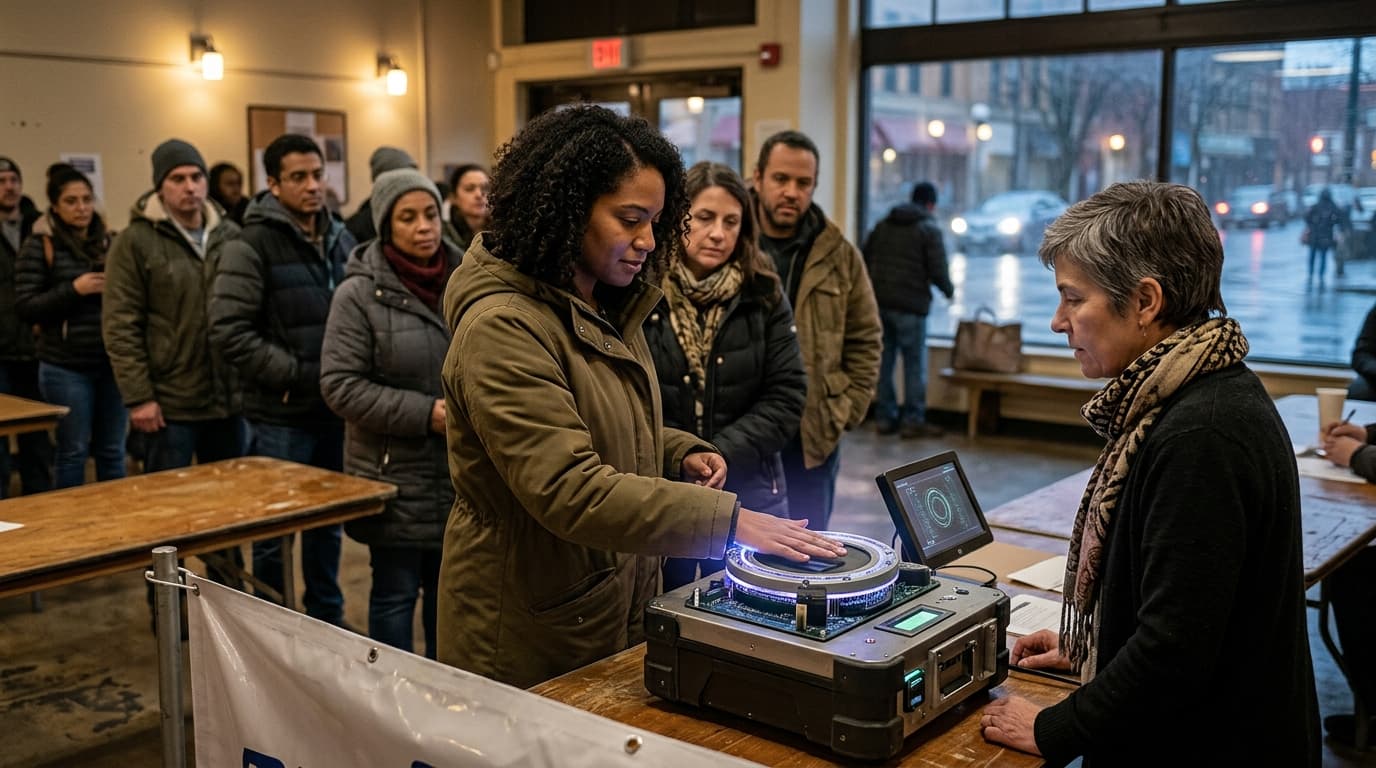
Privacy-Preserving Proof of Personhood
In democratic digital systems, ensuring that each participant represents a single, unique human being—without compromising their privacy—presents a fundamental challenge. Traditional identity verification methods require collecting and storing sensitive personal information, creating centralized databases vulnerable to breaches and enabling surveillance. Privacy-Preserving Proof of Personhood addresses this tension through specialized hardware devices, most commonly iris scanners or other biometric sensors, that can verify human uniqueness while generating cryptographic proofs that reveal nothing about the individual's actual identity. The technology operates by capturing biometric data locally on the device, processing it through secure enclaves or trusted execution environments, and producing a unique cryptographic hash or zero-knowledge proof. Critically, the original biometric data is never stored or transmitted—only the mathematical proof of uniqueness persists. This hash serves as an unforgeable digital credential confirming that its holder is a distinct human being who has not previously registered in the system, without revealing which specific person they are or linking to government-issued documents.
The implications for civic participation are profound, particularly as digital governance systems struggle with bot manipulation, astroturfing, and sybil attacks where single actors create multiple fake identities to distort democratic processes. Online voting systems, participatory budgeting platforms, and digital town halls have historically faced the impossible choice between anonymity and accountability. Privacy-Preserving Proof of Personhood resolves this dilemma by enabling "one person, one vote" guarantees without requiring citizens to sacrifice their privacy to centralized authorities. This technology also addresses the growing problem of AI-generated personas flooding public comment systems and social platforms, where distinguishing authentic human voices from synthetic ones becomes increasingly difficult. By establishing verifiable personhood without identity disclosure, these systems can maintain the legitimacy of democratic processes while protecting participants from tracking, profiling, or retaliation based on their political participation.
Early implementations have emerged in decentralized identity projects and blockchain-based governance systems, where the technology enables global coordination without requiring trust in any single authority. Research initiatives are exploring integration with digital public infrastructure, from secure voting systems to universal basic income distribution mechanisms that require proof of unique personhood. The approach aligns with broader movements toward self-sovereign identity and privacy-preserving technologies in civic contexts. As digital participation becomes increasingly central to democratic life, the ability to prove you are a real, unique human without revealing who you are may become foundational infrastructure for legitimate online governance. The technology represents a crucial building block for scaling democratic participation beyond traditional geographic boundaries while maintaining the privacy protections that enable genuine freedom of expression and political engagement.
Related Organizations

The developer behind Worldcoin, a project attempting to solve 'proof of personhood' via biometric scanning and token incentives.

A blockchain network based on Proof-of-Personhood where users validate each other via simultaneous 'flip' tests.

A system combining social verification with video submission to create a Sybil-resistant registry of humans, linked to UBI.

A social identity network that allows people to prove they are unique humans without revealing personal data or paying fees.

A platform for funding and coordinating open source development.

Uses cryptographically secure biometric verification to link digital identities to physical humans without revealing the biometric data itself.


Formerly Polygon ID, providing Zero-Knowledge (ZK) identity infrastructure for verifiable credentials.

A platform for local community currencies that uses physical meetups (key-signing parties) to prove unique personhood.

A cross-chain protocol that enables ZK-proofs of identity, including passport scanning for personhood verification.
Supporting Evidence
Research this in Signals
Signals turns a topic into a sourced research record you can inspect and rerun. Your first scan is free, and this one starts with Privacy-Preserving Proof of Personhood already loaded, so edit it or scan as is.