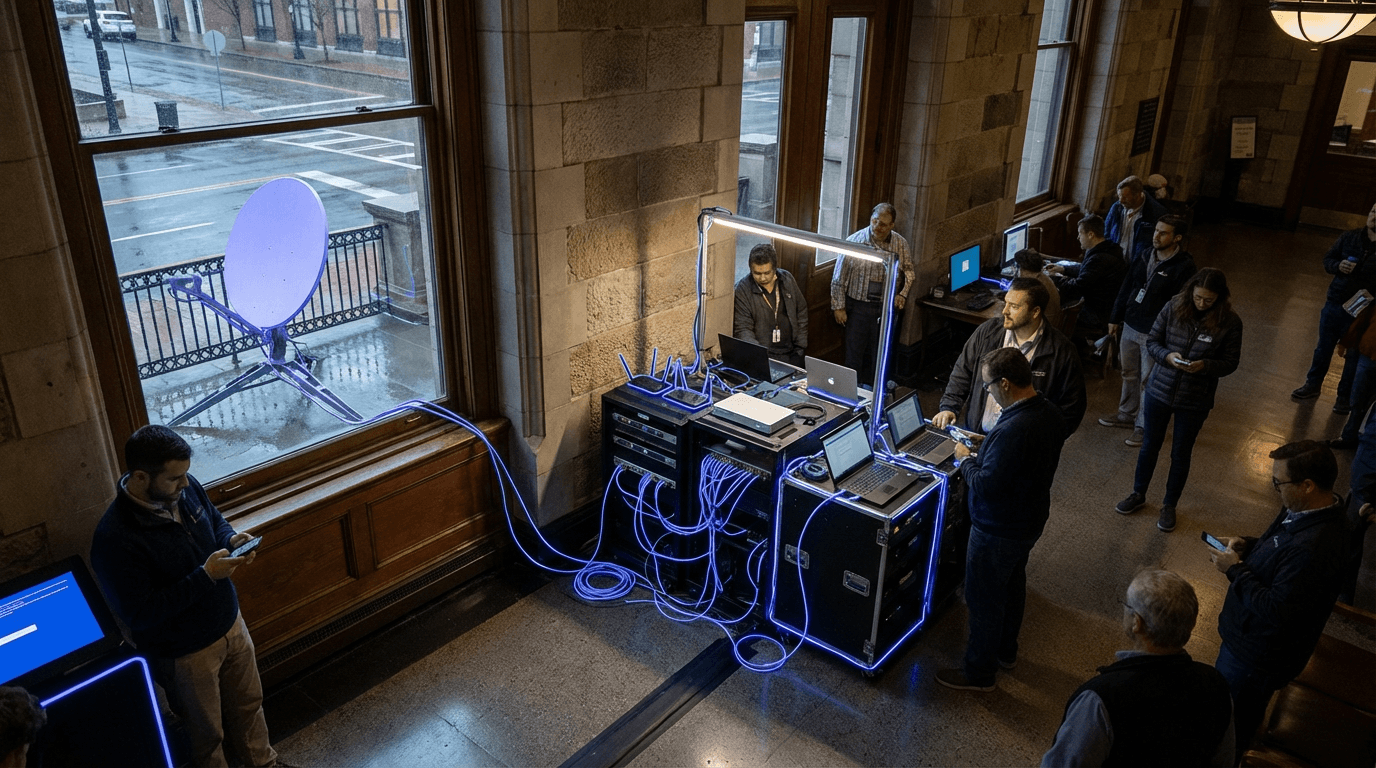
Satellite Backhaul for Civic Resilience
In regions where terrestrial communication infrastructure is vulnerable to natural disasters, deliberate disruption, or authoritarian interference, maintaining connectivity for essential civic functions becomes a critical challenge. Traditional fiber-optic and cellular networks, while robust under normal conditions, can be severed by floods, earthquakes, or intentional sabotage, leaving election sites, emergency services, and government offices isolated at precisely the moments when communication is most vital. Satellite backhaul technology addresses this vulnerability by providing an independent communication pathway that bypasses ground-based infrastructure entirely. The system works by establishing direct links between ground stations at civic facilities and orbiting satellites, which relay data across vast distances without relying on local telecommunications infrastructure. Recent advances in low Earth orbit (LEO) satellite constellations and high-altitude platform stations have significantly improved the latency, bandwidth, and cost-effectiveness of these systems, making them increasingly viable for municipal and regional government deployment.
The strategic value of satellite backhaul extends beyond simple redundancy. For electoral operations, this technology ensures that voting centers can transmit results securely even when local networks are compromised, whether by technical failure or malicious interference. Research suggests that the mere presence of independent communication channels can deter attempts at election manipulation, as it becomes significantly harder to control information flows when multiple pathways exist. Emergency management agencies benefit similarly, maintaining coordination capabilities during hurricanes, wildfires, or other crises that typically destroy conventional communication networks. Government continuity planning increasingly incorporates satellite backhaul as a standard component, recognizing that democratic legitimacy depends partly on the uninterrupted availability of civic services. The technology also supports remote or underserved communities where terrestrial infrastructure may be economically unfeasible, ensuring that geographic isolation does not translate into civic exclusion.
Early deployments indicate growing adoption across diverse governance contexts, from island nations naturally dependent on satellite links to continental regions seeking resilience against both natural and human-made threats. Some jurisdictions have begun integrating satellite terminals into mobile voting units and emergency operations centers, while others maintain them as dormant backup systems activated only during disruptions. Industry analysts note that as satellite capacity expands and equipment costs decline, more municipalities are incorporating these systems into their civic infrastructure planning. The technology aligns with broader trends toward decentralized, resilient governance systems that can withstand the increasing frequency of climate-related disasters and the evolving landscape of information warfare. Looking forward, satellite backhaul represents not merely a technical solution but a commitment to the principle that democratic participation and government accountability should persist regardless of infrastructure fragility or adversarial interference.
Related Organizations

Deploys optical inter-satellite links (lasers) on Starlink satellites to reduce latency and ground station dependence.

Satellite communications company operating a major LEO constellation.

A provider of broadband satellite services and managed network solutions.

Operates the Iridium satellite constellation, providing global voice and data coverage used for remote IoT payments.

Develops flat-panel satellite antennas using metamaterials to electronically steer beams, enabling connectivity with LEO and GEO satellites simultaneously.


Global communications company providing satellite broadband and secure networking.

Developing Project Kuiper, a satellite constellation that will utilize optical inter-satellite links.

Provides satellite ground segment equipment and VSATs.

The United Nations specialized agency for information and communication technologies.
Supporting Evidence
Research this in Signals
Signals turns a topic into a sourced research record you can inspect and rerun. Your first scan is free, and this one starts with Satellite Backhaul for Civic Resilience already loaded, so edit it or scan as is.