Community Radio Civic Nodes
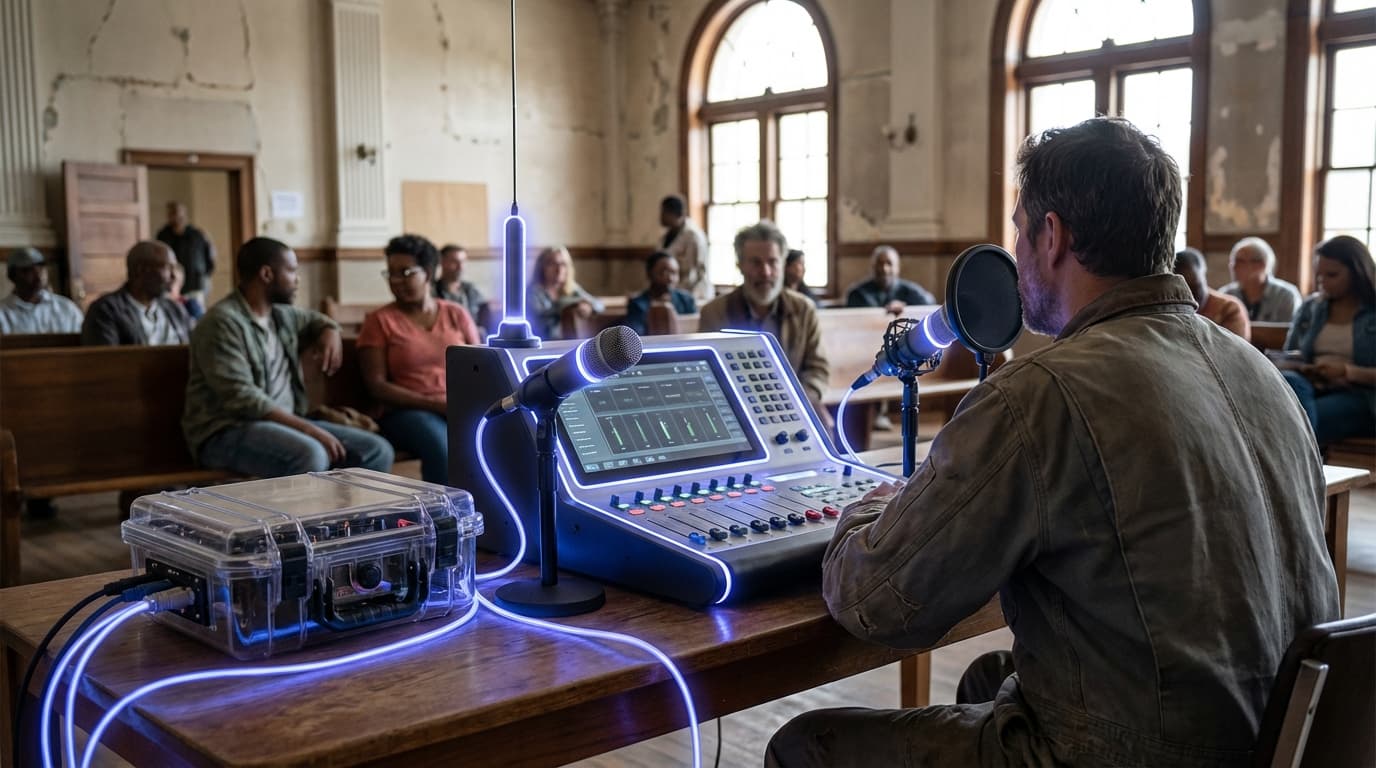
Community radio civic nodes represent a hybrid communication infrastructure designed to address a fundamental challenge in democratic participation: how to meaningfully engage populations in civic processes when traditional text-based channels exclude those with limited literacy. This technology combines established radio broadcasting capabilities with interactive SMS callback systems to create bidirectional communication channels. The technical architecture typically involves a community radio station equipped with mobile telephony integration, allowing listeners to respond to broadcast consultations through simple numeric keypad inputs or voice messages. The system works by broadcasting civic information, policy proposals, or community issues through radio programming, then prompting listeners to provide feedback via SMS codes or recorded voice responses. These inputs are aggregated, analysed, and fed back into subsequent broadcasts, creating a structured deliberation loop. The infrastructure leverages the ubiquity of basic mobile phones and FM radio receivers, requiring minimal technical literacy from participants while maintaining the capacity for nuanced civic dialogue.
This approach addresses a critical gap in participatory governance systems that have historically relied on written surveys, online platforms, or in-person meetings that exclude significant portions of populations in regions with lower literacy rates. In many developing contexts, radio penetration exceeds 70% of households while internet access remains limited and literacy barriers persist. Traditional civic engagement mechanisms fail to capture the perspectives of these communities, resulting in policy decisions that inadequately reflect the needs and priorities of affected populations. Community radio civic nodes overcome these limitations by meeting people through familiar media channels and interaction patterns. The structured feedback loops transform passive broadcast consumption into active civic participation, enabling local governments and civil society organisations to conduct genuine consultations on budget priorities, service delivery, infrastructure projects, and policy reforms. This technology also addresses the challenge of scale in participatory processes, allowing thousands of community members to contribute input that can be systematically aggregated and analysed, rather than limiting participation to those who can attend physical meetings or navigate digital platforms.
Pilot implementations have emerged across regions in Sub-Saharan Africa, South Asia, and Latin America, where community radio stations serve as trusted information sources for rural and peri-urban populations. These deployments demonstrate the technology's capacity to facilitate budget consultations, gather feedback on public services, and enable community monitoring of development projects. Early applications indicate that participation rates through radio-SMS systems can exceed traditional consultation methods by significant margins, particularly among women, elderly populations, and rural residents who face barriers to other forms of civic engagement. The technology aligns with broader trends toward inclusive governance and the recognition that effective democratic participation requires infrastructure adapted to diverse contexts rather than one-size-fits-all digital solutions. As mobile network coverage continues to expand even in remote areas, community radio civic nodes offer a scalable pathway for strengthening democratic legitimacy in contexts where conventional participation mechanisms remain inaccessible to large segments of the population.
Related Organizations

Develops 'Mobile Vaani', an intelligent voice response (IVR) system acting as a voice-based social media platform for low-literacy rural communities.

Creates 'Radio in a Bucket' technology, a solar-powered, cloud-connected hardware kit that allows communities to run small-scale radio stations.

Spun out of Cambridge University, they combine radio broadcasts with SMS channels to gather citizen feedback and data.

Deploys radio and mobile strategies across Africa to share agricultural and civic information with remote communities.

Facilitates community-owned GSM/LTE cellular networks in rural areas of Latin America.

International NGO serving the community radio movement, advocating for the right to communicate.

The UN agency responsible for the 'Recommendation on the Ethics of Artificial Intelligence'.
Supporting Evidence
Research this in Signals
Signals turns a topic into a sourced research record you can inspect and rerun. Your first scan is free, and this one starts with Community Radio Civic Nodes already loaded, so edit it or scan as is.