Citizen Deliberation Assemblies
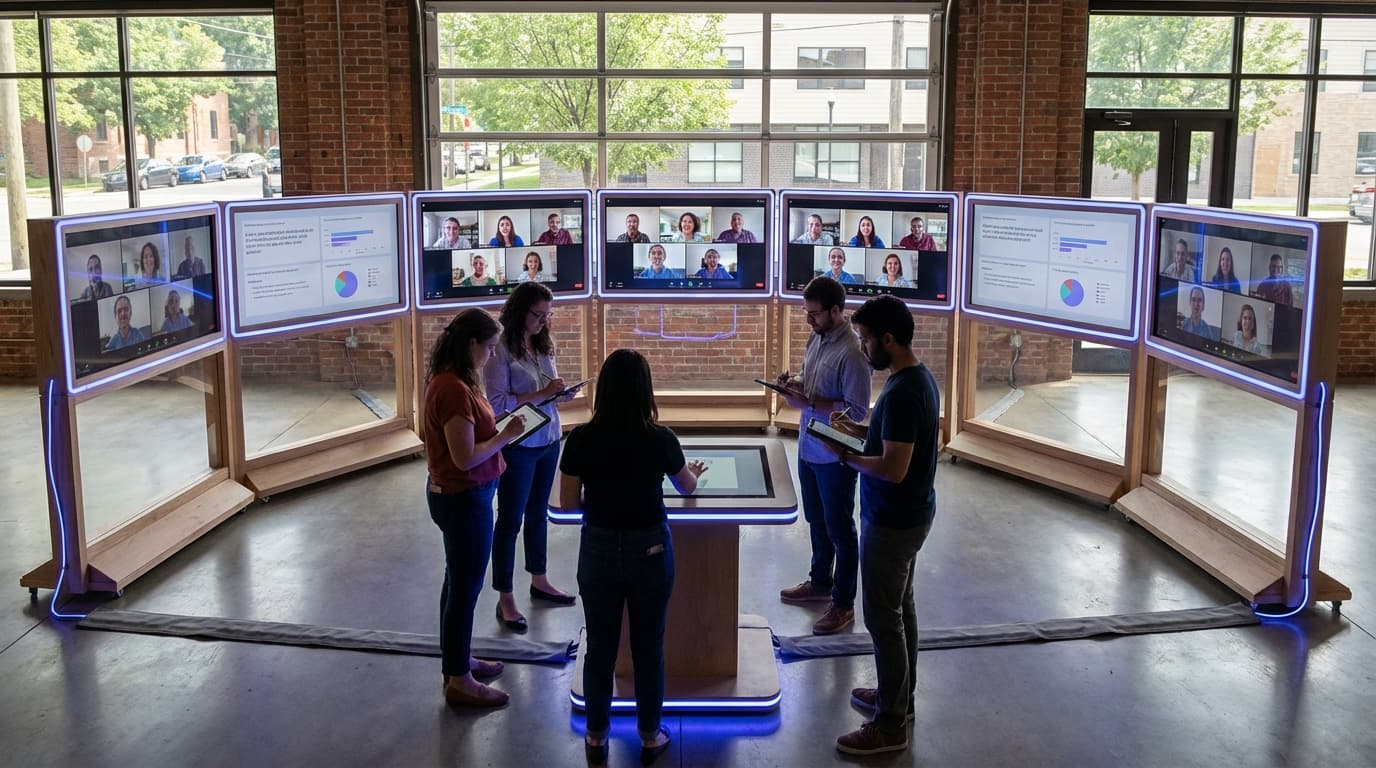
Citizen Deliberation Assemblies represent a digital evolution of traditional town halls and civic forums, addressing the fundamental challenge of meaningful public participation in democratic governance at scale. Conventional deliberative processes—such as in-person citizens' assemblies or public consultations—face inherent limitations in reach, cost, and logistical complexity, often restricting participation to small, geographically concentrated groups. These virtual environments leverage digital infrastructure to create structured spaces where hundreds or even thousands of participants can engage simultaneously in substantive policy discussions. The technical architecture typically combines video conferencing capabilities, threaded discussion forums, and real-time polling mechanisms, all orchestrated through platforms designed specifically for deliberative democracy. AI-powered moderation systems play a crucial role, monitoring conversations for civility, identifying emerging themes across multiple discussion threads, and generating digestible summaries of complex arguments. These systems can also detect when certain voices are dominating conversations and prompt facilitators to ensure more equitable participation, while natural language processing algorithms help cluster similar viewpoints and surface areas of potential consensus among diverse participants.
The democratic deficit in contemporary governance—where citizens feel increasingly disconnected from policy decisions that affect their lives—creates fertile ground for these digital deliberation platforms. Traditional public comment periods and surveys often fail to capture the nuanced reasoning behind public opinion, reducing complex civic questions to simple yes-or-no responses. Citizen Deliberation Assemblies address this limitation by creating structured environments where participants can learn about issues, hear diverse perspectives, and refine their own thinking through dialogue. Research in deliberative democracy suggests that when citizens are given quality information, time for reflection, and exposure to different viewpoints, they often reach more considered conclusions than those captured by conventional polling. These platforms also tackle the challenge of representativeness by enabling stratified random selection of participants that mirror demographic diversity, ensuring that deliberative processes don't simply amplify the voices of those with the most free time or political engagement. For policymakers, this technology offers a mechanism to gauge informed public opinion on contentious issues, potentially breaking through partisan gridlock by revealing areas of common ground that emerge when citizens deliberate rather than debate.
Several governments and civic organizations have begun experimenting with digital deliberation platforms, particularly for issues requiring public input on complex policy trade-offs such as climate action, healthcare reform, and urban development priorities. Early deployments indicate that participants in online assemblies report higher satisfaction with democratic processes and greater understanding of policy complexities compared to traditional consultation methods. The technology has proven particularly valuable during periods when in-person gatherings are impractical, demonstrating resilience as a civic infrastructure. Looking forward, these platforms are likely to become increasingly sophisticated, incorporating features such as real-time fact-checking, multilingual support for diverse communities, and integration with official legislative processes. As concerns about democratic legitimacy and public trust in institutions intensify globally, Citizen Deliberation Assemblies represent a promising avenue for reinvigorating participatory governance, offering a middle path between direct democracy and purely representative systems. The continued development of these tools may fundamentally reshape how societies make collective decisions, moving from adversarial political combat toward more collaborative problem-solving that harnesses the collective intelligence of informed, engaged citizens.
Related Organizations

Maintainers of 'Polis', an open-source tool used by governments (like Taiwan and Bowling Green, KY) to visualize consensus in large-scale discussions using machine learning.

A free open-source participatory democracy framework for cities and organizations.
Stanford Deliberative Democracy Lab
United States · University
Home of the 'Deliberative Polling' methodology, developing automated moderation and AI-assisted deliberation tools.

A decentralized open consultation process in Taiwan that uses digital tools to build consensus.

A digital community engagement platform used by local governments to consult citizens.

Open source citizen participation tool used by governments worldwide for debates, proposals, and voting.

Specializes in the recruitment and selection process for citizens' assemblies, often using digital tools to ensure demographic representativeness.

A civic tech platform that engages millions of citizens in mass consultations using algorithms to surface consensus proposals.
OECD
France · Government Agency
Adopted the 'Recommendation on Responsible Innovation in Neurotechnology' to guide governments and companies.

Provides cloud-based software for government communications, meeting management, and digital services.
Supporting Evidence
Research this in Signals
Signals turns a topic into a sourced research record you can inspect and rerun. Your first scan is free, and this one starts with Citizen Deliberation Assemblies already loaded, so edit it or scan as is.