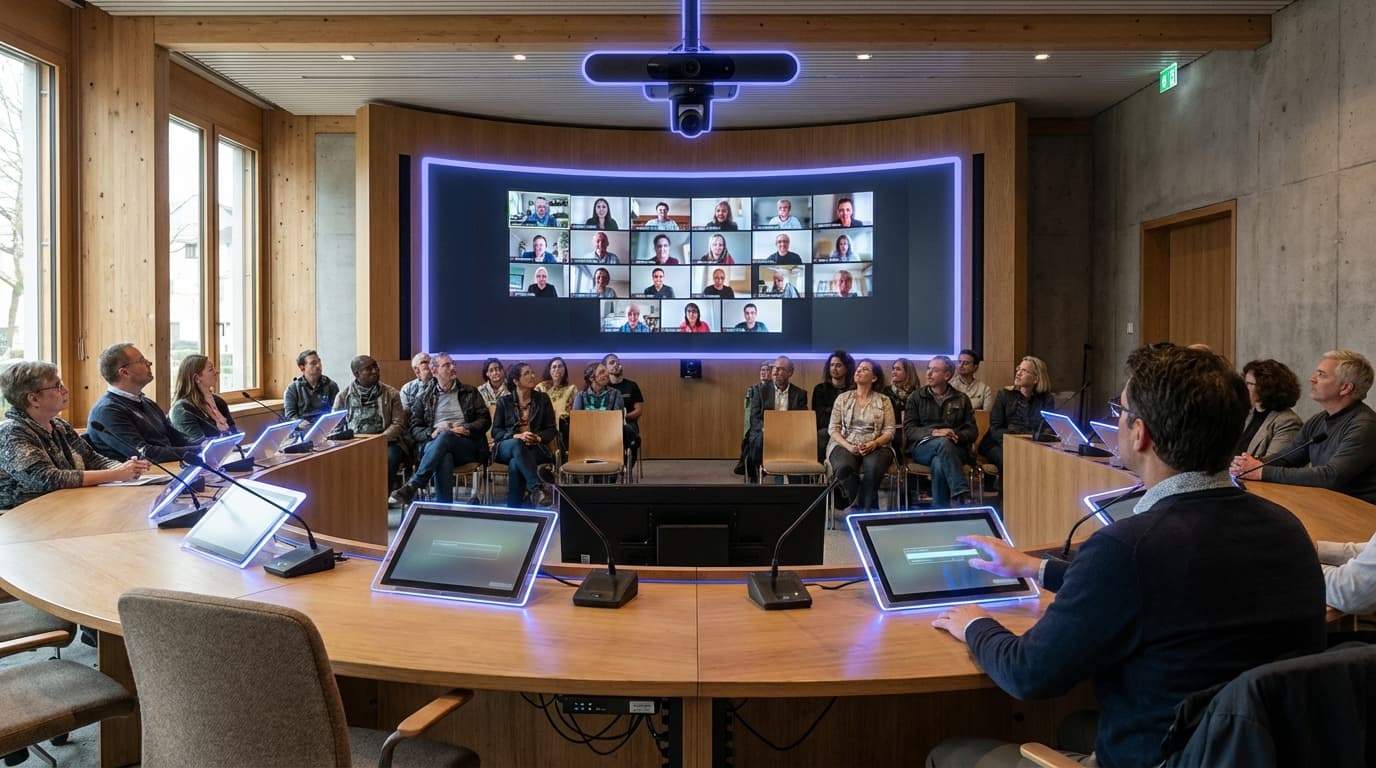
Digital Town Halls & Hybrid Assemblies
Digital town halls and hybrid assemblies represent a fundamental reimagining of democratic participation, combining physical gathering spaces with digital platforms to create inclusive forums that transcend geographical barriers. These systems integrate video-conferencing infrastructure, spatial audio technology, and purpose-built facilitation tools to enable simultaneous participation from both in-person attendees and remote participants. Unlike conventional video-conferencing solutions designed primarily for corporate meetings, these platforms incorporate specific democratic protocols such as structured turn-taking mechanisms, real-time interpretation services for multilingual communities, breakout room functionality for small-group deliberation, and algorithmic systems that monitor speaking time to ensure equitable voice distribution. The technical architecture typically includes features like digital hand-raising queues, anonymous polling capabilities, and accessible interfaces that accommodate participants with varying levels of digital literacy or physical abilities. By creating a unified deliberative space that bridges physical and virtual presence, these systems address the core challenge of maintaining democratic legitimacy while expanding participation beyond those who can attend in person.
The emergence of hybrid assemblies responds to persistent challenges in civic engagement, particularly the exclusion of citizens who face barriers to physical attendance due to work schedules, caregiving responsibilities, mobility limitations, or geographic distance from decision-making centres. Traditional town halls and public consultations have long suffered from participation biases that favour those with flexible schedules, reliable transportation, and proximity to civic venues—typically excluding working parents, shift workers, rural residents, and people with disabilities. Hybrid assemblies fundamentally alter this dynamic by enabling participation from home, workplace, or community centres, thereby broadening the demographic and geographic diversity of civic discourse. These platforms also address the challenge of scaling deliberative democracy beyond small groups, allowing municipalities to conduct meaningful consultations with hundreds or thousands of participants through structured breakout sessions and facilitated discussion protocols. Furthermore, they create permanent digital records of proceedings, enhancing transparency and accountability while enabling citizens who cannot attend synchronously to review discussions and contribute asynchronously through integrated feedback mechanisms.
Early implementations of hybrid assemblies have emerged across various democratic contexts, from municipal budget consultations and neighbourhood planning sessions to national citizens' assemblies on complex policy issues. Research from pilot programs suggests that well-designed hybrid formats can achieve participation rates two to three times higher than traditional in-person-only forums, with notable increases in engagement from previously underrepresented groups. Some jurisdictions have begun institutionalising hybrid participation as standard practice for public hearings and community consultations, recognising that the flexibility and accessibility of these formats strengthen democratic legitimacy rather than diminishing it. The technology continues to evolve with innovations in simultaneous interpretation, accessibility features, and deliberation facilitation tools that help maintain the quality of dialogue across distributed participants. As societies grapple with questions of democratic renewal and institutional trust, hybrid assemblies represent a practical pathway toward more inclusive governance structures that honour both the value of face-to-face deliberation and the imperative of universal accessibility, positioning themselves as essential infrastructure for twenty-first-century democracy.
Related Organizations

A free open-source participatory democracy framework for cities and organizations.

A digital community engagement platform used by local governments to consult citizens.

An open-source system for gathering open-ended feedback and using machine learning to surface consensus across divided groups.

Provides cloud-based software for government communications, meeting management, and digital services.

PublicInput
United States · Company
An operating system for government engagement that integrates email, surveys, and meeting management.

Creators of 'Citizen Space' and 'Simulator', tools for democratic consultation and priority simulation.

A community engagement platform offering mapping tools, surveys, and forums for public consultation.

An online engagement platform specifically designed for planning documents and interactive feedback.
Interactive presentation software used for real-time polling and voting.

An audience interaction platform for meetings and events (Q&A, polling).
Supporting Evidence
Research this in Signals
Signals turns a topic into a sourced research record you can inspect and rerun. Your first scan is free, and this one starts with Digital Town Halls & Hybrid Assemblies already loaded, so edit it or scan as is.