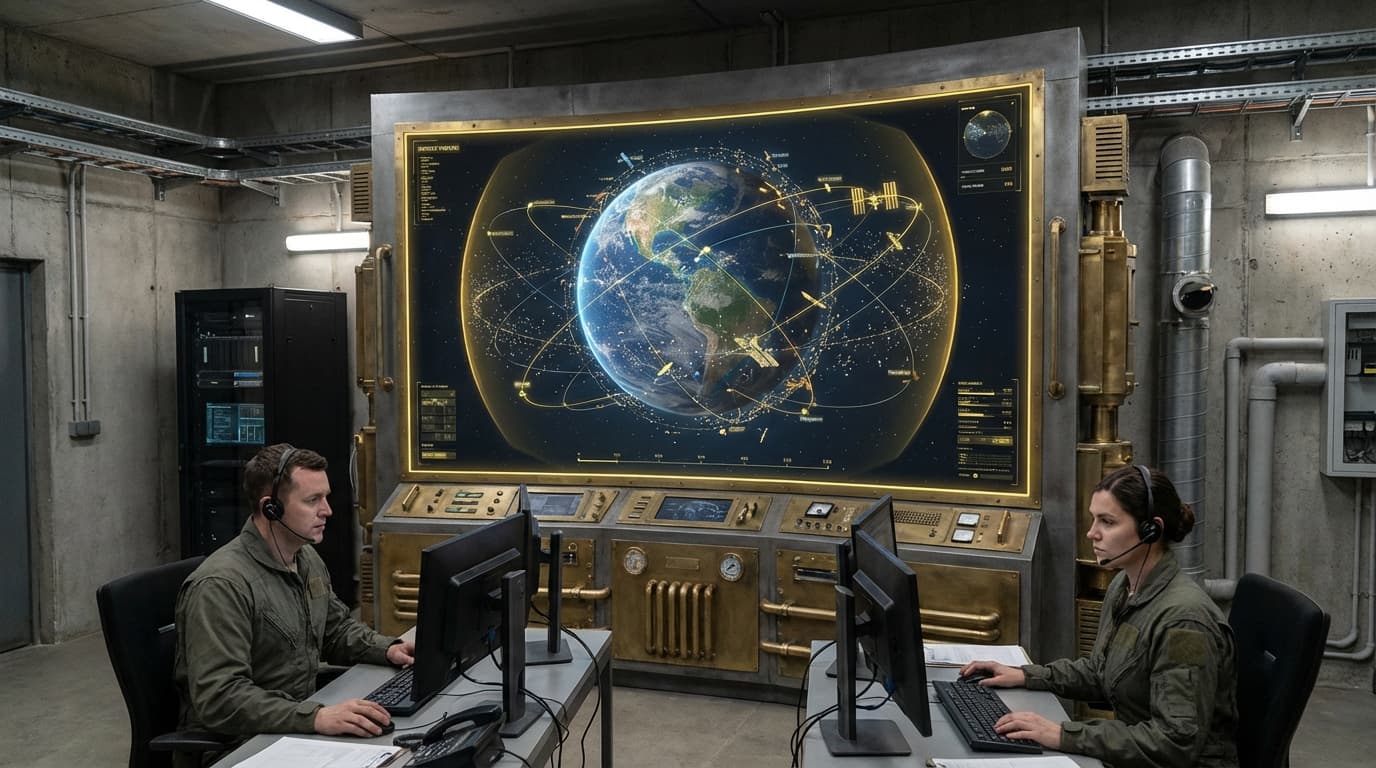
Space Domain Awareness & Orbital Security
The exponential growth of space activity has transformed Earth's orbital environment into a congested and contested domain. With thousands of active satellites, defunct spacecraft, and millions of debris fragments circling the planet, the risk of catastrophic collisions and deliberate interference has escalated dramatically. Traditional space surveillance methods, relying primarily on ground-based radar and optical telescopes, struggle to provide the comprehensive, real-time awareness needed to protect critical space assets. Space Domain Awareness (SDA) and Orbital Security systems address this challenge by integrating multiple sensor networks—ground-based telescopes, phased-array radars, and on-orbit inspection satellites—into unified platforms that continuously track objects, characterize their behavior, and detect anomalous activities. These systems employ advanced algorithms to correlate data from disparate sources, building detailed catalogs of orbital objects and predicting their trajectories with unprecedented precision. The technical foundation combines persistent surveillance capabilities with sophisticated pattern recognition, enabling operators to distinguish between routine maneuvers and potentially threatening actions such as close approaches, rendezvous operations, or directed-energy interference.
For military and commercial satellite operators, the inability to detect threats or predict collisions poses existential risks to mission-critical infrastructure. Communications networks, navigation systems, intelligence platforms, and Earth observation satellites represent billions of dollars in assets and underpin essential services ranging from global commerce to national security. SDA systems solve the fundamental problem of attribution and characterization in an environment where objects can maneuver without warning and adversaries may conduct covert operations. By providing continuous tracking and behavioral analysis, these platforms enable operators to implement collision avoidance maneuvers, investigate suspicious proximity operations, and maintain custody of high-value assets. The integration of space-based sensors—small satellites equipped with optical or radar payloads positioned in various orbits—overcomes the geometric limitations of ground stations, offering persistent coverage of geosynchronous and other strategic orbital regimes that are difficult to monitor from Earth's surface.
Current deployments include both national military programs and emerging commercial services, with several countries operating dedicated space surveillance networks and private companies launching sensor constellations to provide SDA data as a subscription service. Satellite operators increasingly rely on these systems for conjunction assessments, receiving automated alerts when potential collisions are detected and coordinating avoidance maneuvers through shared data platforms. The technology has proven essential during recent incidents involving anti-satellite weapon tests and close-approach events that raised diplomatic concerns. Looking forward, the proliferation of mega-constellations and the emergence of on-orbit servicing capabilities will intensify demands for comprehensive domain awareness. Industry analysts note that SDA is evolving from a purely defensive capability into an enabler of space traffic management, supporting the sustainable use of orbital space through improved coordination, transparency, and norms of responsible behavior in an increasingly crowded environment.
Related Organizations

Operates a global network of phased-array radars to track LEO objects and debris.

Provides commercial space operations center services and high-accuracy cataloging.

Leading academic research group on astrodynamics and space environmentalism.

Deploying a constellation of satellites to monitor space traffic from space.

Builds space simulation and analytics platforms for training and mission planning.

Building a space-based surveillance platform and associated software for orbital insights and collision prediction.

Operates a global network of optical telescopes for tracking objects in Geostationary Orbit (GEO).

Develops the Pathfinder platform, which automates satellite collision avoidance by analyzing conjunction data and generating optimal maneuver plans.

A technology company specializing in directed-energy weapons, unmanned systems, and satellite communications.

Developed 'Wayfinder', an open-access visualization and data engine for space traffic and debris tracking.
Supporting Evidence
Research this in Signals
Signals turns a topic into a sourced research record you can inspect and rerun. Your first scan is free, and this one starts with Space Domain Awareness & Orbital Security already loaded, so edit it or scan as is.