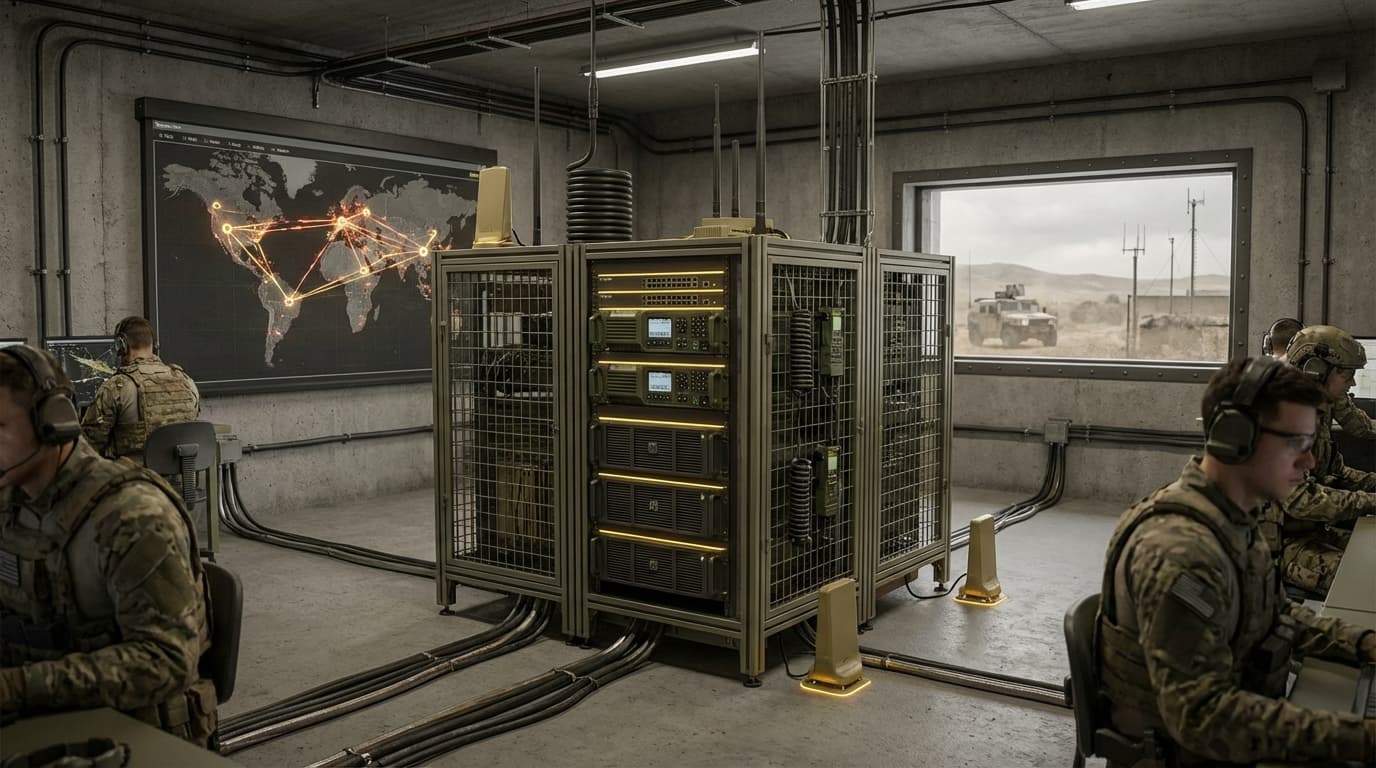
Secure Communications Mesh
Secure communications mesh networks represent a critical evolution in military and emergency response communications, designed to maintain connectivity in contested or degraded environments where traditional infrastructure is unavailable or compromised. Unlike conventional radio systems that rely on fixed towers or satellite links, mesh networks create a decentralised web of interconnected nodes—often combining handheld radios, vehicle-mounted transceivers, and aerial relay platforms such as small unmanned aircraft systems. Each node in the network can simultaneously transmit, receive, and relay signals, creating multiple redundant pathways for data to travel. The system employs sophisticated frequency-hopping spread spectrum techniques, rapidly switching between radio frequencies in patterns known only to authorised users, making interception and jamming significantly more difficult. Advanced encryption protocols protect all transmissions, ensuring that even if signals are intercepted, the content remains secure. When individual nodes are destroyed, jammed, or move out of range, the network automatically reconfigures itself, finding alternative routes through remaining nodes without requiring manual intervention or centralised control.
The fundamental challenge these systems address is the vulnerability of traditional communications infrastructure in high-threat environments. Military forces operating in denied or contested areas, first responders in disaster zones, and security teams in remote locations all face scenarios where conventional cellular networks are unavailable, satellite communications are disrupted, or adversaries actively attempt to block radio transmissions. Conventional point-to-point radio systems create single points of failure—if the relay station or command post is disabled, communications collapse entirely. Secure mesh networks eliminate this vulnerability by distributing communications capability across all participants. Research in this field has focused on reducing the size, weight, and power requirements of mesh nodes while increasing their range and data throughput. The integration of small unmanned aerial vehicles as temporary relay nodes has proven particularly valuable, as these platforms can quickly establish line-of-sight connections over terrain obstacles or extend network coverage to isolated units. This capability enables commanders to maintain situational awareness and coordinate dispersed forces even when operating beyond the reach of traditional communications infrastructure.
Early deployments of tactical mesh networks have demonstrated their value in both military exercises and real-world operations, with several defence forces incorporating these systems into standard equipment loadouts for special operations and forward-deployed units. Commercial variants have found applications in disaster response, where emergency services must establish communications rapidly in areas where infrastructure has been destroyed by natural disasters. The technology is evolving toward greater integration with existing military communications systems, creating hybrid networks that can seamlessly transition between satellite, cellular, and mesh modes depending on availability and threat conditions. Industry analysts note growing interest in artificial intelligence-enhanced mesh networks that can predict jamming attempts, automatically optimise routing paths, and manage bandwidth allocation based on mission priorities. As military doctrine increasingly emphasises distributed operations and multi-domain warfare, the ability to maintain secure, resilient communications across dispersed forces becomes not merely advantageous but essential, positioning mesh networking as a foundational technology for future defence communications architectures.
Related Organizations

Creators of the Wave Relay MANET (Mobile Ad Hoc Networking) system used for battlefield connectivity.

Developer of MN-MIMO tactical radios that create self-healing, high-throughput mesh networks in contested environments.

Develops the TSM waveform, a leading MANET protocol for robust communications in RF-denied areas.

Develops mobile mesh networking hardware and protocols that enable off-grid communication and transaction relaying.

Specializes in industrial-grade Wi-Fi and mesh radio transceivers for robotics and drones.

Parent company of DTC (Domo Tactical Communications), providing IP mesh radios for surveillance and tactical use.

Pioneer of Kinetic Mesh networks using InstaMesh technology for dynamic industrial and security environments.

A global aerospace and defense technology innovator delivering end-to-end solutions.

Developed SlingShot, a system that converts tactical UHF/VHF radios into satellite communicators.
Supporting Evidence
Research this in Signals
Signals turns a topic into a sourced research record you can inspect and rerun. Your first scan is free, and this one starts with Secure Communications Mesh already loaded, so edit it or scan as is.