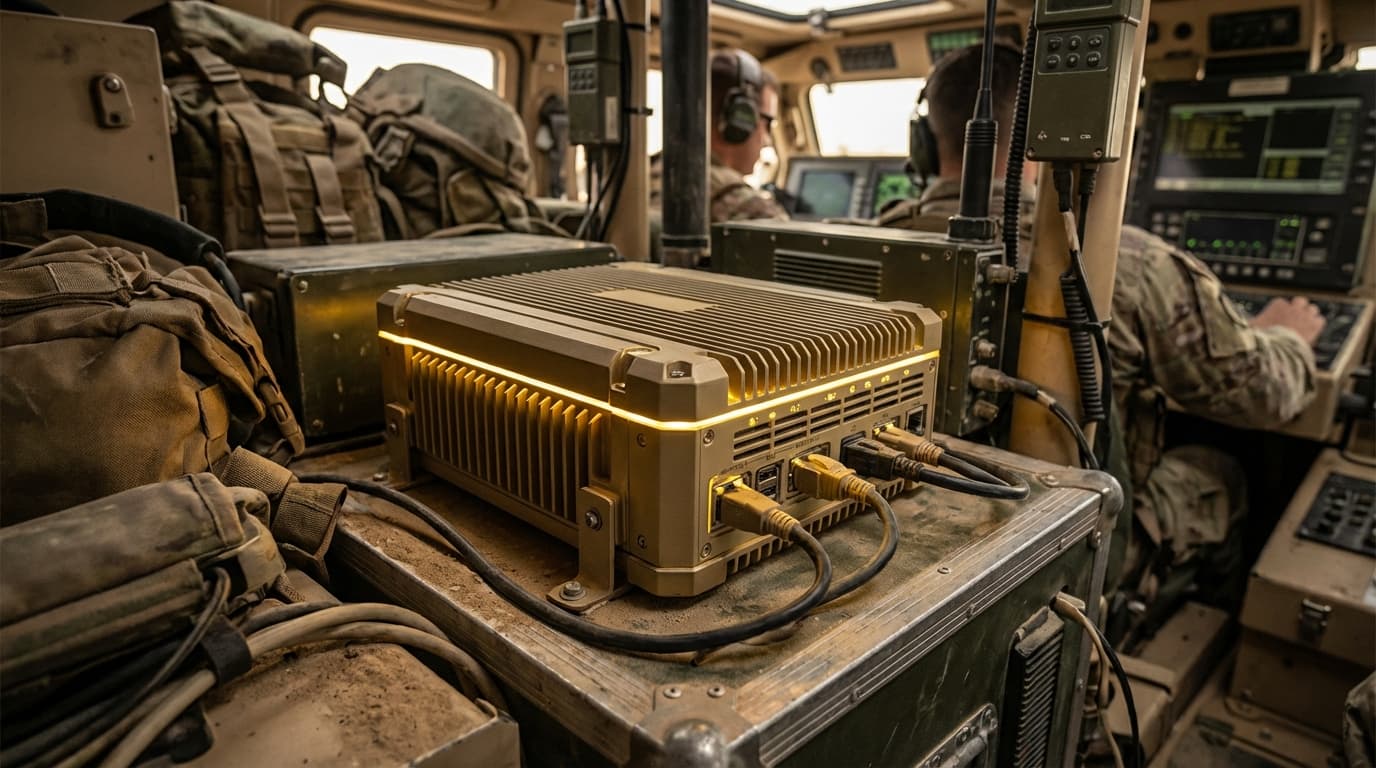
Hardened Edge Compute Nodes
Hardened edge compute nodes are ruggedized (built to withstand harsh conditions), EMP-hardened (protected against electromagnetic pulse attacks) edge computing systems with integrated accelerators (specialized processors) for on-site AI inference (running artificial intelligence locally), C2 functions (command and control operations), and sensor fusion (combining data from multiple sensors) at the edge (where data is collected, not in a remote data center). Designed to operate in contested (areas where communication may be jammed or attacked), low-connectivity environments (places with poor or unreliable internet) where cloud backhaul (sending data to remote servers) is intermittent or unavailable, creating computing systems that can operate independently in harsh, disconnected environments, enabling AI-powered defense capabilities even when communication with central systems is cut off, making defense systems more resilient and autonomous.
This innovation addresses the need for computing in contested environments, where cloud connectivity can't be relied upon. By providing hardened edge computing, these systems enable autonomous operation. Defense contractors and computing companies are developing these systems.
The technology is particularly significant for tactical operations, where edge computing enables autonomous capabilities. As operations become more distributed, edge computing becomes increasingly important. However, ensuring performance, managing power, and achieving ruggedization remain challenges. The technology represents an important evolution in defense computing, but requires continued development to achieve the performance and reliability needed for operational use. Success could enable autonomous defense capabilities, but the technology must prove its reliability in harsh conditions. Hardened edge compute is an active area of development with significant defense interest.
Related Organizations

Manufacturer of rugged servers, switches, and embedded computers for military and industrial applications.

A leading provider of secure, ruggedized mission-critical processing subsystems for aerospace and defense.

Provider of rugged computer hardware solutions optimized for mission-critical applications.

Specialist in open architecture computing and electronic systems for aerospace and defense (now part of AMETEK).

Designs and manufactures USA-made ruggedized high-performance computing solutions for defense.

Provider of rugged embedded systems for military, aerospace, and space applications.

Designer of ultra-compact, high-density rugged servers and switches.

Global manufacturer of electronic packaging and embedded computing solutions.

Manufacturer of rugged computing solutions, displays, and storage for military environments.
Supporting Evidence
Research this in Signals
Signals turns a topic into a sourced research record you can inspect and rerun. Your first scan is free, and this one starts with Hardened Edge Compute Nodes already loaded, so edit it or scan as is.