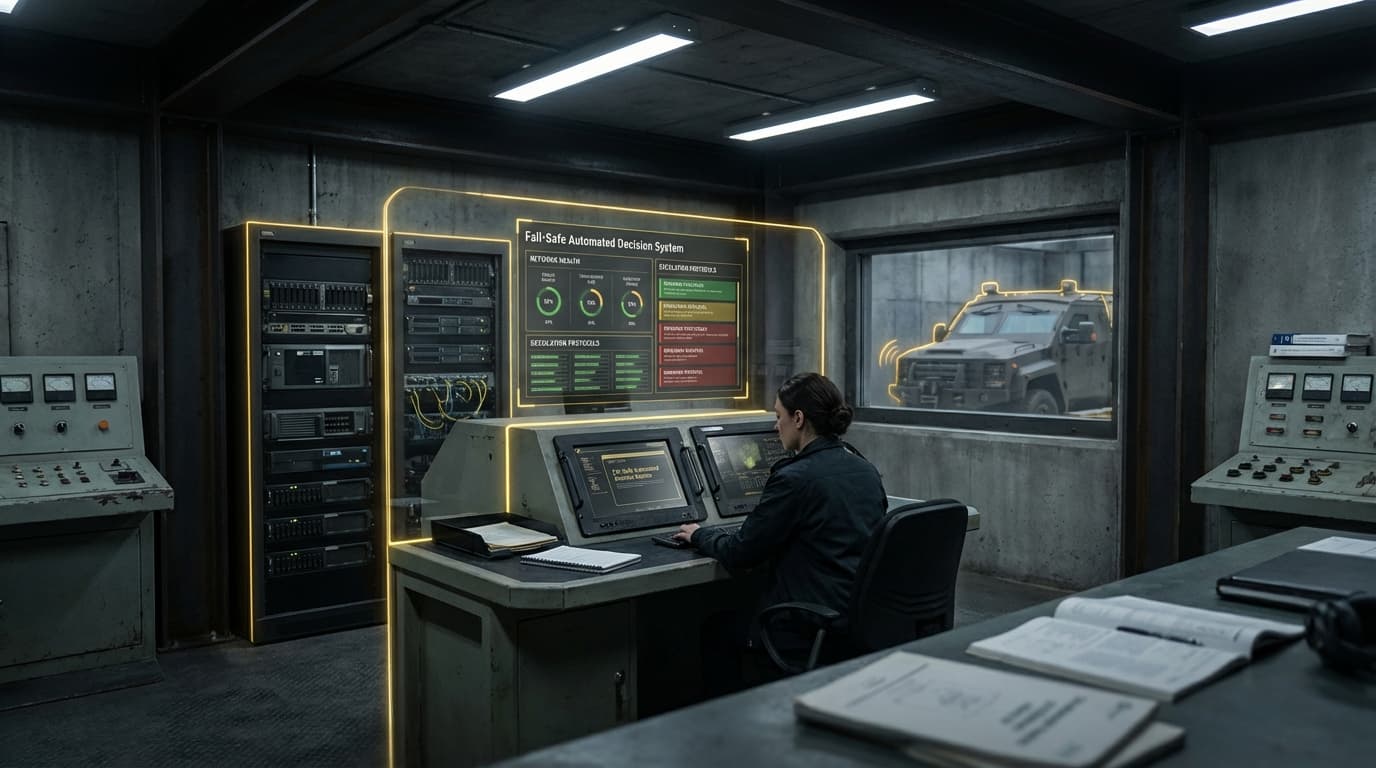
Fail-Safe & Escalation-Resistant Architectures
The increasing automation of defense and security systems has introduced a critical challenge: how to maintain human control and prevent catastrophic escalation when machines make decisions at speeds far exceeding human reaction times. Fail-safe and escalation-resistant architectures address this fundamental tension by embedding safety mechanisms directly into the design of automated decision systems used in conflict scenarios. These architectural patterns draw from principles in safety-critical engineering, incorporating multiple layers of constraints that govern how autonomous systems can act in adversarial environments. At their core, these designs implement circuit breakers that automatically halt operations when predefined thresholds are exceeded, kill switches that enable immediate human override of automated processes, mandatory human veto layers for irreversible actions, and rate limiters that prevent systems from executing decisions faster than human operators can monitor and intervene. The technical implementation often involves state machines with explicit safe states, redundant verification pathways, and time-delayed execution windows that create opportunities for human review before critical actions are finalized.
The defense and security sectors face an acute dilemma as adversaries develop faster response capabilities while the consequences of automated errors grow increasingly severe. Traditional command and control architectures were designed for human-speed decision cycles, but modern threats from hypersonic weapons to coordinated drone swarms operate on timescales that challenge conventional oversight models. Fail-safe architectures solve this problem by creating graduated automation frameworks where systems can respond rapidly to immediate threats while preserving human authority over escalatory decisions. These designs prevent scenarios where automated systems might misinterpret ambiguous sensor data, respond disproportionately to provocations, or trigger cascading responses across networked defense systems. By building in structural constraints rather than relying solely on algorithmic accuracy, these architectures acknowledge that perfect prediction is impossible in adversarial contexts and instead optimize for graceful degradation and containable failures. This approach enables military organizations to leverage automation's speed advantages while maintaining the judgment and accountability that only human operators can provide.
Research institutions and defense organizations are actively developing and testing these architectural patterns, with early implementations appearing in missile defense systems, autonomous vehicle fleets, and cyber defense platforms. Concrete applications include weapons systems that require explicit human authorization before engaging targets, air defense networks with built-in delays that allow cross-verification of threat assessments, and autonomous patrol systems that automatically return to safe modes when communication links are disrupted. The technology reflects broader trends toward trustworthy AI and responsible autonomy, recognizing that the most dangerous failures in conflict scenarios often result not from individual system errors but from the interaction of multiple automated systems operating without adequate constraints. As geopolitical tensions drive continued investment in autonomous defense capabilities, fail-safe architectures represent an essential counterbalance, embedding ethical and strategic safeguards into the technical infrastructure itself. The future trajectory points toward increasingly sophisticated frameworks that can adapt safety constraints dynamically based on context while maintaining inviolable boundaries around the most consequential decisions, ensuring that automation enhances rather than undermines strategic stability.
Related Organizations

A research and development agency of the United States Department of Defense.

RAND Corporation
United States · Nonprofit
Global policy think tank conducting extensive research on nuclear command, control, and communications (NC3) and AI escalation risks.

Policy research organization within Georgetown University focused on the security impacts of emerging technologies.

Designs and operates missions like Parker Solar Probe and STEREO that provide fundamental space weather data.

A Federally Funded Research and Development Center (FFRDC) focused on software and AI engineering.

Focuses on existential risks and the long-term future of life, including the ethical treatment of advanced AI systems.

Builds software that empowers organizations to integrate their data, decisions, and operations (Foundry and AIP).
Chatham House
United Kingdom · Nonprofit
The Royal Institute of International Affairs, an independent policy institute.

Through Copilot and the 'Recall' feature in Windows, Microsoft is integrating persistent memory and agentic capabilities directly into the operating system.
Supporting Evidence
Research this in Signals
Signals turns a topic into a sourced research record you can inspect and rerun. Your first scan is free, and this one starts with Fail-Safe & Escalation-Resistant Architectures already loaded, so edit it or scan as is.