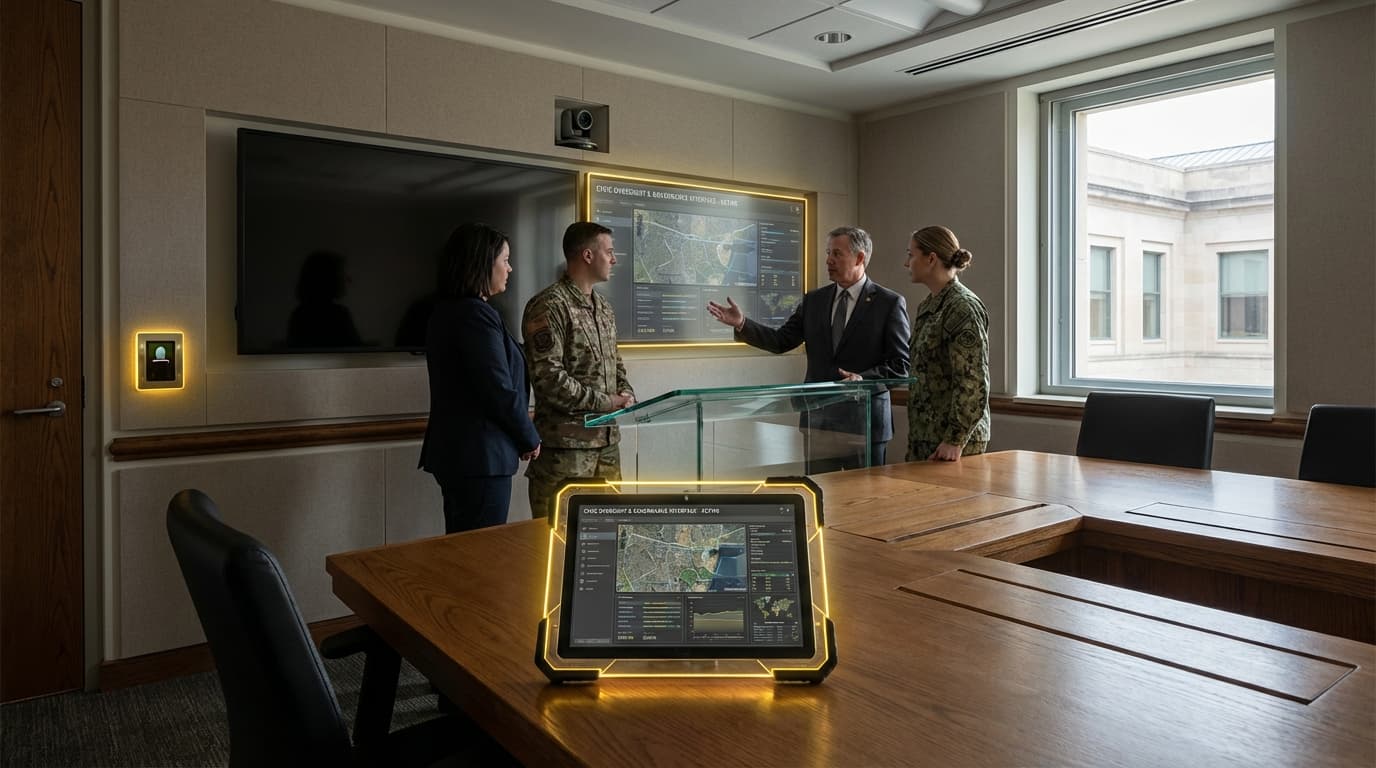
Civic Oversight & Democratic Governance of Defense Tech
The rapid advancement of defense technologies—from autonomous weapons systems to AI-driven surveillance platforms—has created a critical gap between the pace of technological development and the capacity of democratic institutions to provide meaningful oversight. Traditional mechanisms of parliamentary review and public accountability were designed for an era of slower technological change, where defense capabilities evolved over years or decades rather than months. This mismatch poses fundamental challenges to democratic governance, as decisions about the deployment of potentially transformative military technologies are increasingly made within closed circles of technical experts and defense officials, often with limited transparency or public debate. The core problem is ensuring that technologies capable of reshaping the nature of warfare, surveillance, and state power remain subject to democratic scrutiny and aligned with societal values, rather than advancing according to purely technical or strategic imperatives.
Civic oversight mechanisms for defense technology encompass a range of institutional frameworks designed to bridge this accountability gap. These include specialized parliamentary committees with technical expertise, independent review boards composed of ethicists, technologists, and civil society representatives, and structured processes for public consultation on defense procurement decisions. Some approaches involve mandatory impact assessments that evaluate new systems against human rights standards, international law, and democratic principles before deployment. Others establish "red team" exercises where independent experts attempt to identify potential misuses or unintended consequences of emerging capabilities. Research suggests that effective oversight requires both technical literacy among reviewers and genuine authority to delay or modify deployment decisions, rather than merely rubber-stamping choices already made by defense establishments. Civil society organizations increasingly play crucial roles in these frameworks, providing independent analysis and advocating for transparency in areas where national security concerns might otherwise preclude public scrutiny.
Several democratic nations have begun experimenting with enhanced oversight structures, though implementation remains uneven. Some parliaments have established dedicated subcommittees focused specifically on emerging defense technologies, while others have created independent ethics boards tasked with reviewing autonomous systems before operational deployment. Industry analysts note growing recognition that public trust in defense institutions depends on demonstrable accountability, particularly as technologies like facial recognition, predictive analytics, and autonomous targeting systems raise profound ethical questions. The trajectory of these oversight mechanisms will likely shape whether advanced defense capabilities develop within democratic frameworks or increasingly operate beyond effective civilian control. As military technologies continue to evolve at unprecedented speed, the challenge of maintaining democratic governance over defense systems represents one of the defining institutional questions of the coming decades, with implications extending far beyond national security to encompass fundamental questions about the relationship between technological power and democratic legitimacy.
Related Organizations

An interdisciplinary laboratory at the University of Toronto focusing on research, development, and high-level strategic policy and legal engagement.

A research organization that builds tools to explore the connections between tech companies and the defense industry.

A subcommittee of the European Parliament responsible for scrutinizing the Common Security and Defence Policy.

A global coalition of NGOs working to ban fully autonomous weapons and retain meaningful human control.

The supreme audit institution of the US federal government, providing auditing, evaluation, and investigative services for Congress.

Defends and extends the digital rights of users at risk around the world, often challenging state-sponsored cyber capabilities.

A global movement focused on human rights, with a specific 'Amnesty Tech' branch investigating the arms trade and surveillance.

Focuses on the impact of the global arms trade on peace, justice, and democratic governance.

An organization that combines art and research to illuminate the social implications and harms of AI systems.
Supporting Evidence
Research this in Signals
Signals turns a topic into a sourced research record you can inspect and rerun. Your first scan is free, and this one starts with Civic Oversight & Democratic Governance of Defense Tech already loaded, so edit it or scan as is.