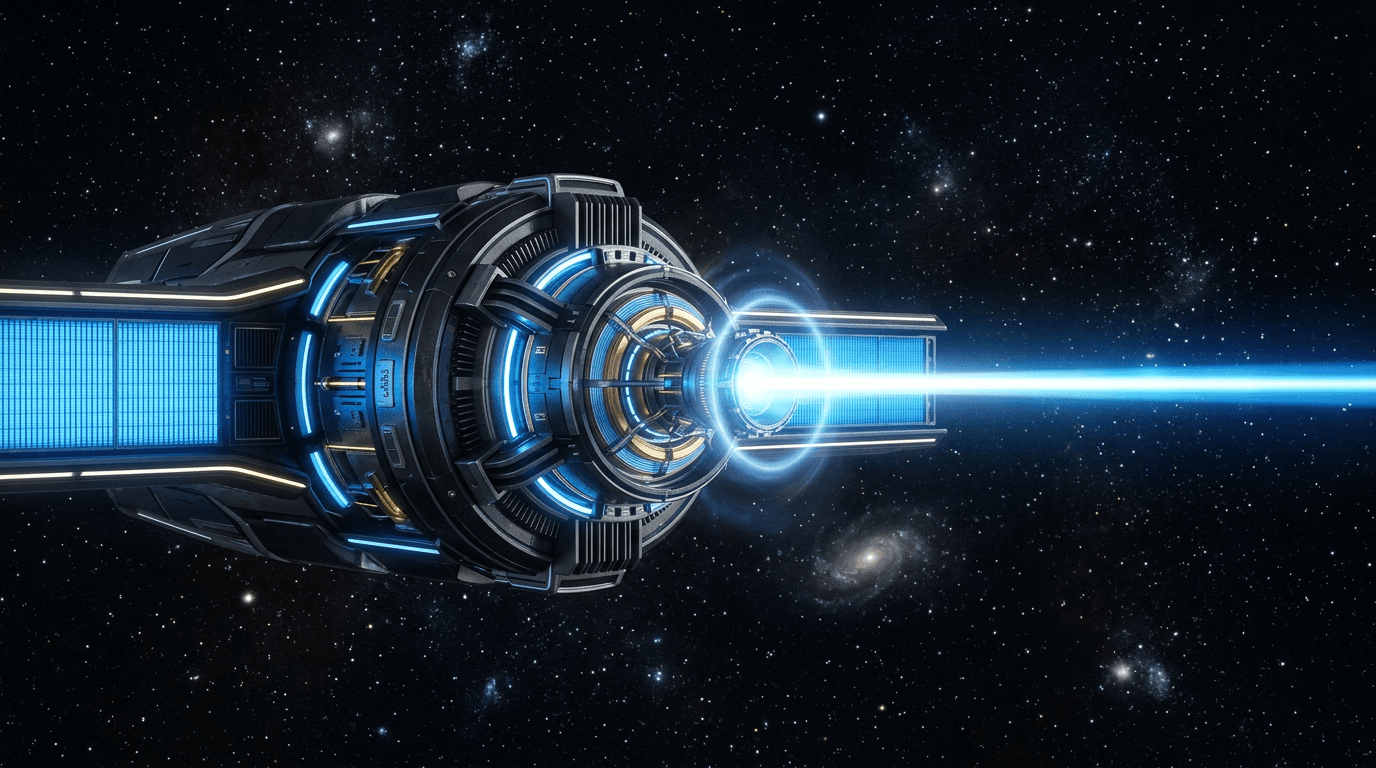
Particle Beam Propulsion
Particle beam propulsion represents a theoretical propulsion architecture that would generate thrust by expelling tightly focused streams of charged or neutral particles at velocities approaching the speed of light. Unlike conventional rocket engines that rely on chemical combustion or ion drives that accelerate particles to modest velocities, this concept envisions accelerating subatomic particles—electrons, protons, or heavier ions—through electromagnetic fields to relativistic speeds before directing them as a collimated beam away from the spacecraft. The fundamental principle leverages Newton's third law at extreme energy scales: by ejecting mass at near-light velocities, even minuscule particle flows could theoretically generate substantial continuous thrust. The technical challenge lies in creating sufficiently powerful particle accelerators compact enough for spacecraft integration, maintaining beam coherence across vacuum distances, and managing the enormous power requirements that would dwarf current space-based energy systems by orders of magnitude.
The aerospace and defense research communities have periodically examined particle beam propulsion as a potential solution to the severe limitations of existing propulsion technologies for deep space missions. Current chemical rockets face fundamental energy density constraints, while electric propulsion systems like ion drives, though efficient, produce thrust levels too modest for rapid interplanetary transit or any realistic interstellar mission profile. The COMETA report, a French government study examining unidentified aerospace phenomena, specifically referenced particle beam architectures as one theoretical framework that might explain observed acceleration characteristics that exceed known human capabilities. This connection highlights the technology's position at the intersection of speculative engineering and attempts to rationalize anomalous observations through extensions of known physics. If realized, such propulsion systems could enable transit times to outer planets measured in weeks rather than years, fundamentally transforming humanity's operational envelope in space.
No operational particle beam propulsion systems exist outside theoretical frameworks and preliminary laboratory experiments with particle accelerators far too large for spacecraft applications. Research institutions have demonstrated the physics of relativistic particle acceleration in terrestrial facilities, but translating these principles into compact, space-rated systems remains firmly in the conceptual domain. The energy requirements alone present formidable barriers—sustaining relativistic particle beams would demand power generation capabilities potentially requiring breakthrough advances in fusion reactors, antimatter containment, or energy storage technologies not yet demonstrated at scale. Some researchers have explored hybrid concepts where particle beams might serve secondary roles, such as clearing debris fields or providing supplementary thrust to other propulsion methods. The technology's trajectory remains speculative, positioned alongside other exotic propulsion concepts like antimatter rockets and laser-pushed light sails as theoretical pathways that could eventually enable true interstellar capability, though practical implementation likely requires fundamental advances across multiple scientific domains before transitioning from suppressed science speculation to engineering reality.
Research this in Signals
Signals turns a topic into a sourced research record you can inspect and rerun. Your first scan is free, and this one starts with Particle Beam Propulsion already loaded, so edit it or scan as is.